Get Full Government Meeting Transcripts, Videos, & Alerts Forever!
Get email alerts on the Criminal Justice Reform topic
No spam. Unsubscribe anytime.
Chief Justice Steven R. Jensen outlines indigent-defense overhaul, pretrial plan and courthouse security in 2025 State of the Judiciary
Summary
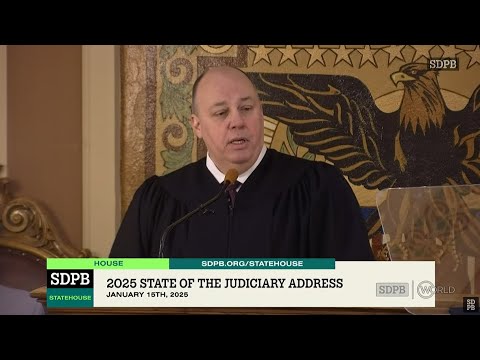
Chief Justice Steven R. Jensen told a joint session of the South Dakota Legislature on Thursday that the Unified Judicial System (UJS) is pressing a range of changes intended to improve access to counsel, expand rehabilitative programs and strengthen courthouse security.
Chief Justice Steven R. Jensen told a joint session of the South Dakota Legislature on Thursday that the Unified Judicial System (UJS) is pressing a range of changes intended to improve access to counsel, expand rehabilitative programs and strengthen courthouse security.
"I'm honored to deliver my 2025 State of the Judiciary message to you," Chief Justice Jensen said, opening remarks that ran through reforms from indigent defense to courthouse safety.
Why it matters: Jensen framed the initiatives as steps to preserve due process, reduce recidivism and protect judges, court staff and the public. Several measures already enacted by the legislature or adopted by the courts create the framework for broader implementation, but Jensen said further statutory authority and funding will be required for full rollouts.
Indigent defense: Jensen reported that the legislature enacted legislation this past session to create a commission on indigent legal services and provided ongoing funding to establish an Office of Indigent Legal Services. "The legislature also provided $1,400,000 in ongoing funding to create the office of indigent legal services," he said. The commission has selected "USD Knutsen School of Law Dean Veil Fulton to serve as chair," and hired Chris Miles as chief defender to lead the new office, Jensen said. The new office initially will handle court-appointed criminal appeals, habeas corpus petitions and child abuse-and-neglect appeals and is intended to create statewide management and standards for indigent defense.
Jensen told legislators the office is projected to save roughly $600,000 per year compared with the previous county-managed system and that counties could see cumulative savings of more than $2,100,000 annually. He said expanding the office to provide regional, full-time trial-level public defenders will require additional statutory authorization from the Legislature and negotiations on how state and county costs will be shared.
Access to civil courts: The chief justice said the UJS adopted a court rule in February to create a commission on access to the courts to address the rise in self-represented litigants in civil cases. Jensen described problems facing people without lawyers — difficulties with legal forms, procedure and limited legal aid capacity — and named legal aid organizations active in the state, including East River Legal Services and Dakota Plains Legal Services. He said Dakota Plains operates a mobile "justice bus" that brings services to rural communities, and noted that legal aid programs receive roughly 350 applications a month and cannot meet all demand.
Probation, pretrial and treatment courts: Jensen provided data on supervision and outcomes: during fiscal year 2024 UJS court services supervised 7,469 adults and 1,490 juveniles on probation; 1,780 adults and 1,038 juveniles were discharged successfully during the year. He described pilot efforts and an "emerging adult" task force focused on people ages 18–25 and urged community volunteer and faith-group participation to support rehabilitation.
On pretrial services Jensen said some counties (including Minnehaha and Pennington) already run limited programs funded with grants and that the UJS is conducting site visits to other states' programs. He said South Dakota "does not currently have statutory authority to monitor adults prior to conviction" and that the UJS anticipates offering legislation to create that authority if the Legislature wishes to move forward. Jensen said the goal of pretrial services would be to increase court appearance rates and reduce reoffending without replacing judges' bond decisions.
Jensen highlighted the state's 17 treatment courts (drug, DUI, veterans and mental-health courts) as an effective rehabilitative option. He said treatment courts have served 2,684 participants since inception, with 1,227 graduates (about a 57% graduation rate), and that fiscal year 2024 admissions exceeded projections (809 served vs. 698 projected).
Courthouse and judicial security: Jensen said the UJS recorded 56 threats or incidents involving judges and employees over the past year and has pursued a three-pronged security strategy: local courthouse security committees (now in 51 of 63 counties), security assessments by Homeland Security and the U.S. Marshals Service (56 site assessments completed) and use of grant funding to implement recommendations. He noted a prior one-time $5,000,000 appropriation from the Legislature to fund security upgrades and said the UJS grant program pays 75% of needed security upgrades; nearly $900,000 in projects were approved statewide this past year. Jensen pointed to planned projects including a full access-control system for the Pennington County Courthouse and a new security checkpoint at the Brown County Courthouse.
Personnel and recognition: Jensen praised court services officers and cited individual probation success stories to illustrate the UJS's rehabilitative work. He also noted recent reappointments of presiding circuit judges and his own reappointment as chief justice for a second four-year term.
What remains: Jensen said several initiatives will require further legislative action or funding to implement fully — notably expanding the Office of Indigent Legal Services to trial-level regional public defenders and establishing statutory authority for pretrial supervision.
The address preceded routine joint-session business. Earlier the session appointed joint committees to receive the chief justice and recessed until 1 p.m. to hear a message from tribal leaders; both procedural motions were approved by voice votes.
Looking ahead: Jensen asked continued legislative and community support as the UJS moves from planning and pilot stages toward broader implementation of these programs.