Get Full Government Meeting Transcripts, Videos, & Alerts Forever!
Get email alerts on the Urban Forestry topic
No spam. Unsubscribe anytime.
Parks to switch from 311 requests to neighborhood-focused tree-planting cycle
Summary
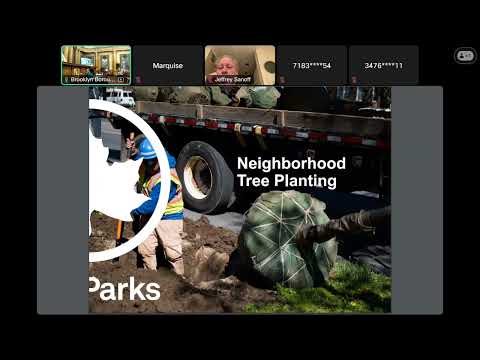
The Parks Department told the Brooklyn Borough Board on Jan. 7, 2024, that it plans to replace its current reactive, 311‑driven tree‑planting model with a neighborhood‑based planting program that targets entire blocks on a predictable multi‑year cycle.
The Parks Department told the Brooklyn Borough Board on Jan. 7, 2024, that it plans to replace its current reactive, 311-driven tree-planting model with a neighborhood-based planting program that targets entire blocks on a predictable multi-year cycle.
“This new approach ... we have decided that in order to do this, we have to discontinue the service the intake of service requests from the public,” said Nieves Strauss, director of tree planting for the Parks Department. Strauss said the department will instead focus on discrete zones worked on in phases and visit every community board on a three‑year cycle as part of a nine‑year full rollout.
Parks delivered the plan as part of a public presentation to the borough board, citing the department’s inventory and backlog as the rationale for the change. Strauss said New York City Parks manages millions of trees, that roughly 86% of canopy is in forests and that the city has more than 666,000 street trees and about 156,000 trees in landscape parks. She told the board the department currently has “over 42,000 public service requests” citywide and an average wait time of about three years for service requests.
Strauss described the new “neighborhood tree planting” approach as more comprehensive: crews would plant trees, remove stumps and nonviable trees, and “close empty unplantable tree beds” across an entire block, rather than responding to single, individual requests. She said the department has been prioritizing planting in neighborhoods ranked highest on the Department of Health’s Heat Vulnerability Index and that the mayor and City Council funding commitments will continue to support those efforts.
She said a transition phase is planned for 2024–2026 while existing contracts are reconfigured and that the department expects to fully implement the nine‑year cycle after that. Strauss told the board the Parks website and messaging to 311 callers will be updated; she said callers will receive an explanatory message and be referred to the website. On the timeline for stopping 311 intake, Strauss said she was “pretty certain” the intake through 311 will end in March 2025 and that the mobile app would follow, though she said she did not have the app‑specific details at the meeting.
Board members and staff who spoke during the presentation raised several concerns about the change. Multiple community board chairs asked for stronger community engagement before block‑level plantings occur, saying residents have not always been notified when trees are installed on their blocks. Chairperson Baptiste said community outreach and collaboration with other agencies — for example on porous sidewalks, sidewalk repair, stormwater capture and DOT coordination — must be clearer if the Parks Department moves away from an individual service‑request model.
Other questions at the hearing included tree species selection and allergy impacts, rat burrows in tree beds, sidewalk damage and homeowner costs, pruning and maintenance schedules, and whether the department would coordinate plantings with other capital or street‑safety improvements. Strauss said planting decisions consider site suitability and that foresters select species appropriate for each location; she also said the Parks Department’s tree‑maintenance and pruning programs will continue and are not replaced by the planting program.
Several board members asked for follow‑up information. The borough board requested the Parks Department provide a species list, more detail on rollout maps, and clarifications about app and 311 changes. Strauss offered to continue conversations with community boards and follow up on technical questions (for example, tree‑and‑sidewalk grading procedures run by a separate Parks program and which types of sidewalk repairs are funded). She also said that funds already allocated by council offices to tree planting would be honored and spent during the transition.
The presentation closed with Parks staff offering to provide more detailed materials to the borough board and to stay engaged on outreach and implementation planning.