Get Full Government Meeting Transcripts, Videos, & Alerts Forever!
Get email alerts on the Housing Agency Briefing topic
No spam. Unsubscribe anytime.
Virginia Housing briefs subcommittee on financing tools, production goals and innovation
Summary
Virginia Housing officials described agency programs, financing mechanisms and priorities — including bond issuance, tax credits, down‑payment assistance, rental lending, innovation grants for modular and 3D printing construction, and efforts to preserve manufactured‑home communities.
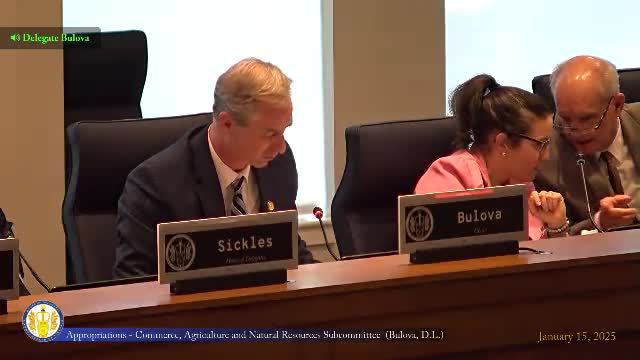
Virginia Housing officials briefed the Appropriations Subcommittee on Commerce, Agriculture and Natural Resources on the agency’s mission, financing tools and program priorities.
Fred Bryant, chief counsel to Virginia Housing, said the authority’s mission is "to help Virginians attain quality affordable housing." He described Virginia Housing’s legal status as the Virginia Housing Development Authority (created under the Virginia Housing Development Authority Act of 1972), an independent political subdivision that raises funds primarily through bond issuance and loan securitization rather than state appropriations. Bryant said Virginia Housing receives 43% of the state’s private-activity bond cap each year and that the authority maintains strong credit ratings (AA+ / Aa1). He added that Virginia Housing’s bonds are not part of the Commonwealth’s debt capacity and that the Commonwealth holds no legal or moral obligation for those bonds.
Bryant and government relations manager Damas Boudreaux summarized the agency’s main programs: homeownership lending (first and second mortgages, FHA/VA/RD and conventional products), down‑payment and closing‑cost assistance, rental housing lending (construction and permanent financing for multifamily properties), administration of federal and state housing tax credits, Community Outreach grants and federal programs such as housing choice vouchers and the recently concluded Virginia Mortgage Relief Program.
On production numbers, the presenters said Virginia Housing assisted roughly 4,000 homebuyers in fiscal 2024 and financed about 3,800 rental housing units in FY 2024, representing about $642 million in financing for multifamily projects. The agency also reported nearly $144 million available in its REACH allocation for FY 2025 to support community programs and loan buy‑downs.
Members asked how Virginia Housing supports new construction technologies and nontraditional housing. Bryant said the authority runs competitive innovation grants that have funded pilot projects such as 3D printing and modular construction, and that manufactured housing remains a focus after recent HUD changes. He cited local examples where nonprofit buyers and rehabilitation efforts preserved mobile‑home parks and said the agency has helped secure loan commitments during short statutory notice windows for park sales.
On private‑activity bond capacity and large projects, Bryant said the state cap is divided among pools (Virginia Housing 43%, local housing authorities, a governor’s discretionary pool and industrial development bonds) and acknowledged competition for scarce volume cap resources on large developments such as Arlington’s Barcroft redevelopment. He said Virginia Housing is in discussions with developers about phased financing and possible mixed funding strategies.
On tax credits, Bryant noted the state housing tax credit is oversubscribed, that he paired state credits with 4% federal credits for certain projects, and that over five years the agency has supported roughly 2,000 units with program pairing, including 31% in jurisdictions under 35,000 population.
Bryant summarized other priorities: preserving existing affordable housing, addressing rising operating costs (including insurance), focusing on rural and permanent supportive housing, and supporting employer‑linked housing strategies (executive order initiatives). The briefing closed with an offer to provide additional data and to accept follow‑up questions.
Questions and follow-ups from members covered regulatory and zoning barriers to modular/manufactured housing, how innovation grants are administered, private‑activity bond allocation strategies, and preserved‑park financing examples. Bryant and staff said they would provide additional data upon request.
The subcommittee adjourned after the briefing.