Get Full Government Meeting Transcripts, Videos, & Alerts Forever!
Get email alerts on the Economic Development Sites topic
No spam. Unsubscribe anytime.
VEDP urges sustained site-development funding, updates Williams Tract and Ready Sites program
Summary
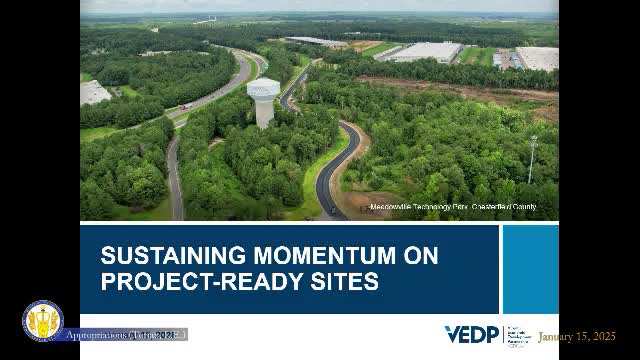
Jason Okuby of the Virginia Economic Development Partnership told the committee that Virginia—s economic development momentum depends on project-ready sites and asked for predictable funding to expand the state's inventory.
Jason Okuby of the Virginia Economic Development Partnership told the committee that Virginia—s economic development momentum depends on project-ready sites and asked for predictable funding to expand the state's inventory.
Okuby said Virginia has made measurable progress in site development since 2018, citing more than 600 project wins, over 100,000 new direct jobs and more than $100 billion in capital investment in that period. He said federal and state incentives plus site investments have driven those results and that state-level site readiness is now a competitive necessity.
The nut graf: VEDP asked the committee to sustain and scale site-development funding so Virginia can win larger projects that require "mega sites," and announced current and recent funding actions including a large commitment to the Williams Tract in Chesapeake.
Okuby said the Virginia Business Ready Sites Program (VBRSP) is the primary grant vehicle to prepare sites; the program requires local matching and focuses state dollars on sites with high win potential and regional impact. He described the program—s budgeting: the existing base was $20 million per year, the governor—s introduced budget proposes an additional $50 million in year two, and VEDP moved $20 million from year two into year one to enable a current funding round that will award about $40 million in this cycle.
Okuby highlighted the Williams Tract (Chesapeake) as the largest single investment VEDP has made through the Ready Sites program. He described the tract as an early-stage, high‑potential site near the North Carolina line with about 4,000 acres of flat land and said the most recent funding round committed $35,000,000 to that site. He clarified that the Williams Tract is privately owned, not under option and has not yet been purchased; VEDP said it is working with the City of Chesapeake toward progress but ownership is not secured.
Okuby presented VEDP—s program rationale and metrics: while only about 6% of projects need sites larger than 500 acres, those large sites account for roughly one‑third of jobs and more than half of capital investment by dollar value in the projects VEDP competes for. He said recent investments are expected to produce large economic returns: VEDP estimates that the work invested in the last two years could lead to 15,000–20,000 new direct jobs and generate $4 billion–$6 billion in new revenue for the Commonwealth over time.
Committee members asked about program details. Delegate Taitta asked how VEDP communicates with localities; Okuby said VEDP maintains frequent meetings, written alerts for funding rounds, webinars and weekly contact for a few dozen high-potential sites. Delegate Wyatt asked about marketing budgets; Okuby said Virginia currently spends about $2.7 million per year on marketing, which he described as below peer states that often spend $10 million or more. Delegates also asked about eligibility: Okuby said the Ready Sites program can serve both new-to‑Virginia projects and expansions by existing Virginia companies, though many local expansions occur on existing sites.
Delegates raised infrastructure and utility questions. Delegate Morphew described challenges in rural southwest localities where power-company security deposits for large new infrastructure can be substantial and may tie up millions of dollars for years; Okuby said VEDP staff would follow up. Delegate Austin and others praised VEDP's work on smaller and topographically challenging sites such as in Allegheny County and noted local successes that used Ready Sites funding.
Ending: Okuby told members the program—s demand is highly oversubscribed and that steady, larger appropriations (VEDP suggested a long-term target of roughly $100 million per year) would be needed to build a full inventory of competitive sites and capture larger, high‑paying projects.