Get Full Government Meeting Transcripts, Videos, & Alerts Forever!
Get email alerts on the Speed Safety topic
No spam. Unsubscribe anytime.
Panel advances bill to let judges require speed-limiting devices as alternative to license suspension
Summary
House Bill 296 would let courts order chronic or extreme speeders to enroll in a VASAP-administered speed-assistance program instead of, or in addition to, suspending licenses. The subcommittee reported the bill as amended to full transportation after testimony from safety groups, AAA and victim families.
A House transportation subcommittee voted to report House Bill 296, a proposal that would create a court‑ordered speed assistance program administered by the Virginia Alcohol Safety Action Program (VASAP), allowing judges to require certain offenders to install devices that limit vehicle speed.
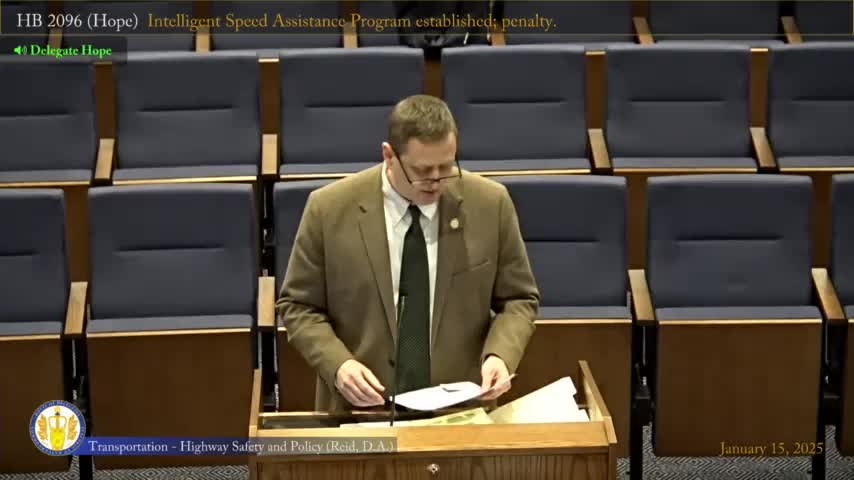
Sponsor Delegate Rodney Hope said the program would be an alternative to license suspension for chronic speeders and a mandatory condition for drivers convicted of extreme speeding (e.g., convictions at speeds above 100 mph). "This technology is proven and it's been used for decades in fleet vehicles," Hope said, describing devices that can limit speed to a configured allowance above posted limits.
The bill, as amended, directs VASAP to operate the program on a timeline compatible with existing license-suspension schedules and requires VASAP to develop regulatory safeguards for device vendors and data handling. Testimony emphasized that the devices are widely used in fleet operations and can be set to allow a small buffer over posted limits for safe merging and highway transitions.
Safety advocates, families who lost relatives to speeding, AAA and the National Safety Council supported the measure. "Speed was a factor in nearly half of traffic deaths in 2023," Chrissy Noonan, a transportation safety advocate, told the committee. Christopher Morris of the Commission on VASAP said the agency can administer the program and that existing interlock regulations provide a model for strong data-security rules.
Witnesses and the sponsor said the bill does not create automated enforcement or speed-camera use; it applies to court‑ordered enrollment after an enforcement stop or conviction. The committee accepted technical amendments requested by DMV and additional language to allow VASAP time to establish regulatory protections. The subcommittee voted to report the bill with amendments to the full transportation committee.