Get Full Government Meeting Transcripts, Videos, & Alerts Forever!
Get email alerts on the Virginia Sea Grant Funding topic
No spam. Unsubscribe anytime.
Virginia Sea Grant director urges $584,095 appropriation to expand fellowships and compete for federal funds
Summary
Virginia Sea Grant asked the House Appropriations Higher Education Subcommittee for $584,095 to expand workforce development programming, including five new postgraduate Commonwealth Fellows. The director said the funding would increase competitiveness for federal NOAA grants; no formal vote was taken.
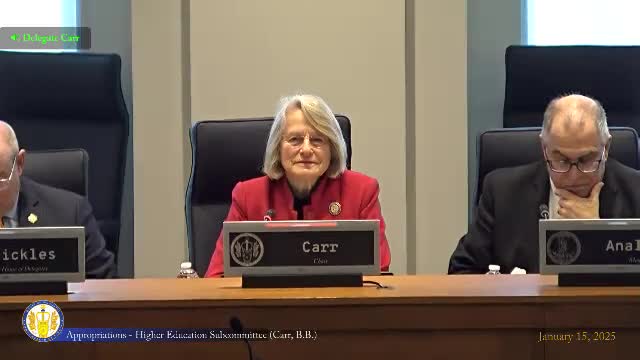
Troy Hartley, director of Virginia Sea Grant, told the House Appropriations Higher Education Subcommittee that a $584,095 state appropriation would expand fellowships and workforce-development programming and improve the program’s ability to secure competitive federal grants.
Hartley said Virginia Sea Grant is one of 34 state-based Sea Grant programs funded in part by the National Oceanic and Atmospheric Administration and that NOAA provides roughly 20% of the program’s base operating budget; the remaining funds must be raised locally. He said the request would fund workforce development, expand fellowship offerings and add five postgraduate Commonwealth Fellows who would be placed with state agencies.
Hartley said the program’s economic return model estimates that a $584,095 investment would return about $4.8 million to the Commonwealth and support 32 businesses and 205 jobs. He described Virginia Sea Grant as a multi-university program with seven member universities and said the Virginia Institute of Marine Science (VIMS) is the program’s host and fiscal agent.
Delegate Sickles asked about NOAA match requirements; Hartley said base NOAA funding requires a 50% match and that many competitive federal opportunities also require a 50% match. Kelly Goodison (staff) and Tony Maggio (staff analyst) raised a transparency point: current draft language routes the funds through the Chev (as drafted) rather than directly to VIMS; staff recommended routing the appropriation directly to VIMS, the program’s fiscal agent, for clarity and administrative simplicity.
Hartley and committee members discussed neighboring states’ investments in Sea Grant as a point of comparison; he said New York and Maryland provide larger state matches and South Carolina funds its Sea Grant at a higher level, which helps those programs compete for additional federal dollars. No formal subcommittee vote on the Sea Grant request was recorded in the transcript.
Hartley closed by outlining the fellowship and workforce objectives and by answering committee members’ questions about partnerships, program focus areas (fisheries, aquaculture, coastal adaptation and economic development) and the role of Sea Grant fellows in agency workforce capacity.