Get Full Government Meeting Transcripts, Videos, & Alerts Forever!
Get email alerts on the Easement Relocation topic
No spam. Unsubscribe anytime.
Subcommittee hears Uniform Easement Relocation Act; witnesses describe court-based process and limits
Summary
The Veil Law Subcommittee reviewed House Bill 1721, the Uniform Easement Relocation Act (UERA). Witnesses said the bill creates a court-supervised procedure to relocate easements without holder consent if the move causes no material harm; proponents stressed safeguards and uniformity, while one resident asked the bill cover existing easements.
Delegate Delia Watts introduced House Bill 1721, the Uniform Easement Relocation Act, at a meeting of the Veil Law Subcommittee of the House Courts of Justice. The committee adopted a committee substitute by voice vote before taking testimony on the substitute.
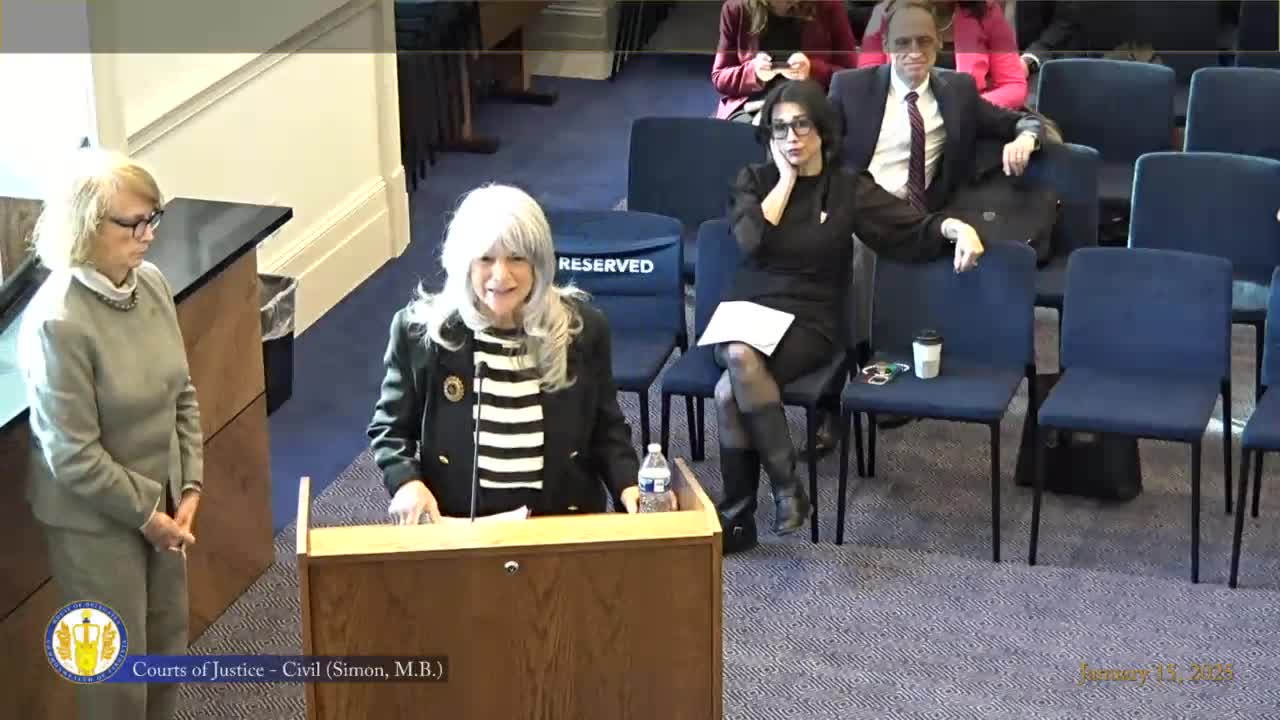
Ellen Dyke, identified herself as chair of the drafting committee for the Uniform Easement Relocation Act, and described the act’s purpose: “The UERA ... is designed to provide a simple and practical solution to a problem that has confronted landowners burdened by easements.” She said the act creates a procedure allowing landowners to seek court approval to relocate an easement without the easement holder’s consent if the court finds the relocation would not “materially impose a burden on the easement holder, impair a purpose for which the easement was created, and impair the safety of anyone using the easement.”
John Lovett, reporter for the drafting committee participating remotely, added that versions of the rule appear in several states and in some court decisions. He said four states had enacted the uniform act (Nebraska, Utah, Arkansas and Washington) and other jurisdictions use restatement or common-law approaches.
A resident, Yvonne Rohrer of Stuart, Virginia, told the subcommittee her family has spent “over $40,000” in litigation and road construction to address an access easement dispute and asked the panel to consider retroactive application. Rohrer said the existing easement passes “12 feet from my child's bedroom window” and that the bill, as drafted, applies only prospectively; she asked that language be changed to cover currently existing easements.
Delegate Watts and other members discussed retroactivity. Committee counsel said Legislative Services drafted the current substitute to apply prospectively, explaining the committee’s normal practice favors prospective application; a member noted the Uniform Law Commission originally allowed retroactive application but the substitute before the subcommittee is prospective.
Committee members and witnesses discussed practical points: the bill places the burden on the party seeking relocation to show the relocation causes no harm, and the substitute adds definitions and exemptions (railroad easements, telecommunications easements, and Commonwealth easements) so those easements are excluded from the act. Witnesses and the patron said the substitute was intended to clarify which easements are covered and which are not.
The committee moved the bill to report (the clerk opened and closed the roll); the transcript does not report a final recorded tally.