Get Full Government Meeting Transcripts, Videos, & Alerts Forever!
Get email alerts on the Use Variance Empire1 0 Chrisfield topic
No spam. Unsubscribe anytime.
Zoning board tables Empire 1 FCU use-variance request for 0 Chrisfield Avenue after resident opposition
Summary
Empire 1 FCU sought a use variance to convert a residential lot at 0 Chrisfield Avenue into a commercial office; the Zoning Board outlined stringent state variance criteria and tabled the application after extended public comment and requests for financial evidence required by law.
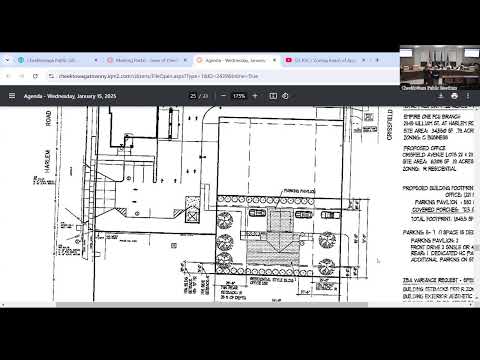
Kelly Sizer, CEO of Empire 1 FCU, and architect Laurie Hauer presented a use-variance application to the Cheektowaga Zoning Board for two vacant lots addressed as 0 Chrisfield Avenue (SBL 113.62-3-7). The applicant asked for permission to establish a commercial office use on property zoned for residence; the board noted that an Environmental Assessment Form (EAF) under the New York State Environmental Quality Review Act (SEQRA) must be completed before a variance determination.
Hauer told the board the lots were acquired as part of a larger purchase (the parcel was purchased last March as part of 1491 Harlem Road) and that the proposed structure is designed like a house — roughly 1,300 square feet — but would be used as a small back-office space housing two to three offices rather than a residence. The architect and applicant said the design preserves residential setbacks and parking consistent with a house; they described the project as “no more than normal residential traffic,” with on-site parking including a two-car garage and several outside spaces.
Board counsel and members outlined the legal standard for a use variance under New York law, emphasizing four strict criteria the applicant must satisfy: (1) the property cannot earn a reasonable return if used only for permitted residential uses (demonstrated with dollars-and-cents financial evidence), (2) the property is affected by unique or highly uncommon circumstances, (3) the variance will not alter the essential character of the neighborhood, and (4) the hardship is not self-created. The board said these criteria are legal requirements and that failure to prove any one of them requires denial under state case law.
Multiple neighbors spoke in opposition. A written letter from a nearby homeowner at 279 Chrisfield (identified in the record as Matt Pazderski) said he purchased his home recently, described difficulty backing out of his driveway because of existing traffic at William Street, and warned that commercial use across the street would lower his property value. Longtime neighbors including Maxwell Horner (43 South Hedley Street) and residents who live on Chrisfield said construction activity around the credit union site had produced trucks and equipment parked on the vacant lot during work, caused noise and dust, and raised concerns about traffic and aesthetics; one resident (identified as Nona Geric, 278 Chrisfield) described repeated complaints to town code officials about staging and parking during the adjacent branch construction and asked whether promises made at an earlier 2023 meeting had been kept.
Applicant representatives said curb cuts and access patterns pre-existed the purchase, that there would be no through-traffic through Chrisfield from the branch and that much of the previous construction staging activity was temporary during the branch build-out. Planning-staff liaison Dan Young was referenced in the discussion; the board advised the applicant to provide the financial documentation required for the first variance factor (proof that residential uses would not provide a reasonable return) and the EAF/SEQRA materials.
After public comment and board discussion, a motion to table the application was made and seconded; on the motion, board members Miss Wertzak, Mr. Brandon and Mr. Kenny Young voted aye, and the chair recorded an aye vote as well. The board tabled the application to allow the applicant to supply the financial evidence and SEQRA/EAF paperwork and for staff to review legal criteria and neighborhood impacts prior to the board’s next consideration.