Get Full Government Meeting Transcripts, Videos, & Alerts Forever!
Get email alerts on the Transit Budget topic
No spam. Unsubscribe anytime.
Transit director says 2026 transit budget balanced at $12,476,365; committee advances ordinance
Summary
South Bend Transit presented a balanced $12.48 million operating budget for fiscal 2026, while warning of capital funding challenges tied to local property-tax cuts and upcoming labor negotiations. The Personal and Finance Committee voted to forward Bill 57‑25 to the Committee of the Whole with a favorable recommendation.
The Personal and Finance Committee advanced Bill 57‑25, the 2026 budget for South Bend Transit, after a presentation from transit staff that described a balanced operating budget and flagged capital and labor risks.
Chris Kubisak, identified at the meeting as the transit presenter, told the committee, “we ended up with a balanced budget this year for '26 at $12,476,365.” He said about 41% of the transit budget comes from local income tax, property tax, license and excise revenue; 18% from federal operating assistance; 10% from federal maintenance; and about 12% from passenger fares.
The committee was told most operating dollars go toward labor and benefits: “of that amount … 51–56% of that makes up wages,” Kubisak said, and “21% of that makes up benefits, utility services, materials, and supplies. When you add those together, that's about 90% of our budget.” He also listed rising insurance premiums, workers' compensation and vehicle maintenance (including CNG tank inspections and fire‑alarm maintenance) as drivers of cost increases.
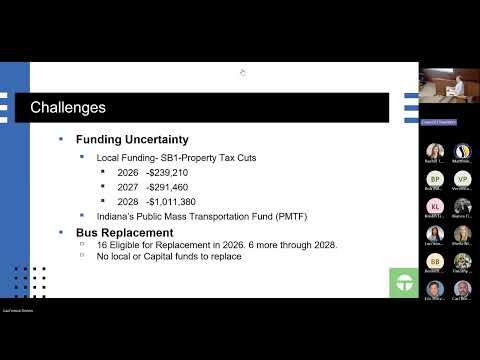
Why it matters: Kubisak and committee members emphasized that capital investment will be harder after the state SB 1 property‑tax changes reduce local match availability for federal capital grants. Kubisak said the local match requirement makes it difficult to apply for capital grants for buses, because applicants must demonstrate local match cash on hand (he used a $600,000 bus as an example that requires roughly $120,000 in local match). Staff said 16 buses are planned for replacement in 2026 and six more through 2028.
Committee discussion covered short‑term federal funding risks. In response to a question from Committee member Dr. Davis about the federal government shutdown, Kubisak said drawing down Federal Transit Administration funds could be delayed and that the city could be affected if the shutdown continued past mid‑October: “...if we were look at when it really would start affect us would be probably around November 1.” He added that the department recently received a state payment of a little over $500,000 and expected to hold back non‑payroll expenses if federal draws were delayed.
Members also asked about service and fare policies. Kubisak confirmed that several local colleges (Notre Dame, Saint Mary’s, Holy Cross and Indiana University) pay directly for student fares and the transit agency bills those institutions once a year; similarly, local school districts are billed when they sponsor rides for students.
Action: The committee voted to forward Bill 57‑25 to the Committee of the Whole with a favorable recommendation. Roll call recorded Committee member Thomas Morgan—Aye; Committee member Dr. Davis—Aye; Committee Vice Chair White—Aye; Committee Chair Sheila Neskofsky—Aye.
Looking ahead: Kubisak said a negotiated collective bargaining agreement for fixed‑route drivers and maintenance staff, expected next year, will be a major determinant of labor costs in 2027–28. He said staff are pursuing scheduling and service changes and vendor recommendations to reduce overtime and improve efficiency.
Votes at a glance: Bill 57‑25 — forwarded to Committee of the Whole with a favorable recommendation (4–0).