Get Full Government Meeting Transcripts, Videos, & Alerts Forever!
Get email alerts on the Governors Budget Amendments Public Safety topic
No spam. Unsubscribe anytime.
Committee staff outlines governor's public‑safety budget amendments: SRO funding, corrections health costs, veterans centers and equipment grants
Summary
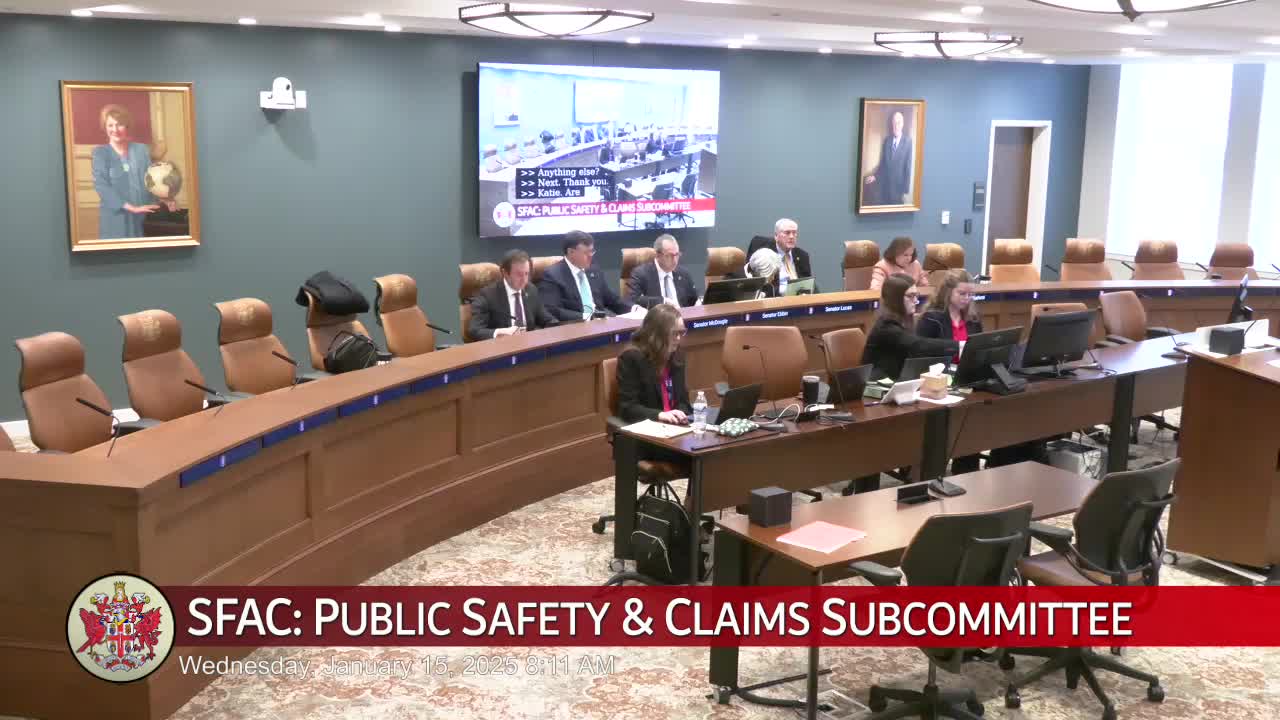
A staff member for the Senate Finance and Appropriations Public Safety Subcommittee summarized the governor's proposed public‑safety budget amendments, including funding increases for school resource officers, firefighter equipment, corrections health care, technology upgrades and veterans' care centers.
A staff member for the Senate Finance and Appropriations Public Safety Subcommittee provided a high‑level overview of the governor's proposed budget amendments related to public safety, listing targeted increases for school resource officers, firefighter equipment, corrections health care and veterans' care centers and describing operational items such as mobile classrooms and technology upgrades.
The staff presentation identified the largest items as $6.8 million for school resource officers (SROs) in FY2025 and $5 million for firefighter protective equipment grants. It also listed a $4.7 million operating request related to two new veterans' care centers (one in Virginia Beach and one in Fauquier County) that the department previously began funding with a $19.1 million appropriation.
For the Department of Corrections (DOC), staff said year‑over‑year inmate health‑care costs are rising, driven in part by specialty drug price increases and a rebound in off‑site clinical services that had declined during COVID. The governor's amendments include funding for expanded dental services provided by two mobile dental teams and funding for mobile career‑and‑technical‑education (CTE) classrooms intended for lower‑security facilities; staff said the CTE item would buy three mobile trailers and that DOC plans to absorb staffing costs from existing vacancies.
Staff described an expansion in community supervision technology branded "Shadow Track," an app that has been used for low‑risk offenders and is proposed to be expanded to additional supervision populations to allow secure messaging, video contacts and alerts if an offender absconds.
The Department of Juvenile Justice (DJJ) was identified as seeking funds to cover higher intake and contracted preplacement costs: staff cited roughly $1.8 million for intake services and about $1.3 million for contracted services tied to preplacement and longer stays in intake. Staff said juvenile admissions remain lower than pre‑COVID levels but have ticked upward since the pandemic.
For the Virginia State Police and other criminal‑justice technology, staff flagged a proposal to add a 1.4 percent pay step for sworn VSP officers on top of statewide increases, and an upgrade program for live‑scan fingerprint machines; the presentation noted about 800 machines statewide may need upgrades and the proposal would initially fund approximately 180 local upgrades. The live‑scan upgrade earlier used ARPA funds at the state level, staff said, and this amendment would extend access for local agencies.
Other items summarized included a proposed $35.2 million expansion of an ECO/TDO transportation pilot statewide, $3.5 million for law‑enforcement transportation reimbursement, $2.5 million for public‑safety communication infrastructure grants and $688,000 for additional fire marshal staffing. For forensic science, staff proposed four positions to maintain a new laboratory and address growing caseloads.
Committee members asked for additional detail in several areas. Members pressed the Department of Veterans Services to provide a formal plan showing how the two new veterans' care centers will become self‑sufficient after initial start‑up funding; Steve Combs, deputy commissioner for the Department of Veterans Services, told the committee the plan is being finalized and would be submitted shortly. Members also requested more detail on how an ongoing victim‑assistance grant to the Office of the Attorney General differs from local victim‑services funding and asked for a breakdown of which victim services are provided by state agencies versus local providers.
Staff flagged two language items of note: one would withhold certain state payments (compensation board and jail per diem and designated local public‑safety funds) from local officials or jurisdictions that do not comply with lawful U.S. Immigration and Customs Enforcement (ICE) detainer requests or that fail to provide 48‑hour prerelease notification to ICE; another would restrict inmates' eligibility to earn enhanced incentive credits where any portion of a concurrent or consecutive sentence is for an offense ineligible for the enhanced rate.
Staff concluded by offering to provide additional data points requested by senators, including breakdowns of mobile classroom deployment, the number of live‑scan machines needing upgrades and financial projections for veterans' centers. No formal votes were taken during the staff presentation.