Get Full Government Meeting Transcripts, Videos, & Alerts Forever!
Get email alerts on the Disaster Recovery topic
No spam. Unsubscribe anytime.
Pinellas officials outline housing, federal aid and shelter steps as storm recovery continues
Summary
County officials told the Board of County Commissioners that Pinellas has secured a major HUD allocation, is processing hundreds of thousands of FEMA registrations and is working on multiple housing pathways — from hotel programs to direct housing and state mitigation — while urging residents to keep documentation current.
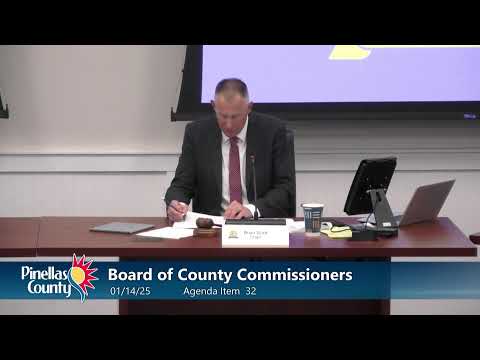
Pinellas County officials on Jan. 14 updated the Board of County Commissioners on recovery operations, describing a continuing focus on housing, permitting and debris management as residents move from emergency shelter to more stable housing.
The county administrator told commissioners that the U.S. Department of Housing and Urban Development (HUD) allocated a “little over $813,000,000” for long‑term recovery for the county and its 23 cities, with a direct allocation to St. Petersburg. The administrator said a consulting team selection will be on the board agenda Jan. 28 to begin developing programs required to use that money.
Why it matters: The HUD allocation is the county’s largest federal recovery award for the storms and will require program design and oversight. County staff said they are coordinating state, federal and local funds so recovery projects can be funded and implemented across housing, public services, public facilities and economic development.
Kathy Perkins, Pinellas County director of Emergency Management, gave specifics on federal and state housing programs. As of Jan. 13, FEMA had 274,721 individual assistance applications for the two storms, Perkins said. She described the Transitional Shelter Assistance (TSA) hotel program and urged applicants to keep contact info current because FEMA is calling registrants to re‑verify eligibility. Perkins said FEMA reported 3,463 households were in TSA and that 959 households had been flagged as unable to continue in TSA unless conditions changed.
Perkins summarized several placement pathways FEMA is pursuing: direct leases into rental units, expedited travel‑trailer placements and travel trailers/mobile home placements on private/commercial lots where local rules permit. She said FEMA had approved 368 expedited RV/travel‑trailer placements and that 52 state travel‑trailer applications existed (20 pending placement, 9 placed). Perkins said FEMA identified 5,908 Pinellas households meeting direct‑housing criteria and that 1,085 of those families need FEMA temporary housing.
Perkins also described locally run programs: a Safe Home Inspection Program for unincorporated areas to enable minor repairs so residents can remain in homes, and a Hurricane Income‑Eligible Home Repair Program that had received 575 applications as of Jan. 13 — 321 meet the program criteria and 255 were missing required documentation, most commonly the FEMA approval/denial letter. The county estimated up to about 7,700 households could qualify by property value and income limits in eligible areas (not including municipalities that run their own programs).
Perkins urged residents who applied to FEMA to update their living status and contact information, and reminded the public that the county’s Disaster Recovery Center at the Enoch Davis Center in St. Petersburg would remain open Monday–Saturday 7 a.m.–7 p.m. through Jan. 31. She also reviewed SBA deadlines for disaster loans, and the state’s upcoming mitigation registration portal for buyouts, elevations and repairs that the state expected to open “end of January, beginning of February.”
Bruce (county staff) described the county’s home‑repair grant as gap financing: the county can reimburse applicants who have completed eligible repairs or pay contractors directly for construction when insurance and FEMA funds leave a funding gap. He estimated a roughly two‑week turnaround for issuing checks once the application and required insurance/FEMA paperwork are complete.
County administrator comments and staff presentations stressed continuing coordination with municipalities and repeated the county’s message that recovery remained “the top priority.” Perkins and county staff asked anyone encountering delays to contact County Emergency Management so staff can communicate directly with FEMA on individual cases.
Ending: Staff said the county is continuing to refine program design for the HUD allocation and to coordinate weekly with FEMA, the state and municipal partners. Officials encouraged residents to use disaster.pinellas.gov, the county hotline and the Disaster Recovery Center for updates and to verify deadlines and documentation requirements.