Get Full Government Meeting Transcripts, Videos, & Alerts Forever!
Get email alerts on the Pesticides Beekeepers topic
No spam. Unsubscribe anytime.
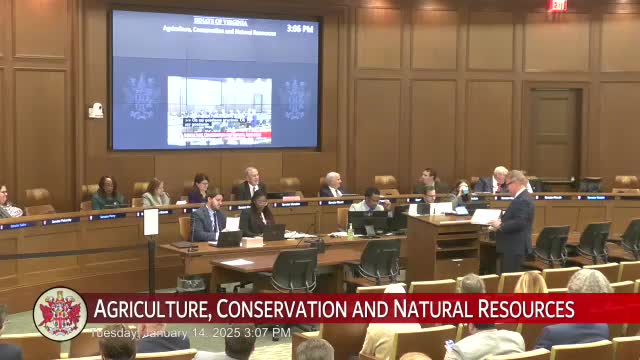
Committee debates bill requiring pesticide applicators to notify registered beekeepers; motion to pass by indefinitely carries
Summary
The Senate Agriculture Committee considered a bill that would require five‑day written notice to beekeepers on the BeeCheck registry before aerial or high‑height pesticide applications; after extensive testimony, the committee adopted a motion to pass the bill by indefinitely (12–1).
The Senate Agriculture, Conservation and Natural Resources Committee heard hours of testimony on a proposal that would force commercial and private pesticide applicators to notify beekeepers listed on the BeeCheck apiary registry at least five days before aerial or other pesticide applications that reach 12 feet or more above the ground.
Senator Bill Stanley, the bill's patron, told the committee the measure is a ‘‘notice’’ requirement, not a ban, and argued it is aimed at safeguarding pollinators that support agriculture. "If there's no bees, there's no food," Stanley said during his opening remarks.
The bill would require applicators to submit written notice containing the application location, total acreage, date and time, brand names of pesticides to be applied and contact information. Notices must go to any beekeeper who both is within a five‑mile radius of the application and appears on the BeeCheck apiary registry. The measure also includes a civil‑penalty provision; the transcript records a $500 penalty for a first offense and an unclear figure described as "$25100" for subsequent violations (amount not specified in the record).
Supporters — including commercial and hobbyist beekeepers, the Virginia State Beekeepers Association, the Chesapeake Bay Foundation, the Virginia Sierra Club and other conservation groups — said the requirement would allow beekeepers to take routine, low‑cost protective steps, such as covering hive entrances or temporarily relocating hives, when a spray is planned. "Bees are livestock really when you think about it," said Sue Roland of the Virginia State Beekeepers Association, which voted to support the bill.
Opponents — including farm groups, aerial applicators and brokers for forestry, poultry and Christmas‑tree growers — argued the timing and radius would be unworkable for modern agriculture and for public‑health mosquito control. Matt Crabb, a professional aerial applicator, told the committee that predicting weather and treatment windows five days in advance over a five‑mile buffer is infeasible. "Five days in, five miles ... not feasible," he said.
Several speakers from agriculture and applicator groups added that applicators are already regulated by state pesticide laws and that VDACS (the state pesticide office) maintains inspection and record‑keeping authority. VDOX/VDACS witnesses told the committee the agency enforces label requirements and that varroa mites and other parasites, not pesticides, constitute the largest stressors on hives statewide, citing federal research reported to the committee.
Committee members pressed the bill's author on practical questions: how applicators should determine who is within five miles (the BeeCheck entry provides location data but does not automatically calculate distances), what happens if weather prevents spraying in the five‑day window, and whether registration on BeeCheck should be mandatory for the new protections to apply. The patron repeatedly described the measure as a tool to encourage communication between beekeepers and applicators, not to create a ban.
After roughly three hours of testimony and questioning, committee members voted on a motion to pass the bill by indefinitely (effectively tabling it). The motion carried on a roll call, 12 in favor, 1 opposed. The committee therefore did not advance the bill out of committee this session.
Votes at a glance: Motion to pass SB 911 by indefinitely (pass by indefinitely carried) — Roll call: Ayes 12, Noes 1.
What happened next: Senator Stanley said he would continue to work with stakeholders on the policy; committee members and witnesses suggested possible technical fixes (shorter notice for emergency conditions, different buffers or methods to identify apiary locations, and clearer enforcement language) for future iterations.