Get Full Government Meeting Transcripts, Videos, & Alerts Forever!
Get email alerts on the Utilities Water topic
No spam. Unsubscribe anytime.
Riviera Beach utility district adopts new water and sewer rates, approves $23.7 million wells GMP
Summary
The City of Riviera Beach Utility Special District on Jan. 15 adopted revised water and wastewater rates tied to financing a new water treatment plant and approved a $23,695,058.17 guaranteed maximum price for four production wells. The actions clear near-term financing steps but drew sustained public concern about cost and oversight.
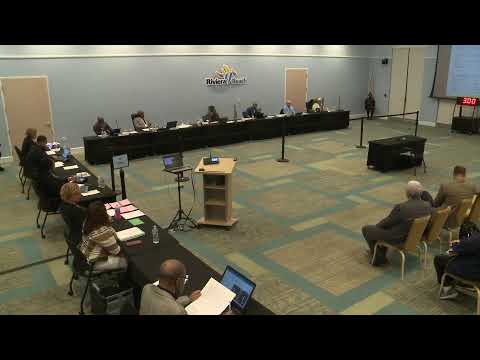
Riviera Beach, Fla. — The City of Riviera Beach Utility Special District on Wednesday adopted a revised 2024 revenue sufficiency and rate report and approved new water and wastewater rates intended to support construction of a replacement water treatment plant, and later authorized a guaranteed-maximum-price work order of $23,695,058.17 for additional production wells.
The rate resolution (No. 00125 UD) was adopted by unanimous vote of the district board — Shirley Lanier, Todrick McCoy, Teshava Miller Anderson, Glenn Spiritus and Chairperson Douglas Lawson — after presentations from the district finance director and the district’s rate consultant. The board later approved GMP No. 3 for the water-supply wells project; that vote recorded four yeses with Vice Chair Todrick McCoy absent.
The revisions matter because they are intended to generate the revenue required to issue bonds and pay for a full replacement of the city’s water treatment plant, which the district and consultants said has reached the end of its useful life.
Robert Dorey, executive vice president of Raptellus Financial Consultants, described the water plant as the primary cost driver behind the recommended rates. “The real objective here is to develop a rate evaluation that fully funds the cost of the water treatment plant,” he said during the presentation, and added that rates must be set to enable the district “to issue bonds, to finance that,” and to support required deposits to renewal-and-replacement funds.
The district’s materials and consultants cite an estimated cost for the new water plant of about $356 million, plus roughly $43 million of additional projects in the five‑year capital plan. The consultants’ financing plan shown to the board anticipates a series of bond issuances with total bond proceeds modeled at about $455 million (including capitalized interest and project costs). The presentation estimated that new debt service would increase by roughly $27.3 million annually under the financing plan.
Randy Sherman, district finance director, and the rate consultant said the resolution replaces interim rates adopted in 2023 and that the rates in the resolution are the district’s new rates rather than an add-on to prior adjustments. “The rates that are in the resolution are the new rates. It’s not that rate plus 3%,” Sherman said when asked how the revised schedule interacts with prior interim adjustments.
The board and consultants emphasized two policy changes reflected in the proposal: higher targeted deposits for renewal‑and‑replacement (R&R) funds — the consultant recommended moving to about 15% of prior year gross revenues for water and about 7.5% for sewer — and maintaining a stronger debt‑coverage target (1.50× net revenues in the plan) than the minimum contained in typical bond covenants. The presentation noted the utility currently receives about 96% of its revenues from rates.
Consultants and staff also presented proposed changes to capital impact fees for new development. The consultant recommended increasing the water impact fee for an equivalent residential connection from roughly $2,110 to over $8,000 because the new plant and associated transmission and wells create a much higher per‑unit capital cost. The wastewater impact fee change was described as materially smaller; the consultant recommended phasing wastewater fee increases over two years or otherwise following the Florida Impact Fee Act process for notice and hearings.
Public comment was extensive and largely critical of the scale and pace of proposed increases. Nora Mahoney, a long‑time resident, asked whether the district would account publicly for how rate revenues are allocated: “Where is the money? Where do you allocate that amount of money that you take from everybody here in the city of Riviera Beach so it can be spent for the water plant like they promised at the time that you formed a special district?” Mike Mahoney, Rochelle Hughes, Marvelous Washington, Margaret Shepherd and other residents urged more transparency, questioned project costs, and warned of impacts on seniors and fixed‑income households.
Board members and staff responded with repeated points that the board is pursuing grant and low‑interest financing opportunities, including the State Revolving Fund (SRF) and federal programs, and that awards or loan forgiveness would be applied to reduce the district’s net borrowing need if secured. “If you get grant funds, which is cost‑free capital to you, we’re not going to issue the debt relative to that,” the rate consultant said in response to a question about grant prospects.
On the wells contract, Michael Hoisington, project manager for the Haskell/CDM Smith joint venture, told the board the contractors who bid the early well package were able to hold pricing for the additional four wells and that approximately 42% of the well work would go to local or minority‑owned firms under the GMP. The board approved the GMP work order for $23,695,058.17; the resolution text made the work order contingent on adoption of the rate resolution.
What the board decided and next steps
Votes at a glance - Resolution 00125 UD — Accept 2024 water and wastewater revenue sufficiency and rate report; adopt revised rates, fees and charges for water and wastewater services: motion made and seconded; vote recorded as yes — Shirley Lanier, Todrick McCoy, Teshava Miller Anderson, Glenn Spiritus, Douglas Lawson; outcome — approved (unanimous). Notes: staff and consultants said no additional rate adjustment will be implemented for the current fiscal year; next adjustments in the plan were described as becoming effective Oct. 1, 2025, depending on the schedule. - Resolution 4‑25 UD — Authorize city manager to issue work order and approve GMP No. 3 (balance of wells) for Haskell/CDM Smith joint venture in an amount not to exceed $23,695,058.17: motion made and seconded; vote recorded as yes — Shirley Lanier, Teshava Miller Anderson, Glenn Spiritus, Douglas Lawson; Todrick McCoy absent for final vote; outcome — approved. Notes: the GMP was presented as necessary to proceed with production wells that feed the planned plant; staff said earlier well work already approved is reimbursable from future bond proceeds.
Board members and staff said the district will continue to pursue grants and low‑interest loans to reduce the net amount to be financed, and the consultants recommended an annual review of the rate analysis so adjustments can be reduced if outside funding is secured. The board directed staff to publish required notices and follow the state’s impact‑fee procedures for any fee increases and phased implementation where applicable.
The meeting record shows broad public concern about cost, accountability, and past operational problems with the utility. The district’s consultants and finance director repeatedly framed the package as a conservative, worst‑case financing plan that the board and staff should adopt now to enable bond tests and timely construction while continuing to seek grant funds and other measures to reduce rates in future updates.
Ending
Board materials show a multi‑year phasing plan for rates, increased R&R deposits, and the planned sequence for bond issuances and construction procurement. The district staff and consultants said they will return with annual updates, detail on capital procurement and grant applications, and notices required by state law before final implementation of impact‑fee changes.