Get Full Government Meeting Transcripts, Videos, & Alerts Forever!
Get email alerts on the Comprehensive Plan Future Land Use Map topic
No spam. Unsubscribe anytime.
Puyallup council reviews draft 2044 future land use map; public hearing set for Jan. 28
Summary
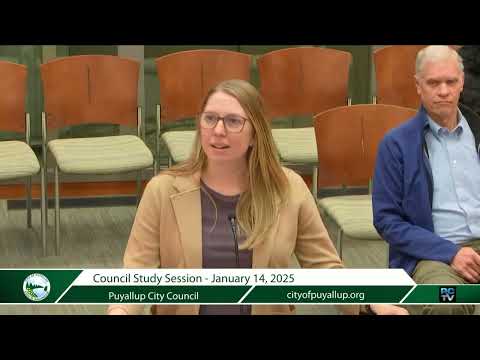
Katie Baker, planning manager, presented the Planning Commission’s recommended future land use map and told the Puyallup City Council the map is a “hybrid” that concentrates most growth in regional growth centers while adding small neighborhood commercial and mixed-use nodes; a public hearing on the comprehensive plan is set for Jan. 28.
Katie Baker, planning manager, presented the Planning Commission’s recommended future land use map for Puyallup’s comprehensive plan update and described the map as a “hybrid” that concentrates the majority of growth in regional growth centers while adding small neighborhood commercial and mixed-use opportunities elsewhere. The council reviewed proposed name changes, targeted nodes for neighborhood commercial and mixed-use designations, and several private requests including a package submitted by the Washington State Fair. The council was briefed that a citywide public hearing on the comprehensive plan is scheduled for Jan. 28 and that a final environmental impact statement is expected in February, with adoption work continuing through February–March.
The presentation emphasized changes to broad designations: “auto oriented commercial” would be renamed “general commercial,” “limited commercial” repurposed as “neighborhood commercial,” two industrial-related designations combined into “mixed employment,” and the separate land-use label “public facilities” would be removed from the land use map and retained only as a zoning category, Baker said. She said the map applies neighborhood commercial (NC) in small nodes along corridors such as West Stewart and West Pioneer and adds mixed-use commercial at the Shaw Pioneer intersection to allow a mix of housing and shops over time.
The South Meridian corridor is proposed to shift some parcels from multifamily to mixed use so that clinics and small medical offices and other commercial uses become explicitly allowed alongside housing, Baker said. No major land-use changes were proposed inside the two regional growth centers (Downtown and South Hill); the staff recommended a few minor adjustments, including conversions of low-density parcels near the growth-center peripheries to moderate density.
Council members pressed staff on how the map fits the city’s housing targets. Council member Witting stated that “between now and 2044, we’re supposed to accommodate another 7,482 housing units on top of the 18,000 we’ve got now,” and asked whether incremental map changes will be sufficient. Baker replied that the city is planning for most growth in regional growth centers and that the next phase will be zoning-code amendments and incentives to remove barriers and make denser development feasible, but she cautioned that targets are planning goals, not guarantees.
Several council members requested a definitional glossary showing what low-, moderate- and high-density residential designations allow (examples: single-family, duplex/townhome, larger apartment complexes) and asked staff to distribute those materials to the council. Baker agreed to provide the definitions and example images and said staff will prioritize code amendments tied to the growth centers and several other items identified through the update.
The Washington State Fair asked the city to redesignate several parcels it owns outside the fairgrounds to a “Fair” land-use designation. Staff noted the Planning Commission recommended not redesignating those parcels until zoning-code changes and a fair master-plan process are in place. Tom Mutterback, representing the Fair, said the organization supports working with staff on zoning and map cleanup and “supports staff’s recommendation that these comp plan designation changes do go forward at this time” while the city addresses zoning details.
Public commenters and outside speakers raised related concerns. Paul Romich noted the loss of Macy’s at South Hill Mall and urged the city to enable smaller, local commercial nodes. Developer Joshua Hawkes Fordow quoted LU policy language calling for mixed-use developments “with no density limitations imposed” and urged the council to reconsider downtown density caps and allow higher densities near transit. Other speakers pressed staff on wetlands and infrastructure constraints for proposed higher-density changes near the southwest sector north of I-512 and south of 31st, and on preventing warehousing from shifting truck traffic onto 39th Avenue SE.
The only formal action taken on the study-session agenda was procedural: a motion to approve the meeting agenda was moved and seconded and carried with all members present saying “aye.” No land-use map amendments were adopted at the study session; staff presented the Planning Commission recommendation for council consideration at the upcoming public hearing.
The city’s next steps: the Jan. 28 public hearing on the full comprehensive plan (including the map amendments), issuance of the final EIS expected in February, and code and zoning follow-up through February–March aimed at aligning zoning with the land-use designations and removing regulatory barriers in key growth areas. The staff presentation and public comments flagged sequencing issues — notably the Planning Commission’s caution about extending Fair zoning allowances beyond the fairgrounds — that council members and staff said will be worked through before zoning changes are final.