Get Full Government Meeting Transcripts, Videos, & Alerts Forever!
Get email alerts on the Cle Cultural Competency topic
No spam. Unsubscribe anytime.
State Bar asks Wisconsin Supreme Court to recognize CLE category for cultural competency and bias reduction
Summary
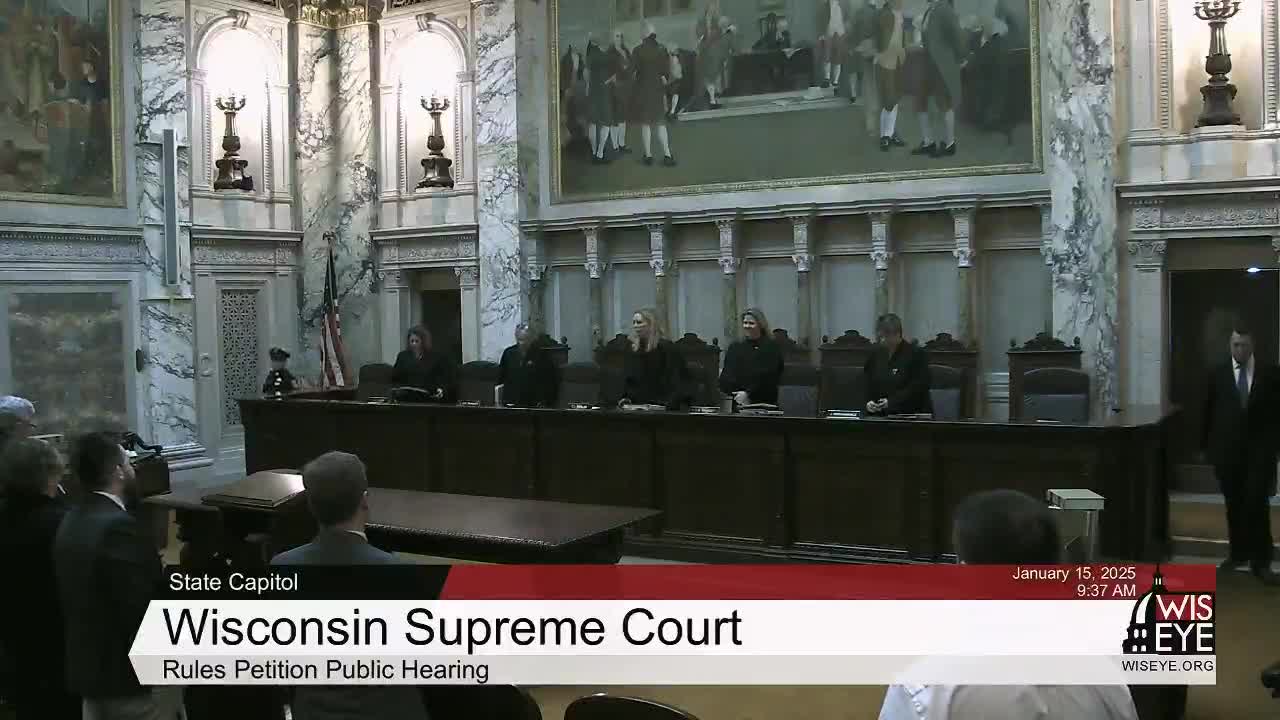
The State Bar of Wisconsin asked the Wisconsin Supreme Court at a rules hearing to add a new, voluntary CLE category for cultural competency and reduction of bias worth six credits under petition 24‑04.
The State Bar of Wisconsin asked the Wisconsin Supreme Court at a rules hearing to add a new, voluntary continuing legal education (CLE) category for cultural competency and reduction of bias that would be approved under the court’s rules as a distinct six‑credit category (petition 24‑04).
The petition, presented by Dean Dietrich, immediate past president of the State Bar of Wisconsin, would let lawyers take up to six CLE credits identified specifically for cultural competency and bias‑reduction training and have those credits count toward the 30‑hour CLE reporting requirement. Dietrich told the court the change is intended to “provide a clear pathway for lawyers to take credits dealing with cultural competency” and to “help lawyers understand and provide services to their clients, recognizing the variety we have of people with different backgrounds.”
Why it matters: Proponents said a defined credit category would clarify how courses are approved and encourage development of instruction aimed at improving access to justice for clients from diverse backgrounds. Opponents and some justices pressed for empirical support and warned that adding a third non‑substantive credit category could reduce the time attorneys spend on substantive law updates.
What was proposed and what supporters said - The State Bar’s proposal would treat cultural competency and reduction of bias as a distinct CLE category, similar to existing categories such as law practice management and lawyer awareness and understanding. The bar’s petition text and supplemental materials define the category’s objectives and list topic areas the bar would expect to cover. - “We are asking for the opportunity to provide CLE credits in the area of reduction and bias in order to help lawyers understand and provide services to their clients,” Dean Dietrich said during his presentation. He emphasized the petition is voluntary and that the Board of Bar Examiners (BBE) would continue to review and approve specific courses. - Legal Action of Wisconsin, the state’s largest civil legal aid provider, told the court it strongly supports the petition and suggested one credit under the new category be mandatory on a biannual basis to ensure broader exposure. Attorney Jacob Haller, representing Legal Action, said the group served “over 8,840 households affecting over 18,976 individuals” last year and argued a minimal mandatory requirement could improve attorneys’ ability to serve low‑income clients.
Questions and criticisms from the bench and intervenors - Several justices asked for concrete examples of courses that are being denied and for evidence that bias‑reduction or cultural competency training changes attorney behavior. The court and commenters referenced a July 13, 2023 denial order in which a related proposal was rejected; the prior history was part of the discussion. - Critics raised two central concerns: (1) that many such courses are already approved and credited by the BBE and the petition therefore duplicates existing practice; and (2) that the empirical literature on implicit‑bias training and similar interventions shows mixed results, with some systematic reviews concluding available evidence is insufficient to demonstrate consistent, sustained effects on professional behavior. One commenter summarized that mandate‑style trainings can in some settings produce no benefit or risk backlash. - Attorney Skyler Croix (opposing the proposal’s unrestricted expansion) framed a practical objection as a “6‑6‑6 problem,” saying adding a third six‑credit non‑substantive category (on top of six credits for lawyer awareness and six for law practice management) could let attorneys satisfy large portions of their reporting hours without taking substantive law courses. - Another court commentator (identified in the hearing transcript as an attorney arguing against creating the category in its present form) urged the court to consider the limited and mixed empirical record on whether such training improves professional practice and cautioned about opportunity cost in a state with limited attorney resources.
Standards, approvals and implementation questions - The State Bar said that, if the court recognizes the new category, course approval and educator qualifications would use the existing review processes shared with the Board of Bar Examiners. Dietrich said the petition is intended to create clarity so organizations will develop appropriate offerings and so practitioners know whether a course counts in the new category. - The BBE proposed an alternate approach referenced in the hearing materials that would cap non‑substantive credits at a combined total (discussed in the hearing as an alternate cap of 12 hours across categories). The State Bar opposed folding the new category into a single combined cap, arguing separate category caps are easier for practitioners to track.
Evidence and evaluation - The court and participants repeatedly noted the limited empirical evidence that CLE of any kind produces measurable improvements in professional practice; several speakers acknowledged the difficulty of measuring changes in attorney behavior after a single program. At the same time, proponents argued that voluntary exposure and availability of higher‑quality courses can raise awareness and provide useful baseline knowledge for attorneys working with clients from different cultural backgrounds.
Next steps - The court did not announce a decision at the hearing. The justices set an open administrative conference and indicated further internal deliberation. No formal vote or rule change was recorded on the transcript.
The hearing record contains questions and critique from multiple justices, prepared filings from the State Bar and the BBE, public‑interest commentary from Legal Action of Wisconsin, and opposing written comments citing academic reviews on implicit‑bias training. The court’s future order will determine whether the new CLE category is recognized and, if so, the final wording, credit caps and any implementation guidance.