Get Full Government Meeting Transcripts, Videos, & Alerts Forever!
Get email alerts on the Administrative Rulemaking topic
No spam. Unsubscribe anytime.
Wisconsin high court questions whether DNR must adopt formal rules to regulate PFAS under spills law
Summary
At oral argument in 22 AP 718, justices pressed lawyers on whether the Wisconsin Department of Natural Resources must promulgate formal administrative rules before treating PFAS as hazardous substances under the state spills law or whether agency guidance and enforcement can suffice.
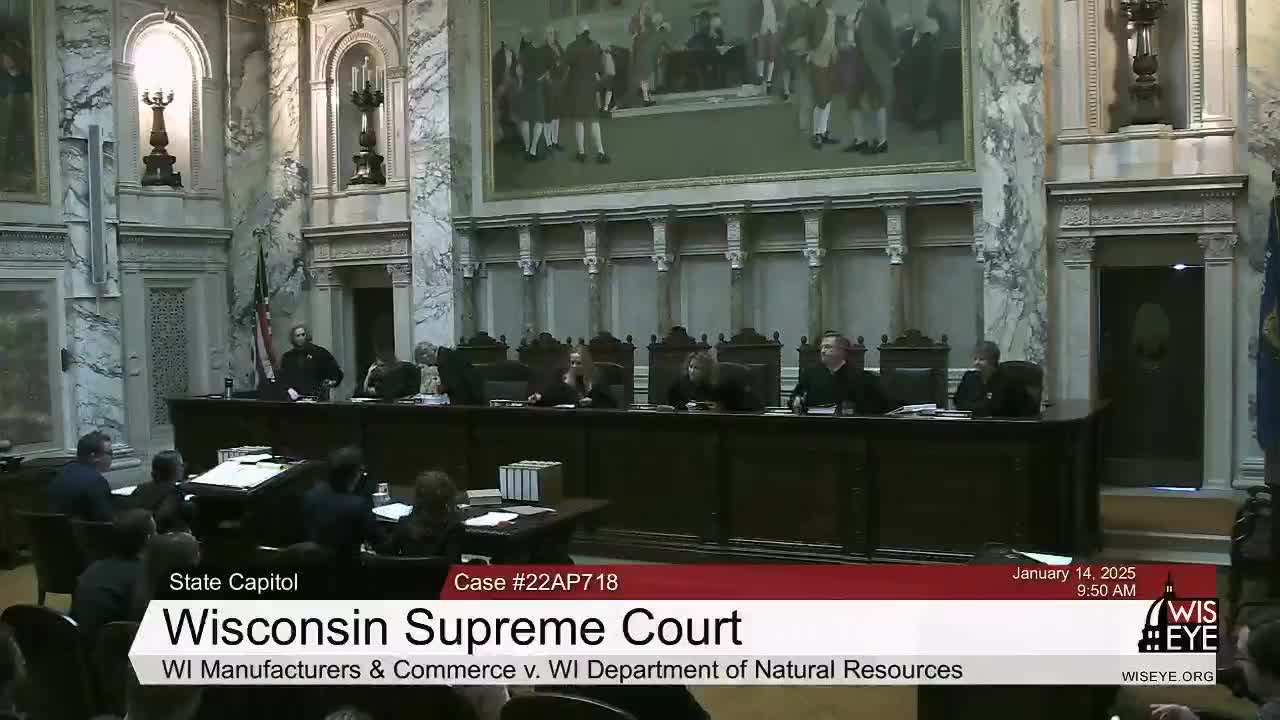
The Wisconsin Supreme Court heard extended arguments over whether the Wisconsin Department of Natural Resources must adopt formal rules before treating per- and polyfluoroalkyl substances (PFAS) as hazardous substances under the state spills law, case number 22 AP 718, during oral argument before the court in Madison.
The question matters because it determines whether the DNR's statements on its website and in correspondence — and an interim interpretation used in cleanup and the Voluntary Party Liability Exemption (VPLE) program — are valid agency action that must be promulgated as rules under Wis. Stat. §227.10, or whether they remain guidance the agency can use to enforce the statute without formal rulemaking.
Attorneys for the agency and for Wisconsin Manufacturers and Commerce (WMC) framed opposing legal paths. Attorney Roth, who argued for the position that agency explanations can be guidance rather than rules, told the court that “for nearly 50 years, DNR and tens of thousands of Wisconsinites have successfully used the spill law to protect our environment and public health,” and that the spills law’s broad statutory language requires agencies to apply general standards to new factual developments rather than pause enforcement until rules are adopted. Roth argued that many prior cases addressing unpromulgated rules remanded to agencies rather than halting enforcement and said treating every agency interpretation as a rule would “seriously weaken the entire executive branch’s core power to interpret and execute the law.”
Lucas Bebber, appearing for Wisconsin Manufacturers and Commerce, urged a contrary reading and focused on two issues: fair notice to regulated parties and the VPLE interim decision. Bebber told justices the VPLE interim decision is “a general policy that they would have had to promulgate” and that the department’s approach left property owners without a predictable standard for which PFAS compounds or concentrations trigger reporting and remediation obligations. He said the problem has practical consequences for regulated parties and for owners seeking to complete remediation and move properties back into commerce.
Justices pressed both sides on whether the crucial statutory provision is 227.10(1) (which says agencies must promulgate as a rule “each statement of general policy and each interpretation of a statute” that the agency specifically adopts to govern enforcement), or whether later statutory amendments defining “guidance documents” and the court’s prior case law (including Lamar, SEIU, and older decisions) narrow that requirement. Several justices described the regulated community’s predicament — cooperative parties who reported PFAS and then received evolving agency directions — and probed whether that experience amounted to a change in agency position that would require rulemaking.
The court’s questioning touched on technical and policy details introduced in the argument record: the DNR’s estimate that there are roughly 9,000 PFAS compounds (a point respondents emphasized), the agency’s identification of a shorter list of compounds it considered hazardous, the federal reporting thresholds in federal statutes relied upon by DNR (discussed in argument as a 1-pound-per-day threshold for certain federal programs), and scientific differences about which PFAS compounds and concentrations pose health risks (arguments referenced parts-per-trillion levels cited in some guidance and the differing federal thresholds used in separate programs).
Counsel debated legal standards and precedents. Roth pointed to prior Wisconsin decisions that found unpromulgated rules but remanded to agencies rather than barring enforcement, and argued that guidance explaining how an agency intends to apply a broadly worded statute does not itself become a rule. Bebber, and counsel for Leather Rich who noted a landowner sitting behind counsel, emphasized that repeated changes in agency interpretation and the practical costs (one owner said to have spent “several $100,000” and years of effort in the record) create unfair uncertainty unless the agency uses formal rulemaking or sets objective criteria that regulated parties can rely on in advance.
No final decision was announced at the argument. Justices repeatedly asked whether a ruling for either side would have broad practical consequences — from halting day-to-day enforcement under the spills law to requiring the Legislature to pass enabling legislation where rulemaking would impose compliance costs exceeding thresholds set by statute. Several justices signaled the court would need to reconcile Lamar and later statutory changes governing guidance documents and the effect of agency communications.
If the court finds the DNR’s guidance and the VPLE interim decision are rules under Wis. Stat. §227.10 and related definitions, it would require formal rulemaking procedures; if it finds they are guidance documents, DNR enforcement under the spills law could continue without promulgating rules. The decision will affect property owners, regulated businesses, local governments, and communities near contaminated sites who rely on clearer standards for investigation and remediation.
The court took no ruling from the bench at the close of argument and indicated it would take the matter under advisement and read it. The case record includes extensive briefing and referenced authority that the justices signaled they will consider before issuing an opinion.