Get Full Government Meeting Transcripts, Videos, & Alerts Forever!
Get email alerts on the Education Open Enrollment topic
No spam. Unsubscribe anytime.
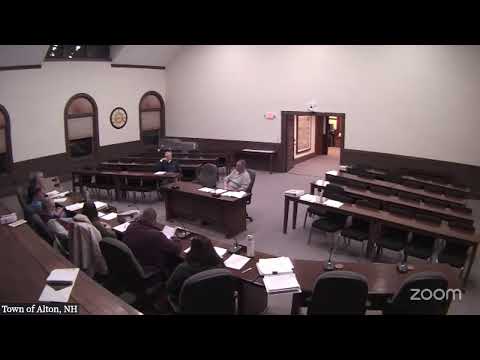
Prospect Mountain open‑enrollment, per‑pupil costs draw detailed questioning at Alton public hearing
Summary
School officials explained why per‑pupil spending has risen as enrollment falls, described the open‑enrollment pilot at Prospect Mountain High School and clarified how out‑of‑district tuition, special education costs and class‑size caps would be handled.
School officials and selectmen used the public hearing to walk through the Alton School District’s budget mechanics and explain a new open‑enrollment approach at Prospect Mountain High School that is intended to bolster enrollment and preserve course offerings.
Heidi, a district administrator, told the hearing that per‑pupil spending rises when enrollment falls because many expenses are fixed: "It's a simple calculation where it's our total cost divided by our enrollment and because our enrollment is going down and our expenses are pretty level, the per pupil does increase." She explained that small changes in enrollment (for example, a loss of 8 students spread across grades) do not necessarily reduce staffing because staffing is organized by grade and program needs.
On open enrollment, Heidi said the district currently has 11 out‑of‑district students enrolled at Prospect Mountain and is working with the state on how payment/tuition will flow. The district expects a state formula will cover only a portion of Alton’s per‑pupil cost; Heidi described the statute as prescribing a fixed state contribution (she did not quote a precise percentage), and participants in the hearing suggested the state payment was roughly 80% of the district’s per‑pupil figure. The transcript discussion included the district’s per‑pupil figure for 2023–24 of approximately $25,233 and participants’ rough calculation that 11 tuition students at an 80% state contribution would leave a material delta that local taxpayers would cover if the district does not collect the difference from sending districts or families.
On who pays special‑education costs, Heidi said the sending district (the district of residence) remains responsible for 100% of the special‑education costs for any of its students who attend Prospect Mountain under open enrollment.
Board members and residents raised practical questions about class caps, admissions and transportation. Officials said the district’s plan envisions incoming ninth graders as the initial growth cohort, with an application process, documentation requirements and an admissions rubric; transportation for out‑of‑district students would be the families’ responsibility. School officials said they would limit intake by grade so the district would not need to add staff unless a class surpassed the agreed cap (the school currently uses a cap of 25 students per class as a guideline, with some classes typically 15–17 pupils).
Officials also said the school board and administration will monitor enrollment and costs as the pilot proceeds. They noted an ongoing legal case in which another district’s denial of an open‑enrollment application is being challenged; the outcome may affect payment processes and state guidance.
Why this matters: The open‑enrollment discussion affects the school’s capacity to offer electives and programs as enrollment declines, and it involves cross‑district funding questions that have a direct fiscal impact on the Alton School District’s budget and on local taxpayers.
Ending: School staff asked selectmen and the public for time to clarify revenue estimates and to report back with a clearer calculation of the net fiscal impact of additional open‑enrollment students before deliberative session.