Get Full Government Meeting Transcripts, Videos, & Alerts Forever!
Get email alerts on the Education School Meals topic
No spam. Unsubscribe anytime.
Bill would let state use leftover school meal funds to reimburse districts for delinquent meal debt, testimony says
Summary
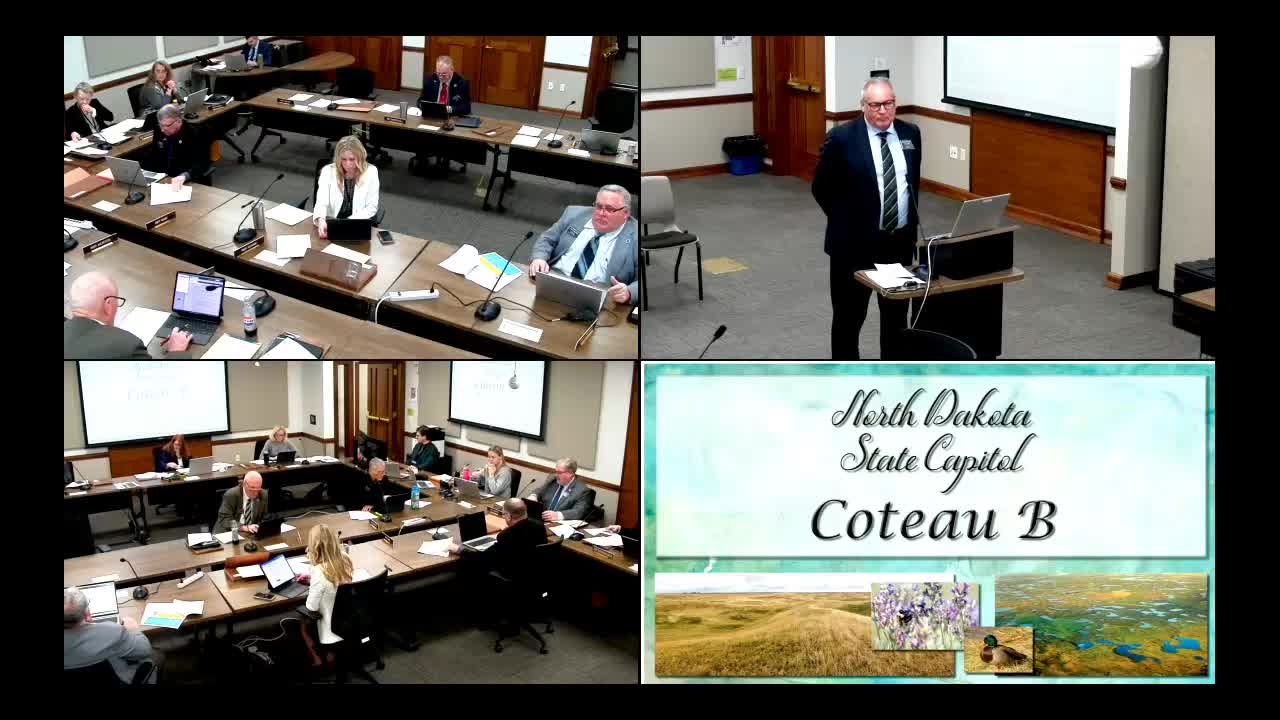
Representative Jonas opened a House Education Committee hearing on House Bill 1100, which would allow leftover funds from a prior $6 million school-meal appropriation to reimburse school districts for delinquent meal debt and require a report to the legislature.
Representative Jonas presented House Bill 1100 to the House Education Committee, saying the bill would allow leftover appropriations from the $6 million free-and-reduced meal funding passed in the 2023 K–12 funding bill to be redirected to reimburse school districts for delinquent school meal debt and require a legislative report on the extent of the debt.
Jonas told the committee the North Dakota scholarship allocation in session 2023 included $6,000,000 for free and reduced-price school meals, which aided roughly 10,000 students statewide. He estimated delinquent meal debt statewide at about $2–3 million and gave district examples: Grand Forks roughly $67,000, Bismarck about $63,000, Fargo about $125,000 and West Fargo about $180,000 (West Fargo projected that amount could rise to roughly $250,000 by the end of the school year).
Nick Archuleta, president of North Dakota United, testified in support and urged a "due pass" recommendation, saying reimbursement would reduce district anxiety over meal debt and provide a detailed report for future legislatures. Archuleta said recurring delinquent debt will reappear absent a permanent policy solution and argued the state should consider universal school lunch as a long-term policy option.
Levi Bachmeier, business manager for West Fargo Public Schools, described how districts struggle to collect small unpaid balances and the fiscal effect when districts choose not to write off debt. Bachmeier said some districts are writing off meal debt and others are carrying it; West Fargo had chosen to carry its receivable and was concerned the bill’s pro rata distribution might disadvantage districts that had previously written off debt. He recommended the committee consider a consistent point-in-time reporting method so districts are treated equitably.
Committee members asked for fiscal clarity. Jim Upgren (Department of Public Instruction) said his office used eTranscript data to estimate that, as written, HB1100 would produce roughly nine additional scholarship recipients for another bill earlier in the hearing; for the meal-debt question he deferred detailed appropriation and carryover questions to Brenda Zastepoel of the North Dakota University System. Zastepoel told the committee that although there would be an impact to reimbursements, carryover from last session would allow the system to absorb the expenses related to this bill.
Johnson, director of child nutrition and food distribution with the Department of Public Instruction, explained federal program rules: the National School Lunch and School Breakfast programs are federally administered by USDA but implemented at state level through NDDPI. Johnson said all districts that participate must have written unpaid-meal-charge policies (as required by 2017 rule and further refined after House Bill 1494 in 2023) and that technical assistance and monitoring are part of DPI’s administrative-review process. He said districts can carry negative balances year to year and ultimately must use nonfederal funds when the debt becomes uncollectible.
Multiple K–12 organizations — including the North Dakota School Boards Association, the North Dakota Council of Educational Leaders, North Dakota Small Organized Schools and business managers who testified — backed HB1100. Supporters said the bill would be a one-time reallocation of remaining funds to reduce district budget strain from unpaid meal debt and would include legislative reporting to inform future policy.
Committee members discussed logistic issues the bill raises: whether districts that previously wrote off debt would be disadvantaged in any pro rata distribution and whether the committee should require point-in-time reporting of outstanding debt plus write-offs to avoid rewarding districts that carried more receivables. The committee closed the hearing on House Bill 1100 after receiving support testimony and technical commentary; no vote was recorded in the transcript.