Get Full Government Meeting Transcripts, Videos, & Alerts Forever!
Get email alerts on the Public Safety Speed Enforcement topic
No spam. Unsubscribe anytime.
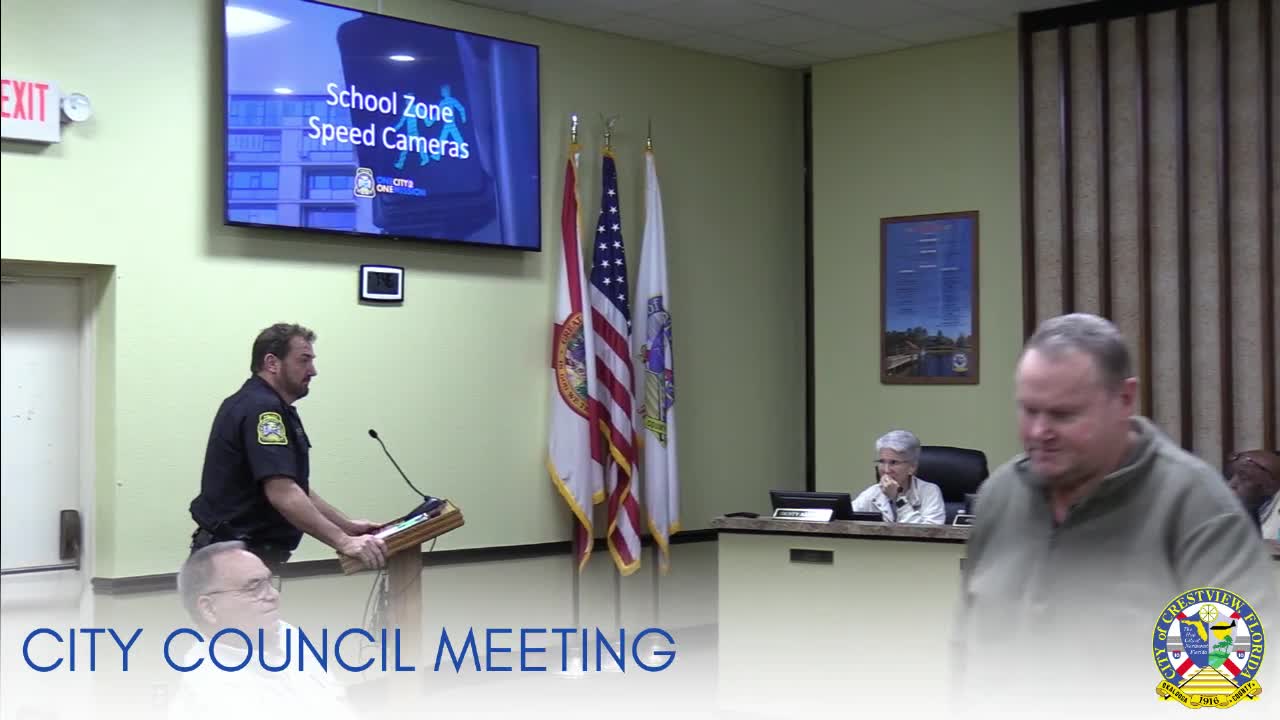
Council asks staff to study school‑zone speed cameras, OKs pilot study and expanded locations
Summary
After a presentation from the police chief, the council agreed 5–0 to begin speed studies and vendor evaluations for school‑zone speed cameras, including proposed east‑west enforcement at two major intersections; chief outlined fines, revenue split and a 30‑day warning period.
The Crestview City Council gave staff the go‑ahead to begin speed studies and vendor negotiations for school‑zone speed cameras, with a unanimous vote to proceed and an instruction to include east‑west enforcement at the city’s two signalized 85/90 intersections in the analysis.
Chief McCoster of the Crestview Police Department briefed council on state law (House Bill 657, 2023) that authorizes automated speed enforcement in school zones "when children are traveling to and from school and throughout the school day." He described a phased plan that would begin with speed studies, vendor procurement and a public education period before fines are issued.
Chief McCoster said the vendor studies typically use short duration speed counts (radar or hose counters) for two to three days followed by data analysis lasting up to a few weeks. If the council moves forward, staff estimated cameras could be installed and active near the August 2025 school term start. The chief recommended starting where high speeds are most evident: corridors with 35 mph or higher posted limits and limited natural traffic calming.
On fines and revenue the chief said: "The fine will be a $100," and described the statutory distribution: "$60 is retained by the city," $5 for crossing‑guard training and retention, $12 to the school district and $23 retained by the state (the chief noted that a vendor fee will reduce the city share). The department recommended a tolerance threshold of 11 mph over the posted school‑zone speed before a violation is issued, and a 30‑day warning/education period after installation.
Chief McCoster also reviewed where the department proposes collections and studies first: corridors serving Crestview High School (the higher‑speed approaches), Ferdon Boulevard, Industrial Drive and several other approaches where recorded speeds run higher than expected. He said some school sites are naturally congested at drop‑off/pick‑up and thus show lower speeds, so cameras would be prioritized where high through‑traffic produces sustained speeding.
Council members asked about enforcement, officer presence and the effect on points and driver records. The chief said the initial citation is a municipal civil violation and is mailed to the registered owner; if not addressed it can escalate to a uniform traffic citation. "The registered owner of the car" receives the notice; the statute provides an affidavit process to identify the actual driver when appropriate, he said. The chief also emphasized the cameras are meant to supplement, not replace, officer presence: councilmembers reiterated that visible enforcement and traffic‑unit patrols remain important.
After questions the council voted (motion by Councilman Hayes; second by Councilman Frost) to authorize staff to proceed with speed studies and vendor evaluation, including estimating costs with and without additional east‑west enforcement at the signalized intersections on U.S. 85/90. The motion passed 5–0.
Clarifying details - Statutory basis: House Bill 657 (2023) allows automated enforcement in school zones "throughout the school day." - Proposed pilot timing: speed studies now; installation and activation aimed for about August 2025 (subject to vendor schedule and DOT approvals). - Tolerance and fines: recommended enforcement threshold 11 mph over posted limit; fine set at $100 by statute. - Revenue split (statutory outline provided by chief): $60 retained by city (less vendor fee), $5 for crossing‑guard training/retention, $12 to the school district, $23 to the state. - Public‑education period: 30 days of warning after activation before violations are issued.
Ending The council’s authorization starts the technical work — speed counts, vendor proposals, DOT permissions and draft contracts — and asks staff to return with cost estimates and recommended enforcement locations. Council members said they expect a follow‑up report before any contract or ordinance adoption that would finalize enforcement details.