Get Full Government Meeting Transcripts, Videos, & Alerts Forever!
Get email alerts on the Long Term Care Rights topic
No spam. Unsubscribe anytime.
Hearing on resident-rights bill surfaces privacy, liability and operational questions; Department seeks more stakeholder work
Summary
Senate Bill 2070 would revise and broaden resident rights for long-term care facilities, adding new definitions for "authorized electronic monitoring" and requirements on transfers, billing and pharmacy choice; witnesses urged more consensus work to resolve privacy, liability and assisted-living implementation concerns.
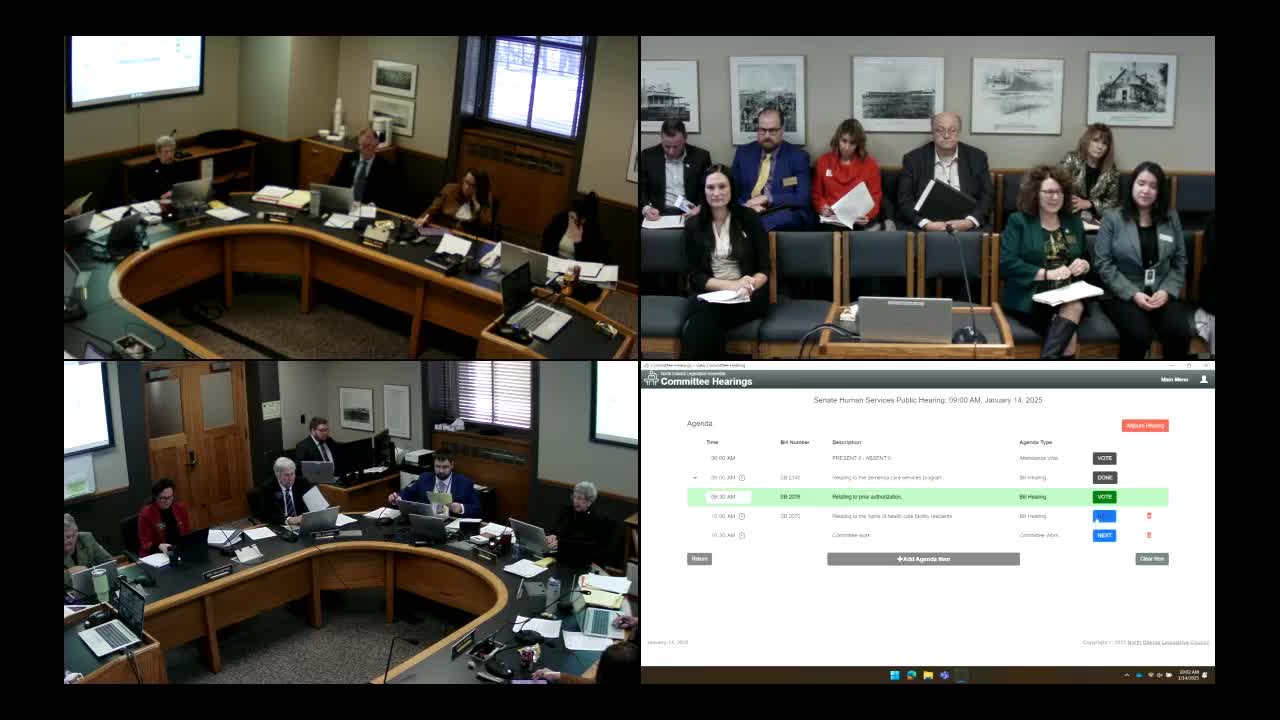
The Senate Human Services Committee opened a public hearing on Senate Bill 2070, a Department of Health and Human Services request bill that would revise the statutory resident-rights chapter for long-term care facilities to reflect new technology and clarify transfer, discharge and billing procedures.
Carla Bachman, the State Long Term Care Ombudsman, presented the changes as an effort to update statutory language, protect resident privacy and reduce recurring complaints the ombudsman's office receives about transfers and discharge notices. The bill would rename and expand definitions (for example, distinguishing "authorized electronic recording" from "technology device" and "virtual visitation"), shorten the window for the initial oral statement of resident rights from 30 to 14 days, set more detailed content requirements for transfer and discharge notices, require facilities to make copies of transfer/discharge notices to the ombudsman's office, strengthen anti-retaliation language, and add timeframes for payout of resident personal funds and refunds.
Bachman said stakeholder meetings were held with providers, residents and families and that the Department had revised several provisions after feedback, but she also acknowledged remaining drafting issues and invited further technical conversations.
The hearing drew substantive comment from the field. Marina Spahr, director of the Medicaid Fraud Control Unit in the attorney general's office, supported the bill's goals but urged removal or narrowing of proposed criminal and civil liability waivers she described on page 10, lines 29'31 of the draft. Spahr said a broad waiver could impede investigation of abuse, neglect or financial exploitation and recommended either deleting the waiver or adding language explicitly excluding the AG's investigative authority (for example, language similar to NDCC 32-40-808, as cited in testimony).
Nikki Wagner, president of the North Dakota Long Term Care Association, said association members had participated in drafting discussions but continued to have substantive concerns. Wagner's written and oral testimony listed operational concerns for assisted living and basic care: (1) shortening the oral explanation window to 14 days could overwhelm new residents and conflict with resident-centered orientation processes; (2) language about "full access to the community" and certain care-plan expectations could impose obligations that fit skilled nursing facilities but not assisted living or basic care; (3) the right to choose any attending physician may be impractical in rural areas with limited transportation and physician availability; (4) requiring written notice when admission is denied for inability to verify a payment source may be administratively burdensome and could embarrass private-pay prospective residents; and (5) some provisions mirror federal skilled nursing regulations (Appendix PP) that do not neatly map onto assisted-living operations. Wagner urged more time for collaboration between providers, the ombudsman and the department before the committee acts.
Other discussion focused on electronic monitoring and recording. Bachman said the intent was to protect residents by distinguishing devices used for communication/visitation (for example, tablets used for video calls) from devices used to record activity in a resident's private room. The attorney general's office recommended clarifying whether family-owned monitoring devices and facility-owned monitoring systems are both permitted and whether recording should be allowed for virtual-monitoring devices; the AG's office also asked for narrower liability language. Providers asked whether the bill unintentionally would import skilled-nursing regulatory standards into assisted living and basic care; they requested specific wording changes and asked for more time to reach agreement.
Committee members responded by asking the ombudsman to share her annual report and by encouraging the parties to pursue technical fixes. Committee members emphasized that while they support stronger resident protections, many provisions present operational challenges across different levels of care and would benefit from additional stakeholder drafting. The ombudsman and provider representatives said they would continue to meet and attempt to narrow disagreements.
No committee vote was taken; senators asked the parties to reconvene and bring recommended language back to the committee.