Get Full Government Meeting Transcripts, Videos, & Alerts Forever!
Get email alerts on the Religion In Schools topic
No spam. Unsubscribe anytime.
Long hearing on bill to require 10 Commandments in classrooms pits history-and-tradition claims against coercion and litigation warnings
Summary
Representative Hoverson's bill to require a specific display of the Ten Commandments in K–12 and higher-education classrooms drew long, sometimes emotional testimony Thursday, with proponents citing history-and-tradition arguments and opponents warning of coercion and near-certain litigation.
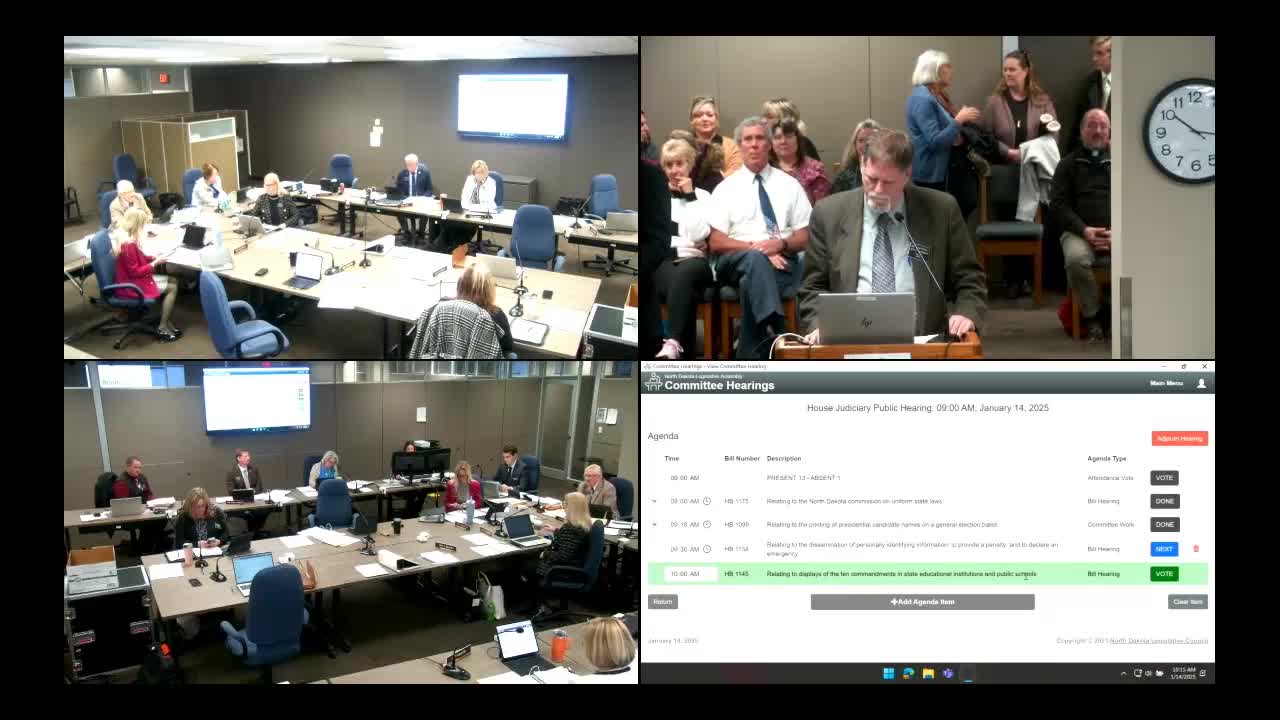
Representative Hoverson introduced House Bill 11-45, which would require a specific display of the Ten Commandments in K–12 classrooms and higher-education classrooms and buildings. The committee scheduled extended testimony and heard more than an hour of testimony on both sides of the measure; no committee vote was taken.
Supporters argued the measure is constitutional under the recent U.S. Supreme Court shift away from the Lemon test toward a history-and-tradition standard. Tim Barton of WallBuilders and Janice Laura of the Pacific Justice Institute told the committee that the Ten Commandments have longstanding educational and civic uses and that the Kennedy v. Bremerton decision (the 2022 football-coach case) changed how courts should assess historical religious displays. "This was such a common part of education...from the pilgrims up until 1980," Barton said, pointing to early primers and McGuffey readers that included the Ten Commandments.
Pat Dean, a former North Dakota school principal, said the measure would promote what he described as civic morals and benefitted students. Several faith leaders and local advocates — including a nonprofit youth-worker who said faith-based programming helped him leave addiction — also testified in favor and tied the proposal to community moral outcomes.
Opponents included the North Dakota School Boards Association, the ACLU of North Dakota, the North Dakota Student Association, tribal and civic witnesses and individual students. Chrisann Norbyjoner, legal counsel for the School Boards Association, argued the bill’s mandatory, uniform posting, font and size requirements mirror prior statutes that federal courts have struck down and described the recent preliminary injunction of a Louisiana law with near-identical requirements. "Requiring public school boards to permanently post a specific version...in every public school classroom and building unconstitutionally pressures students into religious observance of a specific religious scripture," Norbyjoner told the committee.
ACLU representative Cody Schuler emphasized the captive-audience problem in public schools and said the Kennedy decision upholding private prayer by a coach does not authorize a state-mandated, permanent religious display in a classroom. Students and student groups argued the requirement could alienate non-Christian students and international enrollees at public colleges, while a Native witness urged sensitivity given the history of boarding schools.
Legal witnesses and committee members pressed advocates on likely litigation. Janice Laura, the Pacific Justice Institute attorney, said HB 11-45 fits the Kennedy court’s history-and-tradition test and predicted the measure could survive judicial review; other witnesses pointed to the district court injunction in Louisiana and warned of likely lawsuits and associated state costs. Committee members asked the Attorney General’s office and stakeholders to submit case citations and comparative materials; the committee will review written testimony and the submitted materials before taking further action.
No vote was taken at the hearing. Committee leaders indicated written testimony on both sides will be reviewed and that the committee will weigh constitutional and practical implications before scheduling any further action.