Get Full Government Meeting Transcripts, Videos, & Alerts Forever!
Get email alerts on the Doxxing Privacy topic
No spam. Unsubscribe anytime.
Committee hears doxxing bill; victims, industry and prosecutors flag definitions, jurisdiction and penalties
Summary
House Bill 11-34, which would criminalize the malicious dissemination of personally identifying information (doxxing), drew victim testimony and mixed responses from industry, law enforcement and the Attorney General's office. Committee members requested additional statutory comparisons and clarifications; no vote was taken.
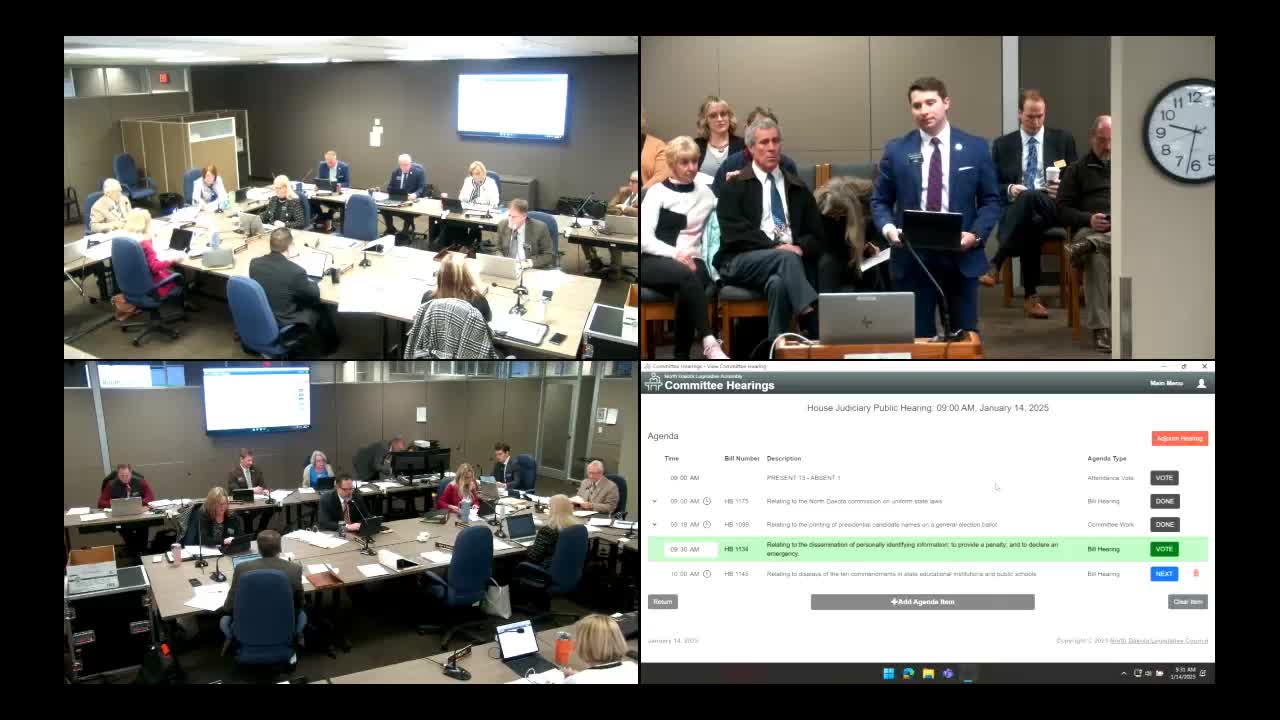
Representative Matt Heilman introduced House Bill 11-34 and told the House Judiciary Committee the measure is intended to protect people from malicious online publication of private identifying information — often called doxxing. The bill would make dissemination of personally identifying information with intent to intimidate, threaten, harass or frighten a Class A misdemeanor, with enhanced penalties if the dissemination leads to bodily injury, serious bodily injury, or death.
The committee heard emotional testimony from Lexi Dupong, who described months of harassment she says began after private information about her was posted online. "Imagine waking up one morning to find all of your most private details...published online for anyone to see," Dupong testified, describing threats, predatory calls and a lasting mental-health and financial impact.
Industry witnesses including a representative from Verizon and TechND supported the bill in principle while urging a narrowly drawn definition and an amendment to protect internet service providers from liability when they act as platforms. "We do support the bill with the amendment," said Todd Crand of a law firm representing Verizon, and he described an amendment meant to avoid making ISPs liable for third-party postings.
Law enforcement and prosecutors raised implementation questions. Danelle Presky, testifying for the North Dakota Association of Counties and the Sheriffs and Deputies Association, urged an exemption or clarification so established law-enforcement notifications — for example, sex-offender registries or Silver/Blue Alerts — would not be jeopardized. Jeremy Enzrud of the Attorney General’s office took a neutral position and asked the committee for several clarifications: he recommended consistent statutory definitions rather than new, divergent ones; warned that limiting dissemination to online postings would exclude some harmful conduct (for example, posted flyers); and highlighted jurisdictional language used in other criminal statutes that treats the crime as occurring where a communication is sent or received.
Enzrud also explained a substantial evidentiary issue: proving that a particular online posting proximately caused later physical harm can be difficult. "Showing that causation between two things is extremely difficult," he told the committee, noting prosecutors would need strong evidence tying a posting to a subsequent assault or worse.
Committee members pressed sponsors on mens rea and penalty levels. Representative Zetter said the bill’s proposed penalty enhancements — with escalating felonies tied to injury and death — appear high compared with comparable offenses and asked the sponsor to re-examine them. Representative Heilman acknowledged a drafting need on the family-member definition and said he favors adopting existing state code cross-references to avoid conflicts; he also said he had proposed an ISP-protection amendment.
No formal committee vote was taken. The Attorney General’s office agreed to provide the committee with statutory cross-references it cited for harassment, stalking and personal-identifying-information offenses and with tables of existing penalty levels to help lawmakers compare the proposed enhancements to current law. The bill remains under consideration pending the committee’s review of those materials and possible amendments.