Get Full Government Meeting Transcripts, Videos, & Alerts Forever!
Get email alerts on the Legislative Procedure Rules topic
No spam. Unsubscribe anytime.
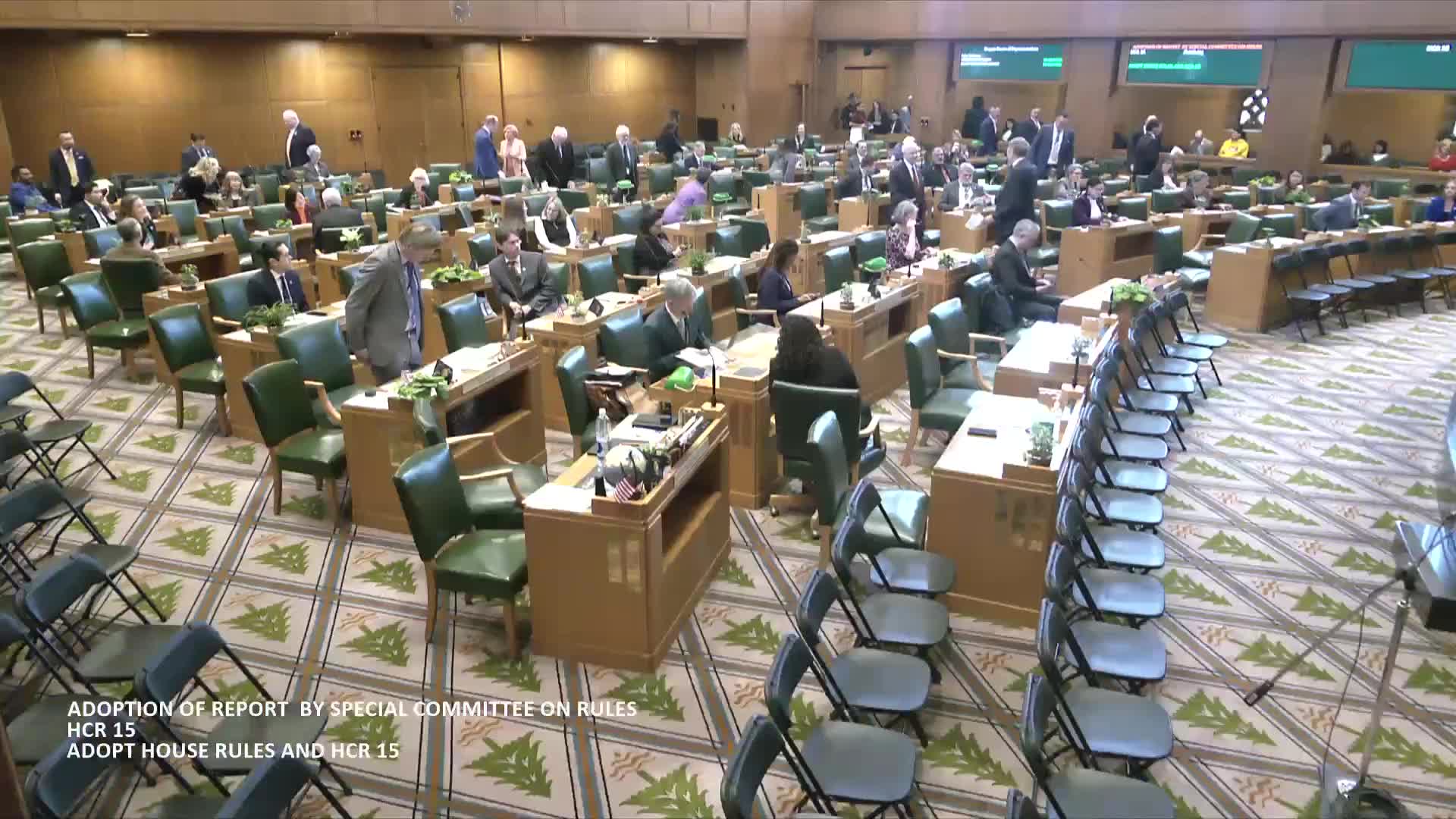
Oregon House adopts rules for 2025 session; committee expands decorum rule and sets censure threshold
Summary
The House adopted rules for the 83rd Legislative Assembly, including expanded decorum standards, limits on courtesies, new restrictions on newsletters and a 31‑vote threshold for censure resolutions. The package was adopted after floor debate and a roll-call vote; House Concurrent Resolution 15 was transmitted to the Senate.
The Oregon House of Representatives adopted a package of rules for the 83rd Legislative Assembly that includes six named substantive changes, expanded decorum requirements and new limits on member communications.
Representative David Gomberg, chair of the special committee on rules, moved adoption and summarized the changes, which the committee described as aimed at balancing minority protections with the majority’s ability to advance business. “Our rules are a living document, and they are based on parliamentary law and the principles of democracy,” Gomberg said while outlining the package.
Why it matters: House rules shape how bills are debated, how committees operate and what floor conduct is permitted. Among the substantive changes put forward by the committee were a rule extending decorum standards beyond floor debate into committee deliberations, clarified limits on “courtesies,” procedures for distributing floor letters and newsletters, penalties for using legislative newsletters to promote or oppose ballot measures, and a specified vote threshold for censure resolutions.
Major rule changes summarized from Gomberg’s floor presentation: - Expanded decorum: Standards that bar impugning motives, ascribing personalities or assailing character now apply beyond floor debate and into committee deliberations. - Courtesies narrowed: Courtesies will be limited to individuals or visiting groups who have achieved a “noteworthy distinction,” with a preference (but not a requirement) that honorees be present. - Floor letters and newsletters: Members may distribute floor letters (subject to clerk review for decorum violations); newsletters may be used to explain measures but cannot be used to urge voters to support or oppose ballot measures. Violations can result in penalties up to $500 and other sanctions. - Censure procedure and threshold: If the conduct committee recommends censure or expulsion, the action must be presented as a resolution; the rules set the censure resolution vote threshold at 31. - Sine die declaration: A clarified timeline for when the speaker may declare sine die imminent; the declaration cannot be made more than 35 days before the constitutional sine die for a long session.
Floor debate and questions: Representative Ed Diehl (Deal) urged a “no” vote, arguing the rules favored one party and proposing additional minority protections such as limited debate on discharge motions and minority vice chair roles in committees. Representative Kevin Osborne thanked committee members and described the rules process as professional despite not receiving all desired changes. Representative Scharf asked whether a city sesquicentennial would qualify for a courtesy; Gomberg replied that the clerk should resolve such edge cases and that rules can evolve.
Vote: The rules package and House Concurrent Resolution 15 were adopted following a roll-call vote. The clerk recorded ayes and noes and the chair declared the motion carried; the journal reflects that the rules and HCR 15 were adopted and HCR 15 is to be transmitted to the Senate.
Votes at a glance: - Adoption of the 2025 House rules and HCR 15 — Outcome: approved (roll-call recorded on the floor; motion declared carried). - Final consideration and adoption of HCR 14 (adjournment of the organizational session) — Outcome: adopted (voice/recorded vote declared carried).
What’s next: Committee memberships were distributed electronically; the House will proceed to committee business and to the regular session schedule outlined in HCR 14 and HCR 15.