Get Full Government Meeting Transcripts, Videos, & Alerts Forever!
Get email alerts on the Protection And Advocacy Budget topic
No spam. Unsubscribe anytime.
House panel hears PNA budget request, pilot program seeks continuation after COVID funding ends
Summary
The House Appropriations Committee's Human Resources Division opened a hearing on House Bill 1014, the appropriation for the North Dakota Protection and Advocacy Project (PNA), where agency leaders asked legislators to fund two additional staff positions, cover an expected retirement payout and continue a COVID‑funded assistive‑technology pilot.
The House Appropriations Committee's Human Resources Division opened a hearing on House Bill 1014, the appropriation for the North Dakota Protection and Advocacy Project (PNA), where agency leaders asked legislators to fund two additional staff positions, cover an expected retirement payout and continue a COVID‑funded assistive‑technology pilot that they say helps people move from institutional settings into independent community living.
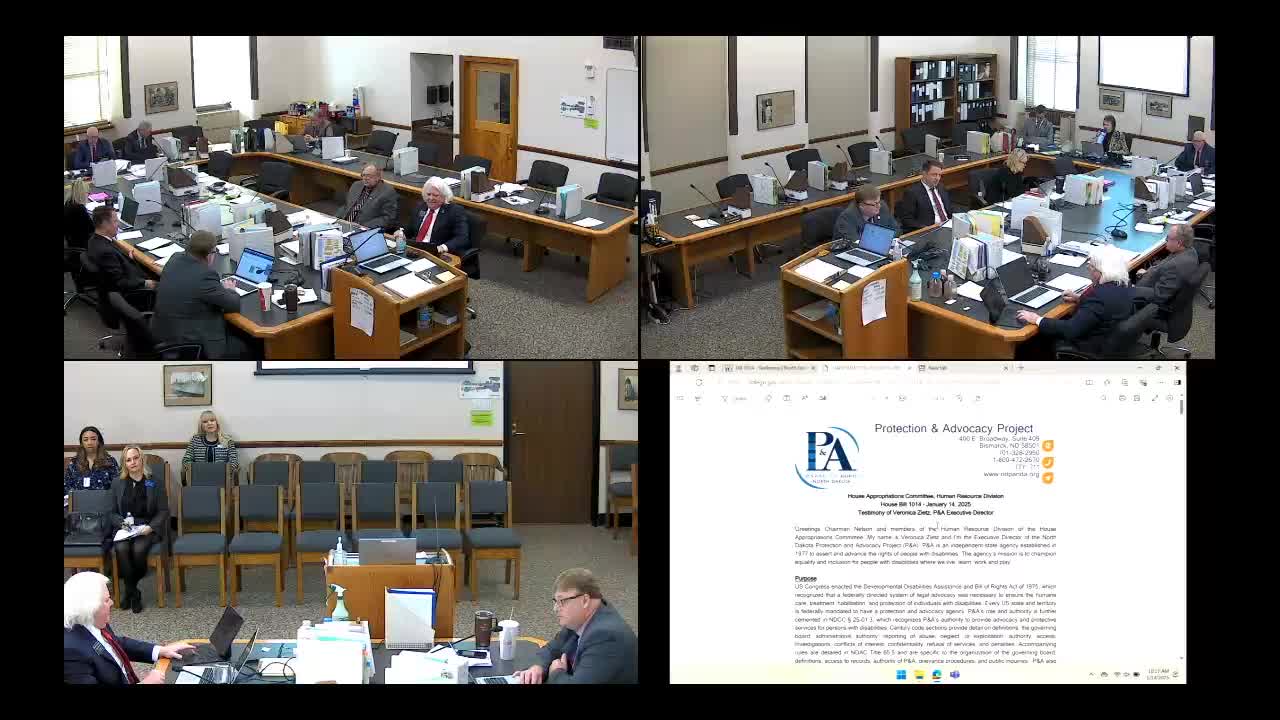
My name is Veronica Zitz. I'm the executive director at the North Dakota Protection and Advocacy Project, Zitz told the committee as she summarized the agency's mission and legal authorities, noting that PNA is federally mandated and referenced state and federal statutes and rules that undergird the work.
PNA provides protective services, advocacy and legal help to people with disabilities, and it reported rising demand: it provided case‑level services to 1,771 clients in the most recent federal fiscal years (up from 1,668 over the prior two‑year period), handled more than 6,000 information and referral requests and reached about 17,266 people through education and training. Zitz said protective‑services cases — investigations of alleged abuse, neglect or exploitation — make up about 63% of the agency's caseload.
Why it matters: committee members pressed the agency for data about caseload trends, staffing and geographic service coverage because PNA's requests would expand its baseline staffing and because a one‑time federal COVID grant that funded a workforce and assistive‑technology pilot is scheduled to end in September 2025.
Key budget and staffing details
• Baseline staff and turnover — PNA said the legislature currently designates 28.5 FTE for the agency. The agency reported 11 vacancies to date in the current biennium and cited turnover of about 32% from June/July 2023 to June 2024 (11% more recently). PNA said average time to fill attorney positions is substantially longer than for other roles.
• Base budget and funding mix — PNA described a base‑level budget in the mid‑$7 million range that is split roughly between federal grants and state general funds (the agency cited roughly 56% federal and 44% state for the current biennium). PNA staff told the committee they typically receive about $3.5 million annually in recurring federal grant funding but that one‑time COVID dollars and other grants have temporarily increased that total.
• Optional decision packages — For the 2025–27 biennium PNA submitted three optional requests: $19,288 for retirement payout coverage (to smooth costs when long‑tenured staff retire), $237,000 and one FTE for a communications specialist to boost public awareness and outreach, and $237,000 and one FTE for a program coordinator to continue the workforce and technology pilot. Zitz told the committee the governor's recommendation included funding for the program coordinator request but did not include the communications position.
Workforce and assistive‑technology pilot
Jordan Wetzel, project coordinator for PNA's Workforce and Technology Project, testified about the pilot the agency launched with one‑time COVID funding. Wetzel described small, practical technologies used in pilot cases — such as automatic door openers, smart bulbs, internet‑safety monitoring tools and low‑cost kitchen aides — and said the equipment can significantly reduce caregiver time and the cost of institutional care.
Wetzel said pilot participants have seen measurable benefits and described a participant who moved from a Life Skills and Transition Center to independent apartment living with roughly $1,250 in assistive‑technology purchases. "These affordable and customizable tools are life changing," Wetzel said, and the project has led to updated Medicaid billing codes and changes to state waivers to improve access, the coordinator told the committee.
Committee questions and follow up
Members asked for historical caseload trends, geographic breakdowns and additional detail on which grant lines are recurring versus one‑time. Zitz said PNA will provide follow‑up data by email, including historical case counts and regional caseload concentrations; she identified Bismarck and Fargo as the highest‑volume regions and noted ongoing needs on reservations, in parts of Walsh County and near Jamestown and the state hospital.
Rep. Murphy and other committee members repeatedly pressed for clarity on how PNA triages inclusion and community‑integration cases when staff resources are limited. Zitz said PNA prioritizes the most severe inclusion cases, works with partner advocacy organizations when it cannot accept individual cases, and pursues systemic remedies when patterns — for example, 30‑day discharges into settings with no supports — affect groups of people.
No formal vote was taken during the hearing. Committee leadership said staff would schedule a later detailed budget review and requested additional documentation from PNA on caseload trends and vacancy costs.
The hearing record
The agency's written materials and PNA witnesses provided program summaries, grant and contract lists (including assistance programs tied to the U.S. Department of Health and Human Services, Social Security Administration and the state Department of Health and Human Services), and a short fact sheet on the assistive‑technology pilot that coordinators handed to committee members.
Looking ahead
PNA emphasized that carrying the workforce and technology pilot forward will require continuing funding once one‑time COVID grant dollars run out; the agency asked legislators to consider the program coordinator FTE to sustain the work while the state and federal partners update billing codes and waivers that would broaden long‑term access to assistive technology.