Get Full Government Meeting Transcripts, Videos, & Alerts Forever!
Get email alerts on the Professional Licensing Counselors topic
No spam. Unsubscribe anytime.
Counselor licensing board seeks rulemaking power, duplicate‑license and technology fees to join counseling compact
Summary
The North Dakota Board of Counselor Examiners told the Senate Industry and Business Committee it needs authority to adopt administrative rules, to charge duplicate‑certificate and a technology fee, and requested an appropriation to build a cloud licensing system to meet Counseling Compact data requirements; the committee asked for fiscal details
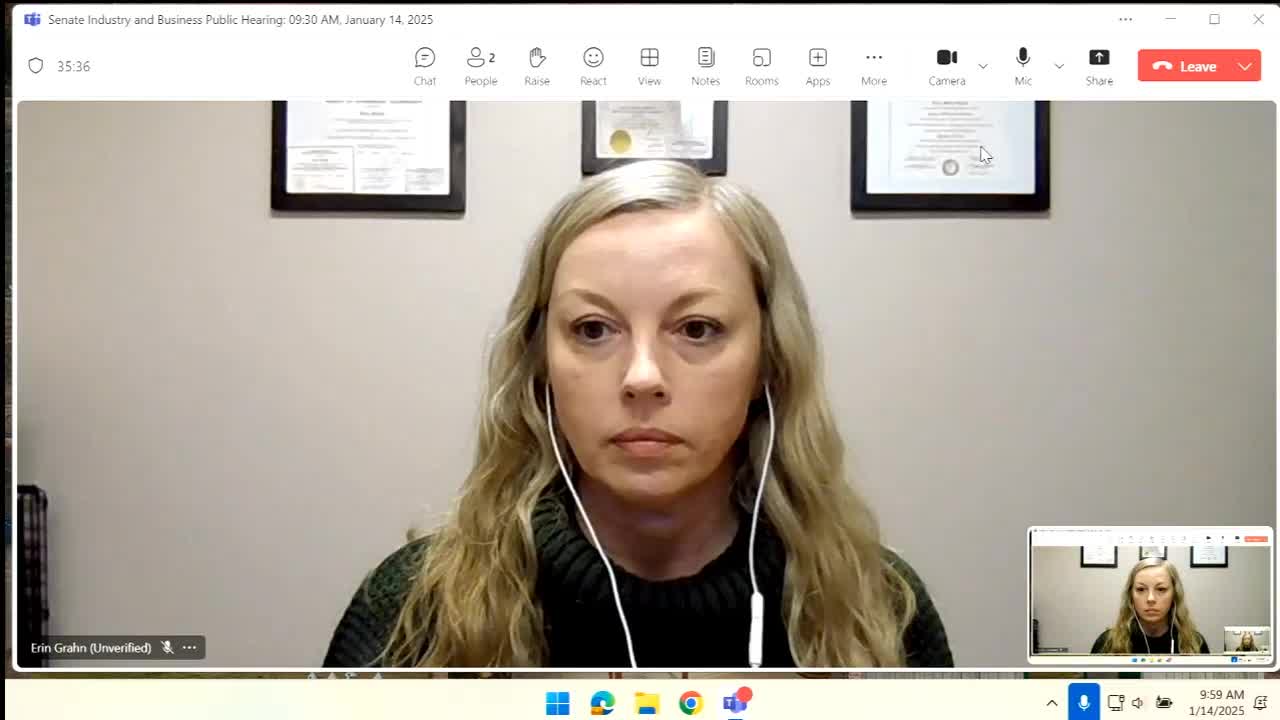
Erin Grond, chair of the North Dakota Board of Counselor Examiners, asked the Senate Industry and Business Committee to approve changes that would allow the board to adopt rules, charge a duplicate certificate fee and a technology fee, and to consider an appropriation to pay startup costs for a cloud‑based licensing system.
Grond testified the board is self‑funded and has historically processed applications with paper records. The proposed technology fee would help pay for a cloud system to receive electronic applications, verify licenses, and provide the two‑way data exchanges required by the Counseling Compact, which Grond said is expected to be operational nationally in coordination with North Dakota in mid‑to‑late 2025.
On fees and costs: Grond said the board had not yet set a duplicate certificate price but discussed a range of $20 to $50 to cover printing and postage. She said vendor quotes for a cloud system’s initial setup ranged from about $54,000 to $65,000; the board requested a $100,000 appropriation to cover initial startup rather than annual maintenance. The board’s approximate reserves were described as about $160,000; Grond said spending reserves to pay startup costs would risk depleting funds held for legal defense and other contingencies.
Assistant Attorney General Matt Mengi told the committee the bill’s proposed rulemaking authority (a new subsection) is central to implementing administrative rules for licensing and technology. Terry Efforts, who assists several mental‑health boards administratively, said vendors can build shared systems and that there are off‑the‑shelf and custom options; one custom option discussed with vendors was estimated around $250,000 for a highly tailored system, while off‑the‑shelf implementations have lower initial costs (roughly $60,000–$100,000) with annual fees.
Committee members asked about consolidation of boards, fee impacts on dual‑licensed professionals, and whether state IT resources could provide a shared solution. Grond said the Counseling Compact requires a two‑way communications capability but does not provide funding for state boards to develop databases; she said the board’s licensing fees are among the lowest in the nation and have not been raised in her six years on the board.
No appropriation was included in the bill as filed; the board said it would provide more precise fiscal figures and that an amendment could add appropriation language if the committee chooses. Committee members requested the legislative management study on a potential universal administrative licensing board be located for further review. The committee did not vote on the bill during the hearing and left the record open for further fiscal and implementation information.
Ending: The committee asked the board to provide written figures for vendor quotes and reserves and encouraged coordination with other mental‑health licensing boards and the state IT directorate when exploring shared systems.