Get Full Government Meeting Transcripts, Videos, & Alerts Forever!
Get email alerts on the Higher Education Funding topic
No spam. Unsubscribe anytime.
Senate committee hears cleanup changes to higher-education funding formula in SB 2034
Summary
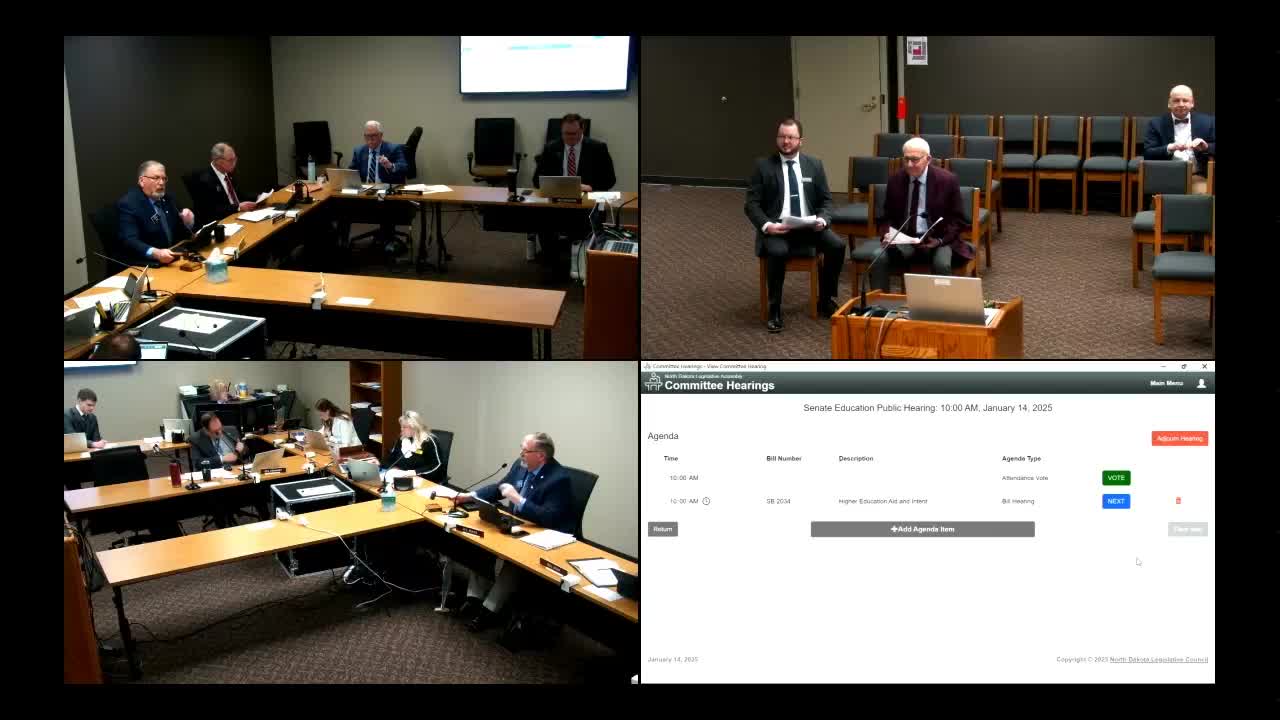
The Senate Education Committee on Monday heard testimony on Senate Bill 2034, a bill that would adjust parts of the state's funding formula for institutions of higher education by clarifying how weighted student credits and institutional size factors are applied and by reclassifying two programs as career and technical education (CTE).
The Senate Education Committee on Monday heard testimony on Senate Bill 2034, a bill that would adjust parts of the state's funding formula for institutions of higher education by clarifying how weighted student credits and institutional size factors are applied and by reclassifying two programs as career and technical education (CTE).
Representative Mark Sanford, who chairs the interim higher education committee, told the panel, "This bill is a bit of a cleanup bill, in terms of some, 2 pieces, 2 components of the funding model or the funding formula." He described the formula as a performance model that pays institutions on weighted credits multiplied by an institutional size factor, and said the bill would prevent growth from being penalized when an institution crosses a size threshold.
The bill addresses two specific situations. First, Sanford and supporting testimony said Dickinson State University has grown and, under the formula as written, could see all of its credits reweighted at a lower size factor when it crosses a threshold. Sanford said the change would preserve the higher weighting on the first tranche of credits and apply the lower factor only to credits above the threshold. Second, witnesses said the bill reclassifies two programs at Lake Region as CTE programs, which carry a higher weighting (CTE credits were described in testimony as weighted at 5.0 under the national classification used in the formula).
Dave Kruzbach, vice chancellor for administrative affairs and chief financial officer at the University System Office, said the university system supports the bill and that Dickinson and Lake Region are the two institutions affected this biennium. "Section 2 transfers the weighted student credit hour, instructional program classification for the wind energy and law enforcement programs to the CTE program, which is a higher credit weighting in the funding formula," Kruzbach said, and he noted the State Board of Higher Education's ad hoc funding formula committee had previously discussed the items.
Leslie Whitstock, vice president for finance and administration at Dickinson State University, provided institution-specific impact numbers during testimony. She said Dickinson's current appropriation for 2023'25 was $23,801,610 and that without the bill the school could see its factor drop such that its next appropriation would be roughly $23,100,000 (a decline of about $681,000). Whitstock said the bill's approach, which keeps the first tranche of credits at the current factor and only applies the lower factor to credits above the threshold, would bring Dickinson's funding closer to $24,700,000 under the example presented.
Alex Kronquist, fiscal analyst with the Legislative Council, told the committee he staffed the interim higher education committee and that members could contact him with questions about fiscal impacts. Committee staff pointed the panel to a fiscal note attached to the bill estimating a biennial cost of about $1,800,000, and the chair noted that any action would require a referral to the Appropriations Committee.
Committee members probed how the transition between size-factor tiers is applied in practice, asking whether institutions could lose funding after growing past a threshold and how biennial calculations and "lock-in" language operate. Committee discussion clarified that the bill's language is intended to preserve the factor for the first tranche of credits at the level an institution received at the referenced period and to apply the lower factor only to credits above that tranche going forward; members asked staff and financial witnesses for more precise breakeven examples.
Senator Baucher moved a due-pass recommendation with referral to the Appropriations Committee; Senator Axman seconded. After detailed questioning and requests for clearer fiscal math, Senator Baucher withdrew the motion and the committee agreed to table the bill to obtain further clarification from financial staff. The chair closed the hearing on SB 2034.
The hearing record contains discussion about the mechanics of the funding formula, specific dollar impacts for Dickinson State University, the reclassification of two Lake Region programs as CTE, and a fiscal note estimating an $1.8 million biennial impact. No formal committee vote on the bill was taken at the hearing; the bill was tabled pending further staff analysis.