Get Full Government Meeting Transcripts, Videos, & Alerts Forever!
Get email alerts on the Industrial Commission Budget topic
No spam. Unsubscribe anytime.
Industrial Commission, Department of Mineral Resources outline $20.25M request, staffing and program needs at budget hearing
Summary
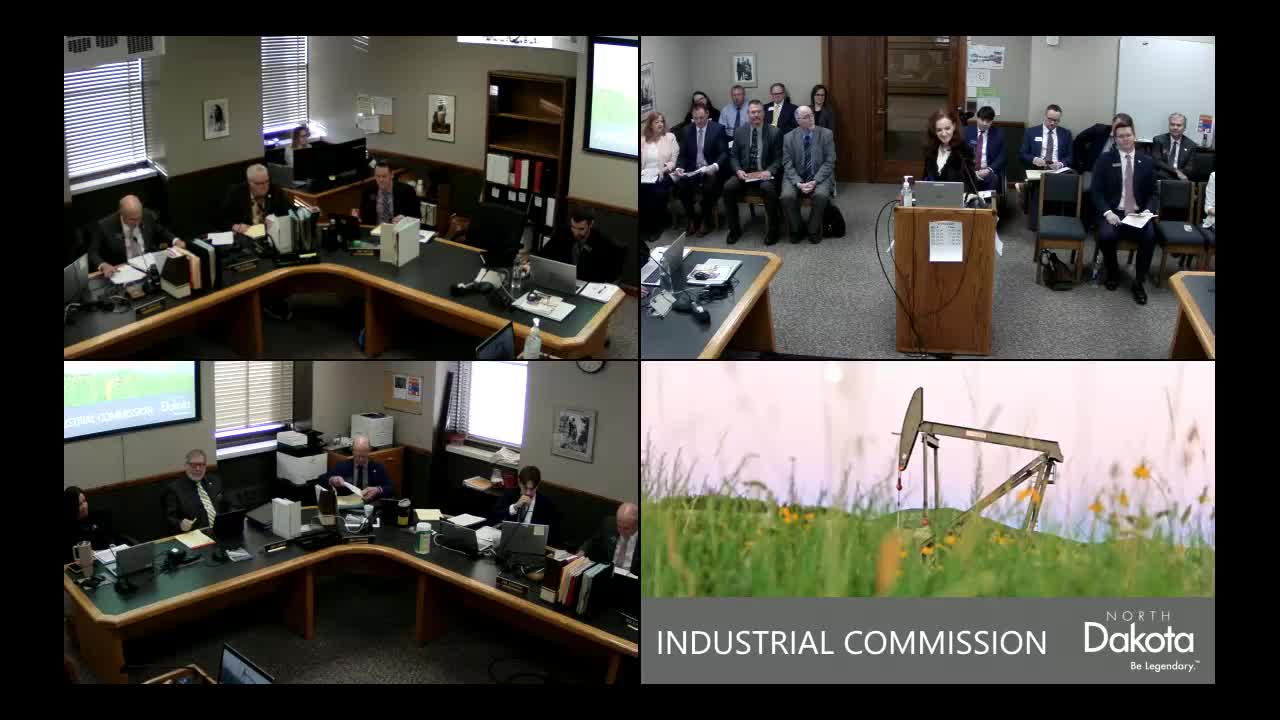
At a legislative budget hearing before the Appropriations - Education and Environment Division, North Dakota Industrial Commission Executive Director Karen Tyler and Department of Mineral Resources Director Nathan Anderson detailed the Industrial Commission Administrative Office’s request for $20,248,083 and outlined related program, grant and staffing needs.
At a legislative budget hearing before the Appropriations - Education and Environment Division, North Dakota Industrial Commission Executive Director Karen Tyler and Department of Mineral Resources Director Nathan Anderson detailed the Industrial Commission Administrative Office’s request for $20,248,083 for the upcoming biennium and described related program and staffing needs.
Tyler told the committee the Administrative Office and the Public Finance Authority are now separated on the budget from the Department of Mineral Resources and that the split was intended to make fiscal, human resources and technology responsibilities clearer. “It is a pleasure for us to appear before you to discuss the appropriation for the Industrial Commission Administrative Office and the agencies and programs that the commission oversees,” Tyler said.
Why it matters: the request covers ongoing operating costs, one-time projects and state matches tied to federal grants; officials said funding will support a new grant-management system, transmission-authority staffing, grid-resiliency grant rounds and ongoing litigation costs tied to lignite matters. Committee members pressed agency leaders for details on recurring costs and program execution.
Grant management system and software costs
Tyler said the commission completed development of a customized grant-management system with vendor support and is seeking $275,000 in ongoing funding to cover maintenance and licensing. The agency reported an estimated ongoing support cost of about $130,000 per year. Brenna Jessen, fiscal manager and project lead for the system, said the $130,000 figure is the solicitation estimate that covers licensing for the office and grantees: “the hundred and 30,000 ongoing per year is for all the licensing for each of our office and for all of the grantees that we have,” Jessen said, and added several vendor bids returned higher ongoing costs.
Transmission authority and grid resiliency
The Industrial Commission serves as the North Dakota Transmission Authority, Tyler said, and requested ongoing funding to convert a previously one-time-funded executive-director position to general-fund support and to cover additional electrical-grid studies. Tyler presented a $600,000 ongoing request for the Transmission Authority executive director contract and related study costs, saying the authority’s workload and demand have increased as grid resiliency and new large electric loads such as data centers grow.
Separately, Tyler requested spending authority to administer a new round of IIJA grid-resiliency grants. She listed a federal component of $11,885,000 and a 15% state match of $1,000,760, which she presented as part of a $13,668,089 spending plan for the next round of grants.
Lignite litigation and other one-time requests
Tyler said the commission seeks at least $3,000,000 in one-time funding for ongoing lignite litigation and rulemaking defense; she told the committee the enterprise has spent on related matters in the current biennium and expects continued legal activity. When asked whether litigation needs would decline under a new federal administration, Tyler said she had discussed the point with the solicitor general and that while some suits may close, new suits could arise if rulemaking is changed.
Department of Mineral Resources priorities: staffing, inspections, permitting and reclamation
Nathan Anderson, director of the Department of Mineral Resources (DMR), said the department is in leadership transition and emphasized succession planning and retention. “It’s important that we attract, develop, retain top tier staff,” Anderson said, describing pending retirements in manager-level roles and a need for overlap and mentoring.
Mark Borer, assistant director of the Oil and Gas Division, outlined permitting and field work. Borer said the division issued about 1,778 drilling permits in 2024 with an average approval time of 44 days (measured from application intake), and that the agency seeks an optional permitting technician to keep rig activity from being delayed. He told the committee the division tries to keep an inventory of roughly 12 months of permitted locations ahead of rigs and that “we will not let a rig set idle” if permitting can be expedited.
Borer also described underground injection control (UIC) permitting (saltwater disposal and enhanced recovery wells), noting 53 UIC permits in 2024 and an average permit time of about 101 days. He outlined requests for three additional reclamation inspectors to staff district offices and suggested those inspectors could help with inspections in slower winter months.
Ed Murphy, director of the North Dakota Geological Survey, summarized mapping and research work including a statewide landslide-mapping effort and a multi-year critical-minerals drilling program. He said the survey has identified thousands of active landslides and has been expanding geologic reviews for infrastructure projects. Murphy and others described a phase-two drilling and sample-analysis plan tied to an earlier $500,000 drilling pilot.
Budget mechanics, fee revenue and audit
Robin Loomer, the DMR finance manager, reviewed fee revenue, audit results and carryover. She said the recent audit covering a three-year period had no findings. Tyler and Loomer said application fees for the commission’s grant programs are currently $100 per application and produce a relatively small amount of revenue (about $4,600 per biennium); the agencies deposit those fees back into the related grant programs.
Process and next steps
Multiple senators asked for prioritization of optional positions and for more detail on recurring software costs and grant match obligations. Senator Thomas questioned the size of ongoing software licensing costs; Brenna Jessen and Tyler said the estimate came from vendor solicitations and that a range of bids was received, with some higher than the estimate. The committees indicated further review and follow-up hearings: the division’s chairman named Senator Schaible as the legislative lead for many follow-up questions and the hearing was recessed until the afternoon to continue consideration of remaining budget items.
Ending
Agency leaders left the committee with detailed written testimony and schedules of projects, positions and one-time requests. The Appropriations - Education and Environment Division will continue to consider these requests as the session’s budget bills are formed and amended.