Get Full Government Meeting Transcripts, Videos, & Alerts Forever!
Get email alerts on the Highway Patrol Budget Sb2011 topic
No spam. Unsubscribe anytime.
North Dakota Highway Patrol outlines $91.8M executive budget, seeks equipment and staffing restorations
Summary
Colonel Daniel Haugen told the Senate Appropriations Government Operations Division the Highway Patrol's 2025–27 executive recommendation totals about $91.8 million and described requests for trooper funding, fleet and equipment, body armor and TASER replacement, FLIR maintenance and other items tied to public-safety operations.
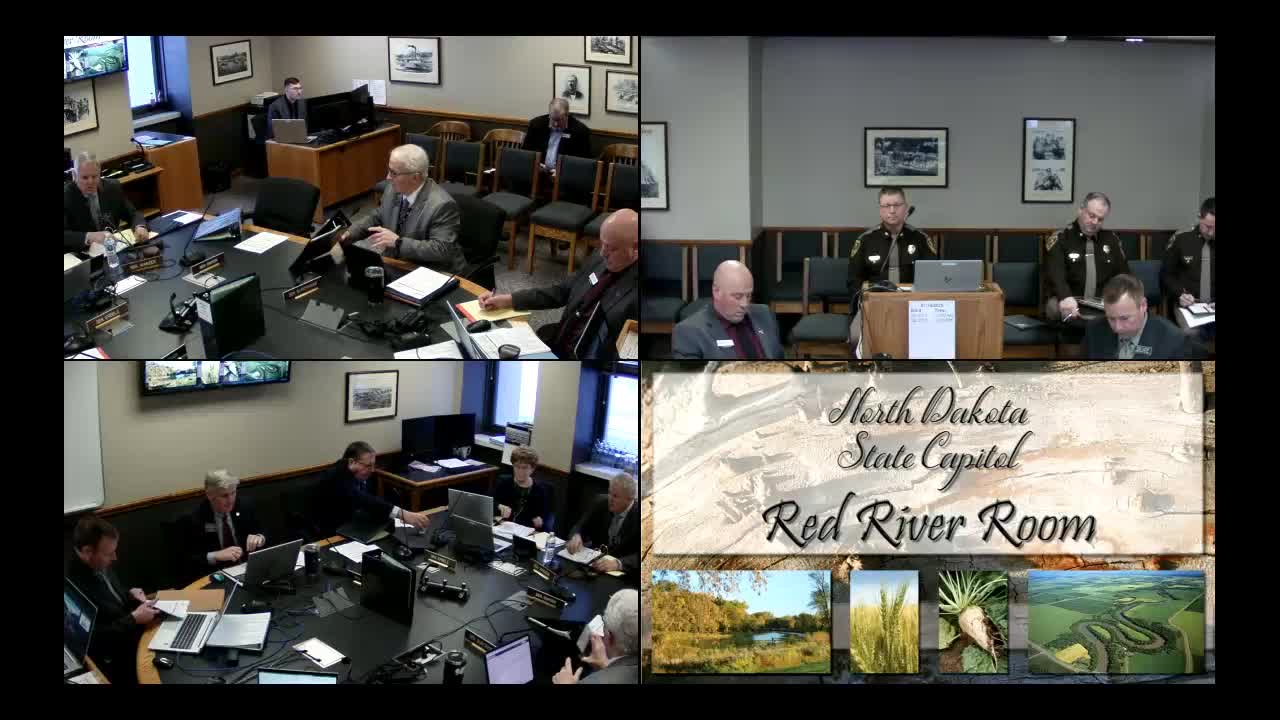
Colonel Daniel Haugen, superintendent of the North Dakota Highway Patrol, presented the agency's budget and program priorities to the Senate Appropriations Government Operations Division during a public hearing, saying the executive recommendation for the 2025–27 biennium is roughly $91.8 million compared with a $71.1 million appropriation for the current biennium.
The Highway Patrol emphasized continuing traffic-safety enforcement and expanded public-safety roles, citing speeding, unbelted drivers and impaired driving as the three primary contributors to serious injury and fatal crashes. “If we could eliminate those three violations, a lot of lives would be saved,” Haugen said, summarizing the agency’s core public-safety focus.
Why it matters: the agency’s budget request covers operational needs (salaries, motor pool, equipment), technology and training that affect statewide emergency response, crash reconstruction, interdiction of illicit narcotics and highway safety. Several requests also respond to higher equipment and fleet costs and to a projected funding shortfall in the Highway Patrol retirement fund.
Key figures and requests
- Executive recommendation and current appropriation: Haugen described the executive recommendation for 2025–27 as about $91.8 million; the current 2023–25 appropriation after adjustments was described as $71.1 million. - Staffing and vacancies: the Highway Patrol reported 171 sworn troopers and 34 civilian staff; the agency filled 12 trooper positions added by the 68th Assembly and reported six sworn and one civilian vacancy on the December 1, 2024 legislative report. The agency said it planned another trooper class in May 2025. - Budget decision-package highlights: restoration funding equivalent to five troopers ($4,687,343 total, with $4.3 million general fund and $300,000 special funds) was included in the executive recommendation; a $874,000 cost-to-continue request for the second year of a legislatively funded pay increase; $184,000 ongoing for body armor; and a sizable motor-pool increase driven by updated per-mile and per-vehicle guidance. - One-time and technology asks: $870,000 one-time from the electronic motor carrier permit fund to replace legacy conducted energy weapons with 162 TASER 10 units (agency indicated the new devices cost more than $5,000 apiece); a $210,000 ongoing request for in-car router network services to improve bodycamera uploads and future live streaming; funding requests for FLIR maintenance for the aircraft-mounted infrared system (service life estimated through about 2029); and $150,000–$300,000 requests for range and driving-pad resurfacing and ventilation improvements.
Accomplishments and operational details
Haugen summarized recent work: expansion of the criminal interdiction team from five to nine members along US Highway 2, Interstate 94 and Interstate 29; the troopers’ reconstruction of 241 serious-injury or fatal crashes and filing of 142 criminal charges in the most recent biennium; 46 and 59 searches by bloodhound trailing teams in 2023 and 2024, respectively; and aircraft callouts (37 in 2023, 35 in 2024) that aided missing-person searches, fugitive operations and wildfire mapping using FLIR.
Grants and federal funding
The Highway Patrol listed several federal and pass-through funding sources: Motor Carrier Safety Assistance Program (MCSAP) funding that covers 23 sworn positions; Victims of Crime Act (VOCA) pass-through funding for crash-assistant positions; a U.S. Department of Justice Bureau of Justice Assistance award for a body-camera program (including $500,000 for in-car router purchases and carryover authority through September 2026); and $5.7 million in State Fiscal Recovery Funds (about $5.4 million spent/obligated, with roughly $309,740 identified for transfer to the Department of Corrections and Rehabilitation).
Retirement funding concern
Haugen flagged Senate Bill 2120, the Highway Patrol Retirement System bill being considered in committee, which the agency said would increase required funding liability and carries a $35.7 million budgetary impact in the presentation. He described the patrol’s PERS fund as having a funded ratio near 70% and projected to decline over decades absent changes; the agency and the bill’s sponsors were discussing options, including a possible one-time infusion.
Policy, equipment and training proposals
The presentation included requests to: move some previously permit-funded items (body armor) to the general fund for better tracking; fund continued operation of the Blackboard learning-management system at the Law Enforcement Training Academy (which the agency says served about 1,400 officers from 92 agencies in 2024); replace aging preliminary breath testing equipment; complete TASER replacement; finance in-car routers and related NDIT fees; and support FLIR maintenance and aircraft operations.
Questions and committee discussion
Senators asked about fleet and motor-pool assumptions, pilot availability and statewide coverage, use of drones versus aircraft, K-9 and bloodhound teams, recruiting and retirement-age trends, and tools for detecting nonalcohol impairment (drug recognition experts, standardized field sobriety tests and the limits of current preliminary testing). Haugen repeatedly described staffing challenges and said the agency was using recruitment incentives, accelerated training for experienced officers and memorandums of understanding with some tribal nations while pursuing agreements with others.
What the agency asked the committee to do
Haugen closed by asking for support of the executive recommendation and the included decision packages, and he told committee members the agency would return with updates after the governor’s budget address. “As superintendent … we ask for your support in allowing us to serve the public,” he said.
Ending
The committee heard additional clarifying questions without taking formal action during the hearing and closed the hearing on the Highway Patrol budget after the presentation and discussion.