Get Full Government Meeting Transcripts, Videos, & Alerts Forever!
Get email alerts on the Medicaid topic
No spam. Unsubscribe anytime.
Division of Medical Services outlines Medicaid enrollment, costs, staffing rules and drug pressures
Summary
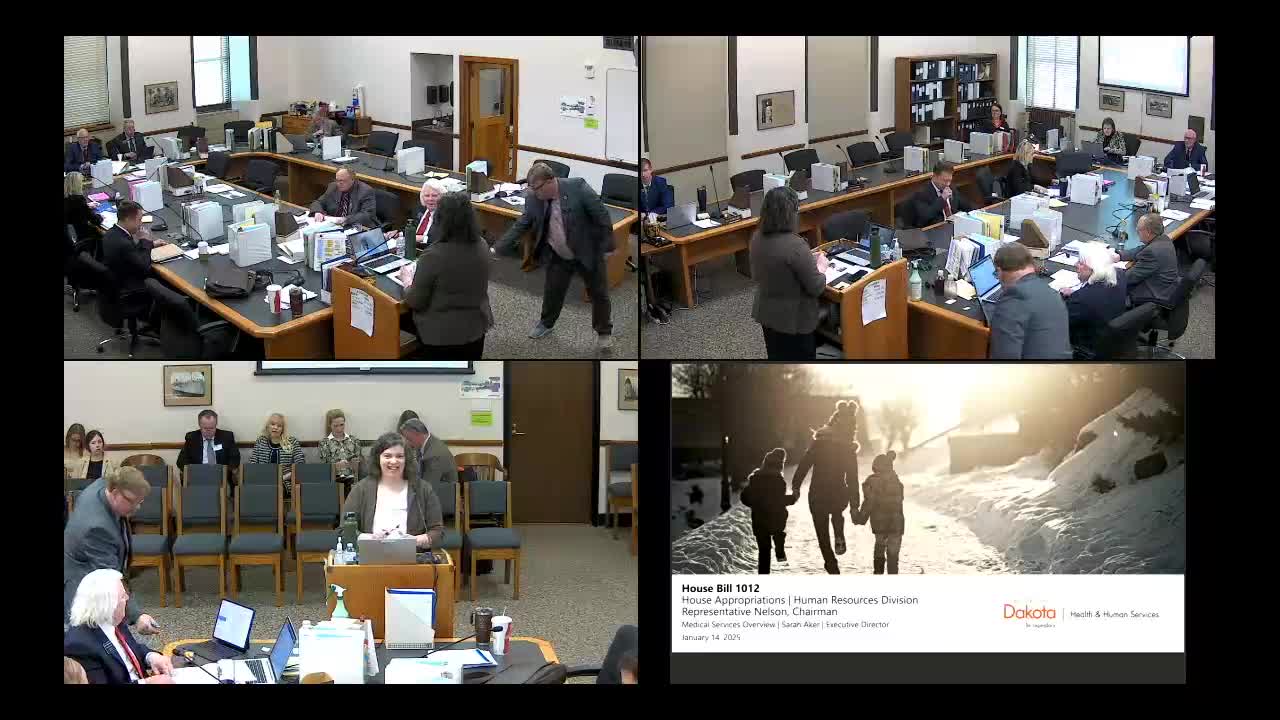
Sarah Acre, executive director of the Division of Medical Services at the North Dakota Department of Health and Human Services, told the Appropriations - Human Resources Division committee that Medicaid covers roughly one in seven North Dakotans and that federal rule changes, nursing-facility staffing mandates and high-cost drugs are driving budget pressures.
Division of Medical Services executive director Sarah Acre told the Appropriations - Human Resources Division committee that Medicaid provides coverage to roughly one in seven North Dakotans and that recent federal rule changes, high-cost prescription drugs and nursing-facility staffing requirements are major budget drivers.
Acre opened her presentation by noting the agency’s strategic goal: "we really like to have strategy drive our agency." She described Medicaid as "a healthcare coverage program" that in state fiscal year 2024 covered more than 150,000 unduplicated individuals and averaged about 112,000 enrollees per month, with children making up 46 percent of enrollees and expansion adults 25 percent.
Why it matters: Medicaid is one of the largest state-funded programs and pays for more than half of nursing facility residents. Acre told the committee that the program’s mix of enrollment and rising acuity — more enrollees with chronic and behavioral-health conditions — plus federal mandates and pharmacy costs, are increasing pressure on the state budget.
Acre reviewed program scope and rules. She said North Dakota operates both Medicaid and CHIP (as a Medicaid look-alike), maintains a state Medicaid plan and multiple 1915(c) Home-and-Community-Based Services (HCBS) waivers, and runs PACE (Programs of All‑Inclusive Care for the Elderly) in Minot, Bismarck, Dickinson and Fargo. She noted that waivers use both financial and functional eligibility, and that only an individual’s income is counted for waiver eligibility in many child waiver cases.
Enrollment and unwinding: Acre summarized the federal continuous-coverage period imposed during the pandemic and the subsequent "unwinding" of that policy. She said North Dakota’s enrollment peaked at roughly 37,684 eligible individuals during the COVID-era continuous coverage period and has since declined and stabilized in the low‑to‑mid 500,000s in recent months. She told members the state budget had been adjusted downward after unwinding because expansion caseloads were smaller than budgeted; she described unspent appropriations as returning to the state general fund.
Claims processing and program integrity: The division reported about 24,000 enrolled providers and processed roughly 7 million claims last year, with an average of seven days from receipt to payment for claims overall. Acre said paper claims increased after a February cyberattack on Change Healthcare and add processing time: "paper claims are a longer time frame." She described program-integrity work — post-payment reviews, audits and fraud investigations — and said the division opened 49 fraud/waste/abuse cases in 2024, made six referrals to the Medicaid Fraud Control Unit and terminated or otherwise removed 16 providers from participation.
Federal rules and staffing: Acre highlighted sweeping 2024 federal regulatory changes that the division must implement, including interoperability and new HCBS reporting, member engagement and rate-transparency rules. She said new minimum nursing‑facility staffing rules from the federal government will raise costs and pose workforce challenges: the rule, as implemented, does not allow LPN hours to count toward required RN hours, which "requires more RNs to be employed by nursing facilities," she said. Acre said North Dakota joined other states in litigation challenging parts of the staffing rule and said federal hardship waivers have been discussed but were not yet defined.
Managed care and Medicaid expansion: The state’s Medicaid expansion population is covered through a risk-based managed-care contract with Blue Cross Blue Shield of North Dakota. Acre said the 2025 capitation rates rose 9.1 percent because of acuity changes and other trends, and that the division uses a medical-loss-ratio (MLR) and a performance withhold (2 percent) to limit excessive health-plan profits and encourage quality. For 2023, Blue Cross earned back roughly 22.93 percent of its withhold under the contract’s quality incentives.
Value-based purchasing and quality: The division has launched value-based purchasing pilots for large health systems and for nursing facilities. Acre said hospitals are currently in a "pay for reporting" period and will move to pay for performance in 2025–26. For nursing facilities the state distributed $4,000,000 as incentive payments; 58 of 75 facilities received an incentive. She said some child- and adolescent preventive metrics (for example, adolescent immunizations) ranked highly for the state, while other measures including well-child visits in early life and dental evaluations for children lagged national medians.
Pharmacy costs: Acre said pharmacy is a major and growing cost driver. She said roughly a third of Medicaid spending is for prescription drugs and that an increasing share of pharmacy dollars is concentrated in very-high-cost prescriptions: today nearly 60 percent of pharmacy dollars is spent on prescriptions costing more than $1,000 per claim. She gave examples of expensive, rare‑disease medications the program paid for, including treatments described to the committee for Rett syndrome and short‑bowel conditions.
Tribal care coordination and payments: Acre described a tribal care coordination mechanism that captures higher federal matching funds when eligible services are provided at certain facilities; she said tribes receive 80 percent of the additional funds under the current arrangement and that the state was issuing its first payments under the program. Acre said initial barriers to tribal participation included the need for tribal resolutions and extra documentation by providers.
IT and systems: The division described ongoing MMIS (Medicaid Management Information System) needs. Acre said prior system certification allows a 90/10 enhanced federal match for implementation and then a 75/25 operations match; she said the division expects substantial IT costs for upgrades and to meet interoperability requirements.
Budget context and requests: Acre said the division’s base request includes funding for salary and some conversions of temporary positions to FTE, additional pharmacist staff and IT increases (the presentation cited $650,000 for MIS maintenance, enhancements and interoperability requirements). She also called out a roughly $710,000 increase associated with Medicare Part D/Part B payment interactions ("clawback") and said many requested vendor and provider contract increases reflect inflationary pressure. Acre said some budget decreases reflect right‑sizing expansion caseload estimates after unwinding.
Committee follow-ups: Members asked for details Acre said the division will provide, including the total value of pharmacy rebates, the value‑based program pool sizes, and more granular utilization and enrollment numbers. Committee members requested publishing performance results once the state transitions to pay‑for‑performance.
No formal decision or vote on policy was taken during the presentation; the session moved to additional detail and follow-up requests.
Ending: Acre told the committee she will return with detailed slides and data requested by members. The division emphasized multiple near‑term priorities: implement federal requirements, modernize IT, manage high drug costs, address workforce and long‑term‑care needs and continue value‑based payment pilots. "If I can leave you with anything," Acre said, "our goals are bending the cost curve, delivering whole-person care, promoting sustainability and improving the member and provider experience."