Get Full Government Meeting Transcripts, Videos, & Alerts Forever!
Get email alerts on the Mill And Elevator Budget topic
No spam. Unsubscribe anytime.
North Dakota Mill and Elevator requests budget boosts to expand capacity, urges keeping General Fund transfer at 50%
Summary
The North Dakota Mill and Elevator told the Appropriations - Education and Environment Division it seeks additional operating and capital funding to support added milling capacity, while asking lawmakers not to raise the portion of profits transferred to the General Fund above the current policy of returning 50% of remaining profits.
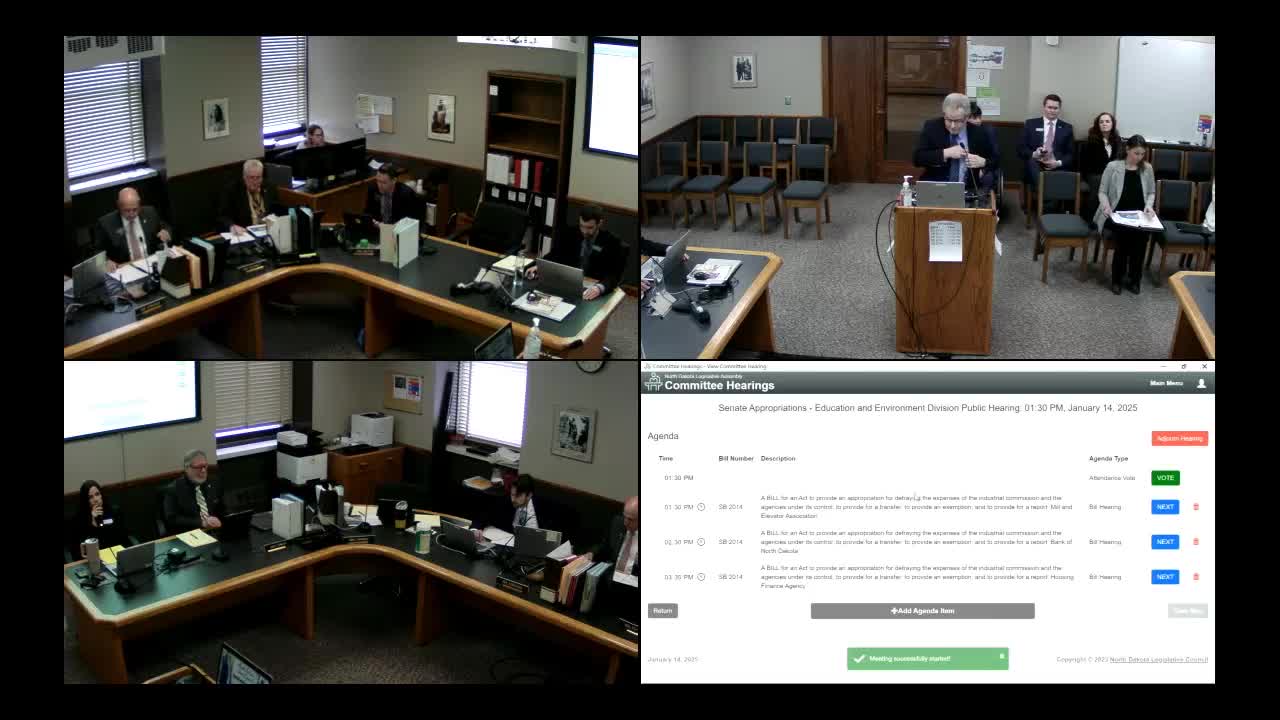
Vance Taylor, president and CEO of the North Dakota Mill and Elevator, told the Appropriations - Education and Environment Division on Jan. 15, 2025, that the state-owned milling complex is seeking additional operating and capital flexibility to support planned capacity increases and to complete a $56,000,000 mid‑storage and handling (MIDS) project scheduled for March 2025.
Taylor said the mill returned record profits of “over $20,000,000” in fiscal 2024, transferred about $9,800,000 to the General Fund and just over $1,000,000 to the Ag Products Utilization Fund (APUF), and expects sales and production targets of roughly 19,500,000 hundredweights in future years. “We currently transfer 5% of our profits to the Ag Products Utilization Fund, and 50% of the remaining profits to the General Fund,” Taylor said.
The mill, located in Grand Forks, described itself as the largest single‑site wheat flour mill in the state and among the largest in the United States. Taylor and Kathy Dube, the mill’s chief financial officer, outlined production and financial metrics: the complex operates multiple milling units, ships predominantly bulk flour, processed roughly 130,000 bushels per day of spring and durum wheat, and reported record purchases of roughly 37.2 million bushels in fiscal 2024, tracking toward about 40,000,000 bushels for the current year.
Dube, presenting budget details, said the mill’s salary and wage appropriation request for the 2025–27 biennium is about $61,960,000 — “requesting the total amount of the FTE funding pool that was removed from the 23,25 biennium” — and that operating expenses for the biennium are being requested at about $45,000,000 (a 6.3% increase from the 2023–25 biennium). She also described a change package that would add two additional FTEs (car‑checker positions) and restore FTE funding pool amounts removed in the prior biennium. “The 2 additional FTEs are for car checker positions... to bring both the 2nd shift car checking crew and the 3rd shift car checking crew to 5 employees,” Dube said.
Taylor gave a debt breakdown: total debt of about $108,000,000 composed of roughly $47,000,000 on the operating line, $23,000,000 on a term loan and $38,000,000 on construction financing for the MIDS project. The mill said it has invested about $115,000,000 in capital projects over the last six fiscal years and has another ~$37,900,000 in projects underway.
Committee members questioned assumptions used for wage projections (the mill used a 4% annual wage increase estimate for contract negotiations beginning in June 2025), the timing of hiring additional shifts, and the requested increases in specific operating lines such as “operating fees and services,” which the mill said reflects higher fumigation and heat‑treatment costs. Taylor and Dube noted market and regulatory headwinds — elevated interest rates, inflationary pressure on input costs, volatile grain markets and evolving food‑safety rules — as ongoing challenges.
Taylor asked the committee to maintain a 50% General Fund transfer of remaining profits (instead of raising the transfer rate), arguing that higher statutory transfers would “hinder growth and put pressure on cash flow.” Committee leadership said they would assign a committee lead (Senator Scheible) to follow up on the mill’s budget and that the mill might be asked back for additional hearings or virtual follow up.
The mill presentation included production, staffing and capital plans but did not result in any formal committee vote during the hearing. Lawmakers signaled further review would continue in follow‑up budget work sessions.
Ending: The committee accepted the mill’s presentation for further review, assigned lead follow‑up responsibility and indicated more detailed budget work and negotiation would continue in subsequent meetings.