Get Full Government Meeting Transcripts, Videos, & Alerts Forever!
Get email alerts on the Road Safety topic
No spam. Unsubscribe anytime.
DOT officials highlight Vision 0 progress, discretionary grant awards and fleet costs
Summary
Deputies for safety, planning and engineering described reductions in fatalities, a large pipeline of federal discretionary grants, work zone crash data and state fleet size and costs during the appropriations hearing.
Deputy directors from the North Dakota Department of Transportation described the agency's safety programs, discretionary-grant successes and fleet operations for the Senate Appropriations - Government Operations Division.
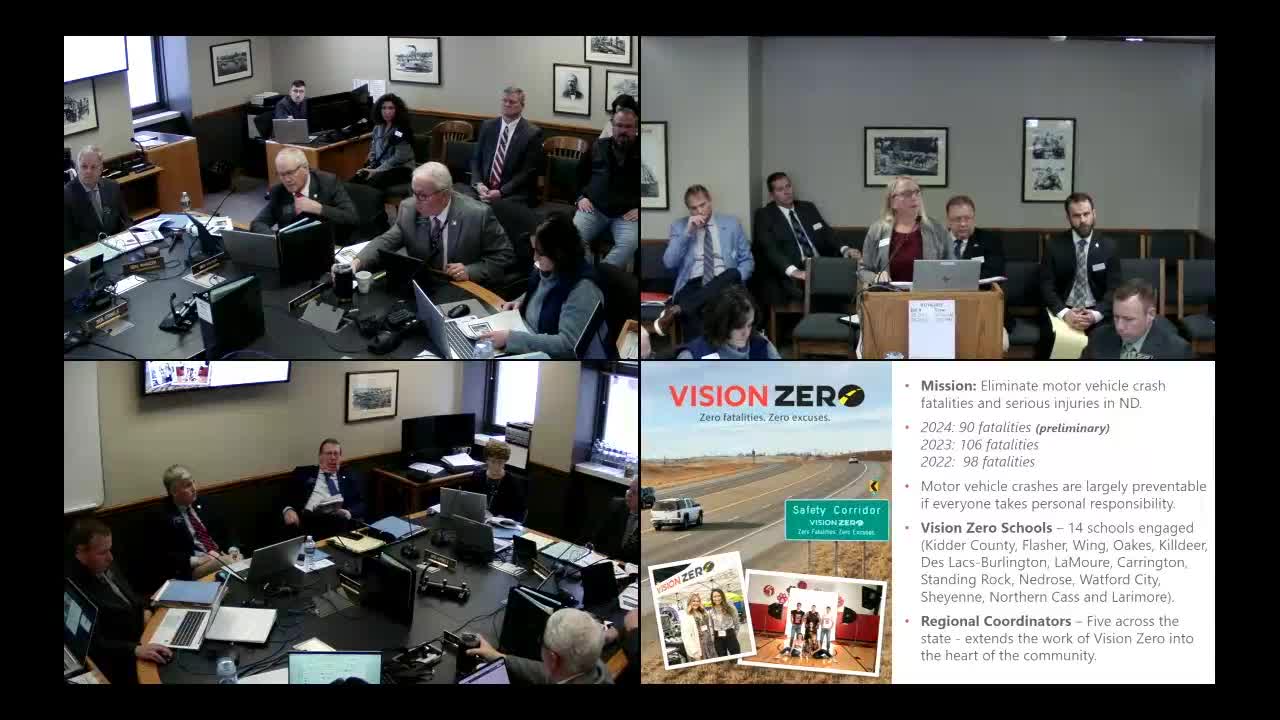
Robin Reberg, Deputy Director for Driver Safety, said preliminary data show 90 traffic fatalities in 2024, down from 106 in 2023, and credited continued Vision 0 efforts for part of the improvement. "Our preliminary data shows that we had 90 fatalities in 2024... 16 less over 2023," Reberg said. She added that lane departures accounted for 69% of fatalities in the preliminary figures and that 50% of lane-departure fatalities occur on local roads.
Deputy Director Ron Hanke and Chad Orrin described the department's grant activity and discretionary awards. Hanke said the DOT had received about $236,000,000 in discretionary funding this biennium and had applied for roughly $800,000,000; some awards are 50/50 match programs while others require no match. Hanke detailed examples including a $500,000 video oversized-vehicle detection grant and a $24.5 million award for two 10-mile pavement stretches of I-94 east of Bismarck.
On fleet and maintenance, Reberg and Matt Lineman (Deputy Director for Engineering) said the state fleet includes roughly 35,100 vehicles and about 351 snowplow trucks; annual snow-and-ice operations cost roughly $27,000,000. Lineman said the department tracks snowplow incidents and reported five snowplow collisions so far this winter, down from 24 during a harsher season. He discussed investments in equipment, tethered drones for inspections, and expanded use of data and pavement test sections to evaluate low-carbon materials.
Committee members asked about work-zone safety, the composition of consultant teams that assist with grant writing and design, and the state's strategy for rising construction costs. DOT deputies said they are modifying project scopes when needed, using consultant capacity for specialized work and pursuing federal and state matching funds. No formal committee action occurred during the testimony.