Get Full Government Meeting Transcripts, Videos, & Alerts Forever!
Get email alerts on the Disability Access topic
No spam. Unsubscribe anytime.
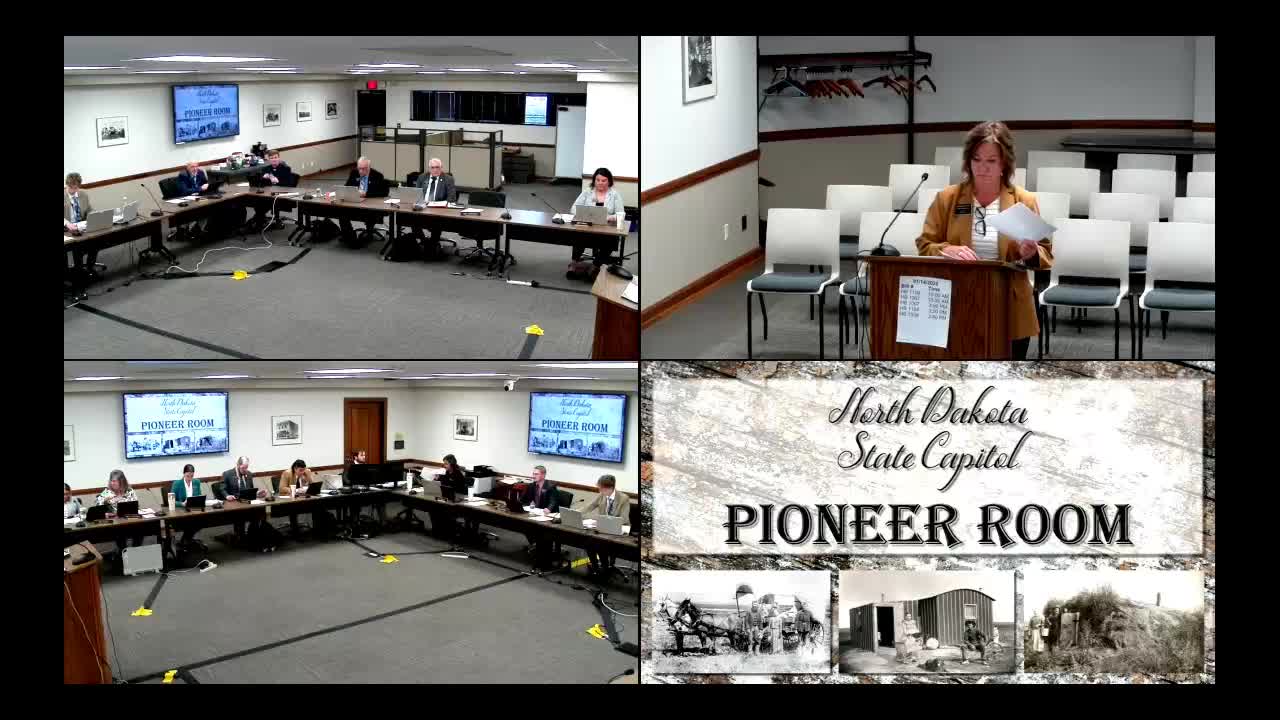
Rep. Kathy Fralick asks committee to study statewide communication access for people with hearing loss
Summary
Representative Kathy Fralick urged the House Human Services Committee to advance House Bill 10‑97, a one‑section interim-study bill to identify gaps and low‑cost technology solutions that would improve access for North Dakotans who are deaf, hard of hearing or have other hearing differences.
Representative Kathy Fralick, R‑District 15, asked the House Human Services Committee to give House Bill 10 97 a "due pass" recommendation and to commission an interim legislative study on communication access for people with hearing loss.
Fralick told the committee the bill is a single‑section study request intended to identify practical, low‑cost ways state and local agencies, businesses and nonprofits can provide effective communication for people who are deaf, hard of hearing or who have other hearing differences. "This bill is born of my own frustration," she said, adding her regular employment is with the North Dakota School for the Deaf in Devil's Lake and that she personally will not financially benefit from the bill.
The bill would convene a stakeholder group including people with lived experience, interpreters, education staff and IT professionals to catalog barriers and possible fixes. Fralick defined three groups she wants the study to consider: people who are deaf and use American Sign Language as their primary language; people who are hard of hearing who rely on hearing aids or assistive devices; and people with other hearing differences, including those who use cochlear implants or home signs.
Fralick outlined common failure points she said the study should examine: a rural transit rider who cannot call for a ride; a benefits applicant told the agency will call to complete an application but who lacks access to video relay services; and an older resident who cannot hear a county commission meeting. She noted federal law — the Americans with Disabilities Act (ADA) title II and title III — already requires effective communication but said state practice and technology use could be improved.
Fralick described available technologies and services the study should review, including video relay and video remote interpretation (VRI), speech‑to‑text and live captioning, text‑to‑pop‑up messaging and modern smartphone dictation or captioning apps. She described TTY (teletypewriter) as a largely obsolete technology that still appears on brochures, and she said North Dakota currently has a limited pool of fully licensed sign language interpreters. "We only have 20 ASL interpreters in the state," Fralick said, adding that nearby Minnesota has far more.
Committee members asked for technical clarifications. Representative Anderson asked Fralick to explain how TTY differs from VRI and video relay services; Fralick explained that modern video relay services use a remote on‑camera interpreter to voice calls for the hearing party and that agencies could install in‑office video phone service for in‑person applicants. Representative Rohrer asked about EIPA certification and interpreter pay; Fralick explained EIPA (Educational Interpreter Performance Assessment) applies to school interpreters and said there are distinct registries and licensing pathways for working interpreters.
Fralick told members she had discussed the proposal with the state Department of Labor and Human Rights and with the state IT chief, whom she said agreed to participate in a study. She also suggested parent and family groups such as Hands & Voices and staff from the North Dakota School for the Deaf would be stakeholders.
The committee took no formal action during the hearing and closed the record after receiving no testimony in opposition.
Fralick concluded her remarks by saying the study may identify fixes that do not require a substantive state fiscal note and that North Dakota already has federal ADA obligations that the state can better meet through improved processes and technology.