Get Full Government Meeting Transcripts, Videos, & Alerts Forever!
Get email alerts on the Zoning Ordinance topic
No spam. Unsubscribe anytime.
Birmingham leaders outline scope, timeline for citywide zoning ordinance update
Summary
City planners and the joint planning board and city commission reviewed the scope of work and consultant selection process for a citywide zoning ordinance update tied to the 2040 plan. Staff emphasized public engagement, a seven-step consultant workplan and that the update is a major revision—not an automatic rezoning of properties.
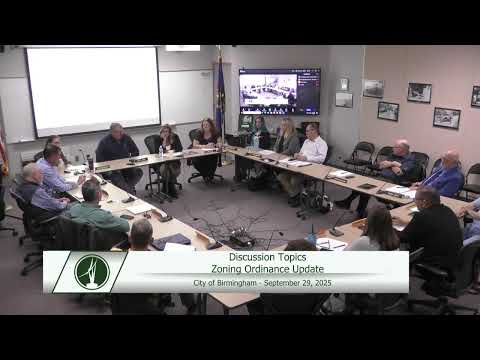
BIRMINGHAM, Ala. — City planners and members of the Birmingham City Commission and Planning Board reviewed the scope of a citywide zoning ordinance update and the consultant selection process during a joint meeting on Sept. 29 at the Department of Public Works.
Leah, a city planner, told the boards the project is funded in this year’s budget and is the second of two required joint meetings per year under the ordinance. She said the city opened a request for proposals on Sept. 2 and that the RFP will close the day after the meeting. "This is not throwing out the entire zoning ordinance and putting high rises everywhere in the city," Leah said, adding that the update will be a major revision based on the existing code and the 2040 plan.
The meeting focused on a seven-step scope of work staff refined for the RFP: (1) kickoff and scope refinement with the consultant, (2) public engagement and stakeholder involvement, (3) a diagnostic report identifying deficiencies and best practices, (4) drafting a revised zoning ordinance, (5) updating the official zoning map as needed, (6) revising administrative and procedural elements (applications, permitting, timelines) and (7) preparing a final draft and supporting materials for adoption and public hearings.
Why it matters: Commissioners and planning board members said a clearer, more usable ordinance should reduce confusion for residents, speed routine approvals and reduce staff time answering questions. Several speakers stressed the need to keep the public informed and to make the final product easy to use and understand.
Planning Board Chair Scott Klein praised staff for the RFP and presentation. "Staff did an excellent job pulling this together," Klein said. Multiple planning board members urged strong, early public education so neighbors understand basic zoning terms, how site-plan reviews work and how the ordinance interacts with approvals.
Robin Boyle, a planning board member, said public engagement should explain that if a site plan meets the ordinance’s standards, the board generally must approve it. "This is their opportunity to think about and to have input on the broader context of what the community and the various zoning categories will look like," Boyle said.
Janelle Wilco Boyce, also on the planning board, urged simple, plain-language outreach materials and a glossary so residents know what terms such as "R‑1" or "lot coverage" mean before formal hearings.
Ryan Williams, a planning board member who spoke repeatedly during the discussion, described the update as a more comprehensive effort than past piecemeal plans and said the work will require careful attention. "This effort, by contrast, for the first time in decades, is comprehensive," Williams said.
Commissioners emphasized two priorities: ease of use and timeliness. Commissioner Emery said the city is fortunate to have an experienced planning board and urged the commission to take the board’s recommendations seriously. Commissioner Long urged transparency at every step because the public will watch the process closely.
On consultant selection, staff and planning board members said the planning board will review proposals, score them and likely narrow the field to two or three finalists for the commission to consider. Staff noted the procurement threshold for this work exceeds $75,000, and planning board members discussed forming an internal subcommittee to review submissions and conduct initial interviews. Final interviews and the contract award would come before the full commission.
Speakers also discussed ancillary topics the consultant will review, including overlays, graphic illustrations and the relationship of the zoning ordinance to the city’s 2040 plan and prior area plans such as the Triangle Plan (adopted in the 2000s). One planning board member suggested asking prospective consultants how they plan to use artificial intelligence tools for research and drafting and to disclose any use of AI.
Next steps: the RFP closed the day after the meeting, after which planning staff and the planning board will evaluate proposals and recommend a consultant to the commission. Staff said the consultant will produce interim deliverables, including a diagnostic report and draft ordinance, and will assist through public hearings and final adoption. The group discussed regular check-ins; several members suggested quarterly updates or stage‑gate reports tied to interim deliverables.
There were no formal land-use votes or changes taken at the meeting. The commission adjourned after the discussion.