Get Full Government Meeting Transcripts, Videos, & Alerts Forever!
Get email alerts on the Student Services topic
No spam. Unsubscribe anytime.
Snoqualmie Valley student services outlines preschool expansion, special‑education changes and mental‑health screening gains
Summary
District student services presented a districtwide update Jan. 9 that summarized preschool inclusion work, early‑literacy training, MTSS and referral process changes, homelessness and McKinney‑Vento spending, suicide‑prevention protocol revisions and a successful SBIRT screening push for 7th–8th graders.
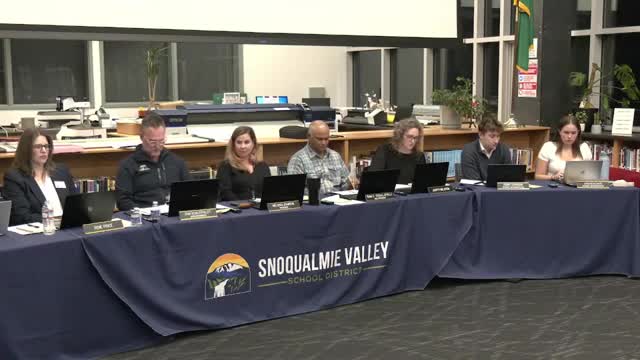
Snoqualmie Valley School District student services leaders on Jan. 9 told the Board of Directors they are expanding preschool services and early‑literacy training, strengthening the district’s referral and MTSS systems, and stepping up mental‑health screening and suicide‑prevention work.
The update, delivered by Executive Director Kim Mackie and program leads, summarized multiple initiatives the department said support the district strategic plan: a Preschool Inclusion Champion grant, preschool‑adapted LETRS training for early‑literacy, a Pathways to Excellence focus on high‑school transition planning, increased use of data in MTSS referrals, outreach for students experiencing homelessness under McKinney‑Vento, a county‑funded SBIRT screening pilot for middle schoolers, and a draft, districtwide suicide‑prevention protocol.
Why it matters: the presentation highlights services that influence students’ day‑to‑day access to general‑education classrooms, special‑education placement decisions, and post‑secondary planning. Leaders said several efforts address compliance and equity requirements (OSPI disproportionality reporting) while also producing immediate interventions — for example through SBIRT and McKinney‑Vento funds.
Mackie opened the presentation by saying student services supports district goals even when work is not directly in classrooms: “we definitely play a part and support the schools in implementing their school improvement plans and then the overall strategic plan,” she said. Program leads then described more than a half dozen initiatives and related data points.
Preschool and early literacy: the district is in its second year of a Preschool Inclusion Champion grant (about $5,000 in each of the two years) used for professional development, materials and to expand “supported preschool” (a push‑in model that replaces a previous pull‑out program). Kelsey Carr presented the early‑literacy and language work: district staff are bringing an early‑childhood version of LETRS to preschool teachers and specialists, and implementing a critical‑data matrix so children who need early intervention are identified consistently across settings. Mackie reported the district currently serves about 90 preschoolers (ages 3–5) with a transition‑to‑kindergarten class of 14; she said enrollment can vary during the year and projected the preschool population could reach about 120 by year‑end. The main preschool site is Snoqualmie Elementary School; the district said it hopes a new early‑childhood center will open sooner rather than later.
Special education, MTSS and disproportionality: the presenters described expanded professional development and a refined referral process intended to reduce delays in services and improve equity. Mackie and colleagues said OSPI data previously identified the district with significant disproportionality in 2021–22 and 2022–23 in certain placement measures; they said changes in practice and placement decisions reversed that designation in the 2023–24 data. Mackie attributed improvements to clarified referral pathways, additional role‑specific professional development for ESA staff (school psychologists, SLPs, OTs/PTs), and greater collaboration between special‑education and general‑education staff.
Pathways and transition planning: the district said it is aligning Individualized Education Program transition work with high‑school “High School and Beyond” plans so students with IEPs receive cohesive post‑secondary goals. Ryan Vaidos explained that case managers and counseling staff are coordinating course and career planning earlier in high school and that the district is expanding professional development for case managers through Seattle University modules. He said the high school has roughly 300 students with IEPs; the Transition Learning Center (TLC) currently serves about 15–16 students and provides post‑secondary programming for students up to age 22.
Mental‑health screening and suicide prevention: the district reported a rebound in participation for SBIRT middle‑school screening (screening, brief intervention, referral to treatment). Vaidos said 382 students had been screened through Dec. 20, with 33 opting out (about 9%). Of those screened, 96 students needed an intervention and 57 were students the district did not previously have on staff‑radars — the department said those students were connected to services. Separately, counseling and mental‑health staff have drafted a consolidated suicide‑prevention framework (documentation checklist, evidence‑based screeners and community resources); staff training for that protocol is planned for the spring.
Students experiencing homelessness: the district reported identifying 65 students experiencing homelessness so far this year (district staff noted siblings and household composition affect how cases are counted). Using new McKinney‑Vento funding, student services described direct supports purchased this school year — school supplies and clothing, transportation, luggage for students transitioning to Job Corps, emergency hotel nights, personal‑care items and activity fees — and creation of a small committee to review eligibility and needs for services.
Tech integration and AI pilot: staff said the district piloted Magic School AI for educators after a UW Herring Center recommendation. Examples cited include simplification of complex texts for struggling readers and AI‑generated social stories for speech therapists; staff said the district has provided ethical‑use training and is sharing classroom innovations through professional communities.
Process and next steps: presenters emphasized that much of the work is system‑building rather than agenda items for board action. The department plans continued training (LETRS, MTSS referral work), rollout of the suicide‑prevention protocol in spring, continued SBIRT screening through April, expansion of preschool supports as funding and facilities allow, and ongoing family engagement (quarterly events and transition meetings).
"If we encounter any family… it really comes back to that personal connection," said Mackie about enrolling multilingual preschoolers, describing outreach that includes personal phone calls and conversations with counselors or trusted administrators.
The presentation closed with board members and student representatives offering questions and suggestions about counseling capacity, expanding transition planning into middle school, and more transparent course‑pathway information for families and students considering CTE, college or trades.