Get Full Government Meeting Transcripts, Videos, & Alerts Forever!
Get email alerts on the Board Policy OE3 topic
No spam. Unsubscribe anytime.
Board reviews new OE3 policy language on communication, seeks clearer monitoring indicators
Summary
The Lake Washington board reviewed superintendent interpretations and monitoring indicators for a consolidated OE3 policy on communication and community engagement and asked staff to refine indicators before final adoption.
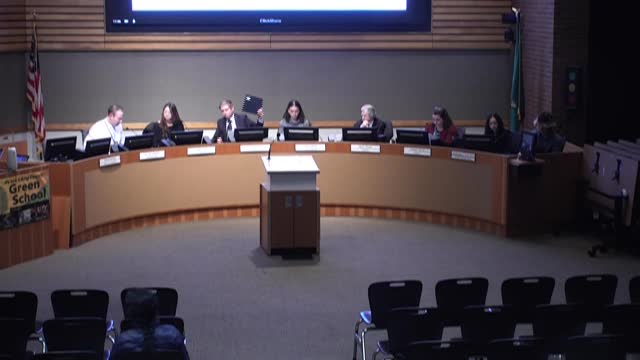
The Lake Washington School District board spent much of its Jan. 13 meeting reviewing superintendent interpretations and proposed monitoring indicators for a consolidated operational expectation now labeled OE3: Communication and Community Engagement.
Superintendent Dr. Mary Holman presented the interpretations and a set of proposed indicators for nine subsections (3.1–3.9) and asked the board for feedback before returning with revisions. "As part of the Board's governance model, the Board adopts policy, the superintendent then goes through an exercise of interpretation," Holman said.
Nut graf: The discussion focused on turning activity counts into meaningful evidence: directors asked staff to emphasize impact, not just frequency, and to clarify where district‑level decision feedback differs from school‑level engagement.
Board members pressed for concrete, measurable indicators. For example, 3.1 (community partnerships) originally listed the number of partnerships; directors asked for "evidence of formal partnerships" and narrative about impact rather than a raw count. On 3.2 (relationships among families and educators) members recommended using school‑visit reports and case studies as qualitative evidence. Director Guthrie suggested indicators should show “benefit and outcome,” not only activity.
Directors also debated the scope and language for family participation in individual learning plans and IEPs, noting legal and timing constraints for 504 and IEP processes. Board members recommended sampling or cross‑section analyses rather than a universal 100% metric, and suggested documenting timely delivery of complex plans as part of evidence of communication effectiveness.
Several directors asked staff to develop survey items to measure stakeholder perceptions of transparency and to report on recruitment strategies used to increase diverse family participation. Holman said she will revise indicators and return with updated language for board review, aiming to present revised language for discussion at the meeting in February and to incorporate monitoring into next fall’s cycle.
Ending: The board did not adopt the indicators at the Jan. 13 meeting; Holman said she will update the documents and bring revisions back for review, with the goal of monitoring before the end of the 2024–25 school year.