Get Full Government Meeting Transcripts, Videos, & Alerts Forever!
Get email alerts on the Foreign Policy topic
No spam. Unsubscribe anytime.
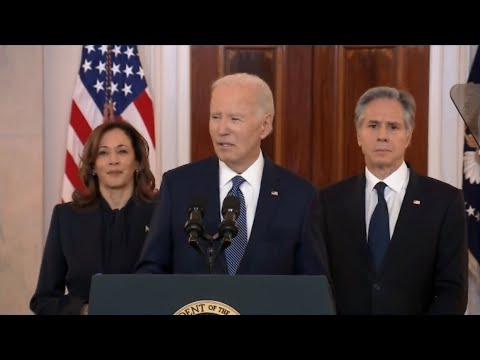
Biden announces phased ceasefire and hostage-exchange deal between Israel and Hamas
Summary
President Joe Biden said Israel and Hamas have agreed to a three-phase ceasefire and hostage-exchange framework beginning with a six-week pause and the release of some hostages, including Americans; implementation will continue into the next administration, he said.
President Joe Biden announced that Israel and Hamas have agreed to a three-phase agreement that will begin with a six-week ceasefire and the release of some hostages, including Americans, and said negotiations toward a permanent end to the war would continue beyond that period if needed.
Biden said the deal "is structured in 3 phases. Phase 1 will last 6 weeks. It includes a full and complete cease fire, withdrawal of Israeli forces from all the populated areas of Gaza, and the release of a number of hostages held by Hamas, including women and elderly and the wounded." He added, "I'm proud to say Americans will be part of that hostage release in phase 1 as well. And the vice president and I cannot wait to welcome them home."
The president described the initial exchange as already underway, saying, "In exchange, Israel released 100 of Palestinian prisoners." He said the pause will allow a surge of humanitarian assistance into Gaza and permit Palestinians to return to their neighborhoods in some areas during the first six weeks. Biden said the framework provides that, if talks to move from phase 1 to phase 2 take longer than six weeks, "the ceasefire will continue as long as the negotiations continue."
According to Biden, phase 2 would aim to secure "the remaining living hostages, including male soldiers," complete the withdrawal of Israeli forces from Gaza and make the temporary ceasefire permanent. He said phase 3 would return the remains of hostages who have been killed and launch a major Gaza reconstruction plan. "This is a ceasefire agreement I introduced last spring," he said.
Biden framed the United States role as having helped shape conditions for the deal, saying U.S. support "helped them badly weaken Hamas and its backers and create the conditions for this deal." He named senior U.S. officials he said had worked on the effort, saying, "Secretary of State Antony Blinken led the effort, [and] National Security Adviser Jake Sullivan, CIA Director William Burns, Brett McGurk, Amos Hochstein, and the vice president worked relentlessly."
The president also characterized regional shifts he said helped produce the opportunity for a deal, including pressure on Hamas, actions against proxy forces and new political developments in Lebanon and elsewhere. He said the United States organized a coalition of roughly 20 countries to counter Houthi attacks and described Iran and Hezbollah as diminished on the battlefield. "All told, these developments in the region which the United States helped to shape changed the equation," he said.
Biden acknowledged the deal's implementation will largely fall to the next U.S. administration and said he had directed his team "to coordinate closely with the incoming team to make sure we're all speaking with the same voice because that's what American presidents do." He closed by calling the agreement "a day of success" after "many difficult days" and offering prayers for hostages and their families.
No formal vote or executive action was recorded during the remarks. The announcement was a public statement by the president reporting a negotiated framework between the parties and describing U.S. diplomatic and military support that he said contributed to the outcome.