Get Full Government Meeting Transcripts, Videos, & Alerts Forever!
Get email alerts on the Permitting Reform topic
No spam. Unsubscribe anytime.
Permitting reform report recommends staffing, SEPA reforms and a state renewable‑energy authority to speed clean energy projects
Summary
Beveridge & Diamond presented a permitting‑reform study for Commerce recommending SEPA time limits, non‑project reviews, a permitting oversight dashboard, standardized mitigation, and creation of a Washington Renewable Energy Authority to coordinate transmission and ‘build‑ready’ renewable site preparation.
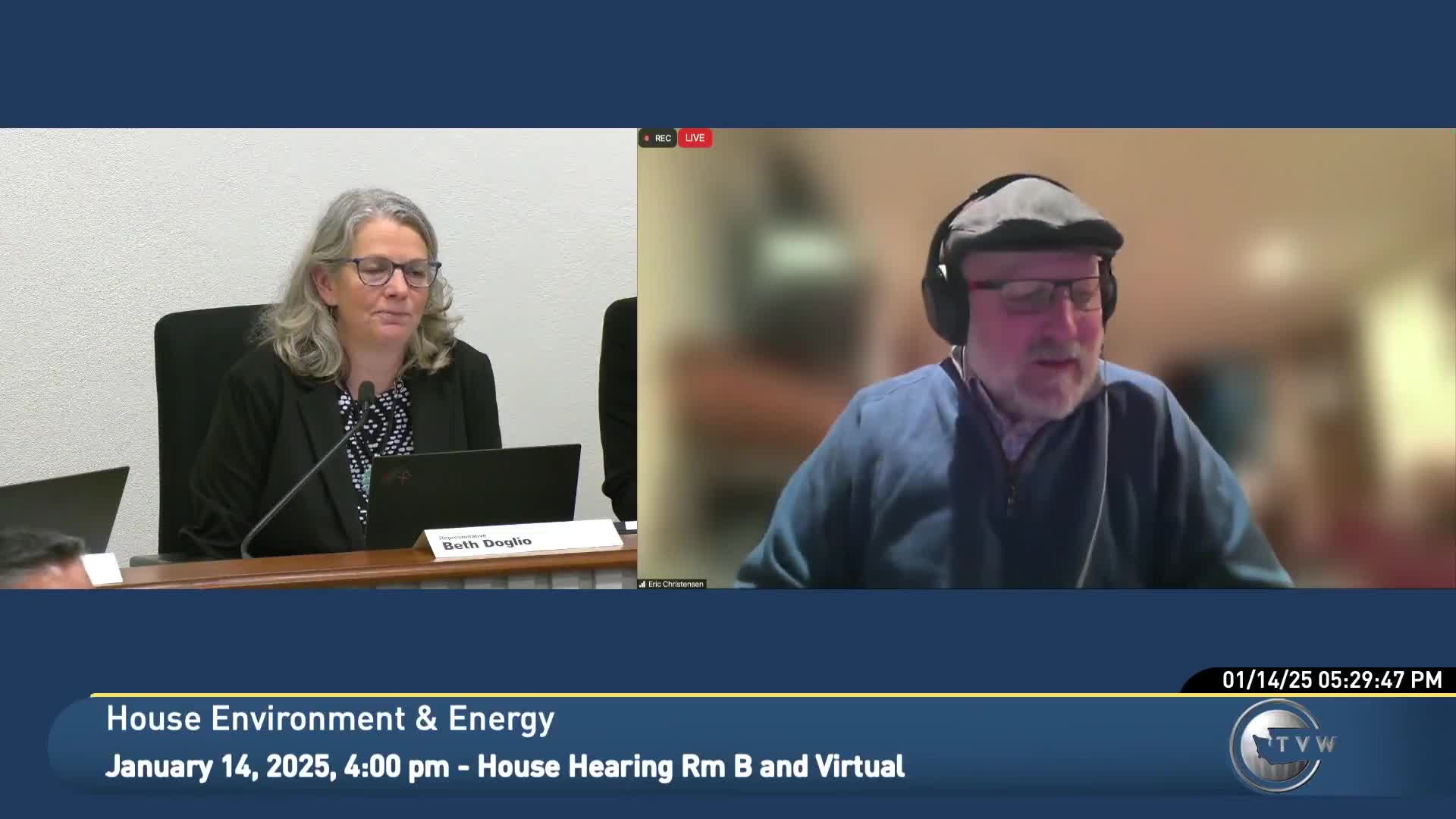
Eric Christensen, a shareholder at the law firm Beveridge & Diamond, summarized a permitting‑reform report prepared for the Washington Department of Commerce that recommends steps to accelerate siting and permitting of clean‑energy projects while retaining substantive environmental protections.
The report frames the problem as a need to rapidly scale clean‑economy infrastructure to meet state decarbonization goals while avoiding permitting timelines that make projects unpredictable, expensive or infeasible. The authors examined federal and out‑of‑state models — including the federal FAST‑41 approach, newly adjusted NEPA processes, and state programs in Massachusetts, Pennsylvania, New York and others — and used those findings to tailor recommendations for Washington.
Core recommendations
- Adequate agency staffing: make permitting personnel and their budgets visible and resourced in agency budgets to avoid bottlenecks. - SEPA process reforms: establish time limits for agency review of SEPA checklists and requests for additional information, adopt page limits where appropriate, integrate environmental‑justice review, and authorize non‑project or programmatic reviews to address generic impacts of widely deployed technologies so site‑specific review can focus on local effects. - Standardized mitigation and categorical exclusions: create standardized mitigation pathways (including mitigation funds for biological resources) and expand categorical exclusions for actions with minimal impacts. - Permitting oversight body and dashboard: establish a one‑stop permitting dashboard and project management teams to track projects, provide an information clearinghouse (maps, least‑conflict analyses, renewable energy zones) and coordinate pre‑application roundtables with agencies, tribes and local governments. - FSEC reform (facility siting): recommend clearer, binding legal standards, independent decision‑makers (modeled on the Pollution Control Hearings Board) and technology‑specific regulatory standards to reduce uncertainty for projects such as solar and wind farms. - Local permitting and transmission corridors: define allowable local setbacks and limit moratoriums and give local governments a role in defining transmission corridors while reducing local scope to block projects that conform to corridor plans. - Washington Renewable Energy Authority: create a state authority to coordinate transmission planning, define corridors that connect renewable zones to load centers, and establish a ‘‘build‑ready’’ program to permit and prepare sites (brownfields, degraded lands and low‑value agricultural lands) that can then be offered to developers.
Tribes and federal permitting
Christensen said the report recommends regularizing tribal consultation and providing technical support for tribal and local governments that may be overwhelmed by permitting reviews. Members asked about projects that cross federal lands and NEPA; Christensen said the report focuses on state authority and coordination and that the state cannot override federal permitting, but that a state authority could represent Washington in federal processes and coordinate with federal reforms such as national interest transmission corridor designations.
Implementation approach
The report’s authors described the recommendations as a menu of options that can be adopted in part or in whole. Christensen noted Massachusetts and Pennsylvania have recently adopted elements that mirror the report’s recommendations and that the greatest effect comes from combining capacity building, procedural streamlining and targeted programmatic reviews.
Ending
Christensen closed by offering follow‑up materials and said the full report with appendices is available online; he answered committee questions about SEPA/NEPA interplay, tribal consultation, and whether recommendations could be implemented piecemeal.