Get Full Government Meeting Transcripts, Videos, & Alerts Forever!
Get email alerts on the Clean Fuel Standard topic
No spam. Unsubscribe anytime.
Ecology outlines Clean Fuel Standard mechanics, market trends and forthcoming rule changes
Summary
Department of Ecology staff summarized Washington’s Clean Fuel Standard (CFS): regulated fuels, life‑cycle carbon accounting, credit and deficit markets, participation fees and ongoing rulemaking to add third‑party verification and tighten accounting for out‑of‑state renewable certificates.
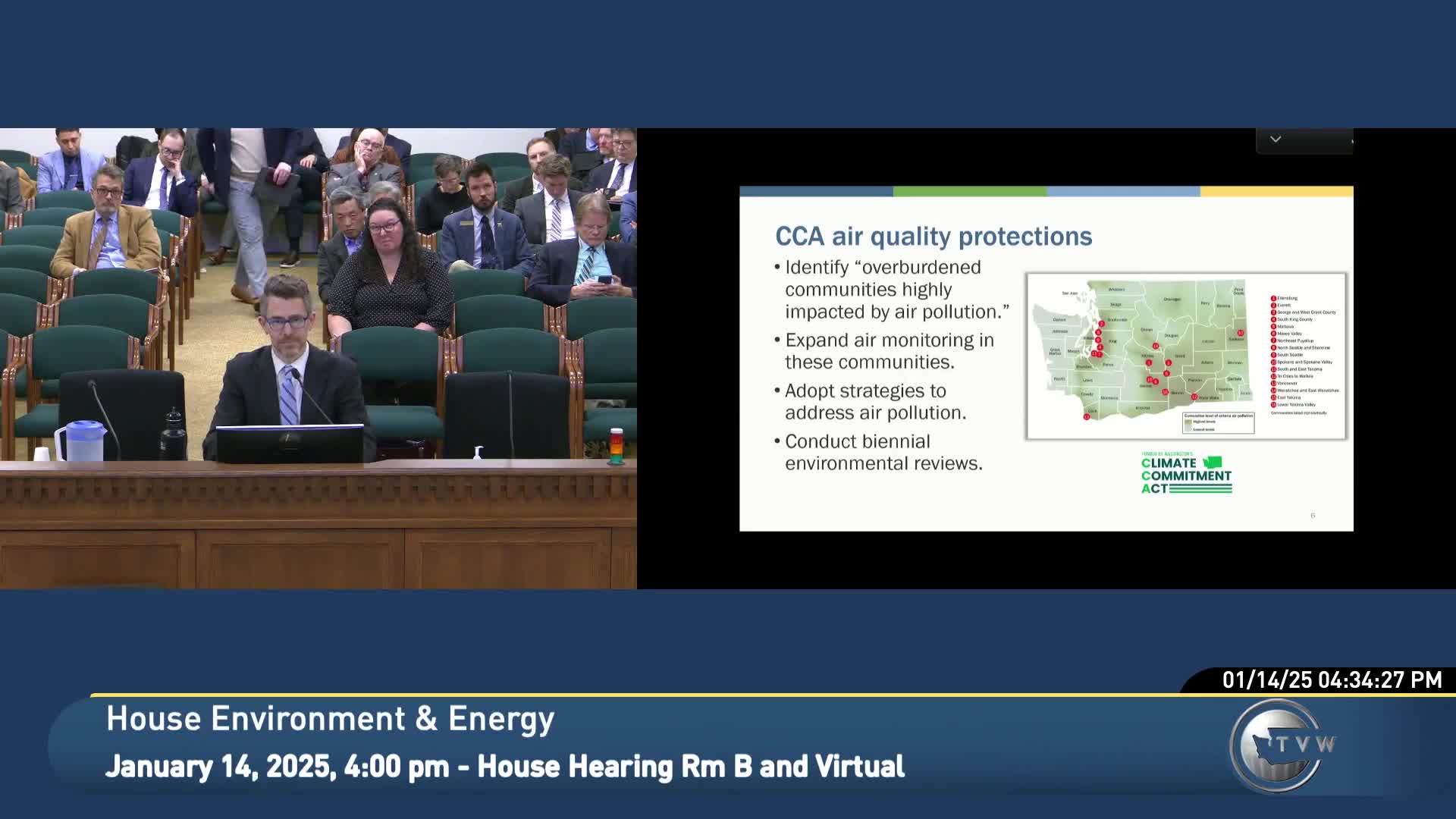
Joel Creswell, climate pollution reduction program manager at the Washington Department of Ecology, presented an overview of the Clean Fuel Standard (CFS), its structure, market performance to date, and planned regulatory changes intended to strengthen in‑state climate and equity outcomes.
The CFS, enacted in 2021, requires a declining carbon intensity standard for transportation fuels measured on a life‑cycle basis and is designed to achieve a 20% reduction below 2017 levels by 2034. “The clean fuel standard is another market based policy,” Creswell said, explaining that fuels with a carbon intensity lower than the annual standard earn credits and fuels above it create deficits.
Who participates and how credits work
- Regulated fuels: gasoline, diesel, ethanol, biodiesel and blends, and specified natural gas fuels (CNG, LNG) where producers/importers must report and hold credits or deficits. - Opt‑in fuels: electricity for charging, sustainable aviation fuel and some bio‑gases may opt in to generate credits. - For residential electric vehicle charging, the serving utility is the reporting entity; public chargers report at the station owner level. - Credits are created when fuel pathways earn a carbon intensity below the standard; deficits must be covered at year end. Credits trade in private markets; Ecology does not set credit prices.
Market performance and program finance
- Creswell presented credit price history: initial credits traded over $100 in 2023, then fell; by November 2024 prices were about $25 per credit. - Credit generation in Washington has been led by electricity, ethanol and renewable diesel (residential EV charging data for all of 2024 were not yet complete at the time of the briefing). - Program funding: participants pay a flat participation fee that is designed to cover about 5% of program administrative budget; the 2024 flat participation fee was $274. The remaining budget is covered by deficit generators through tiered fees. - The statute provides two 5% set‑asides: capacity credits to help finance buildout of DC fast chargers and hydrogen refueling stations, and advanced credits that allow public entities to borrow against future credits to finance projects upfront.
Rulemaking and integrity measures
Creswell said Ecology is conducting rulemaking to better align the program with state emissions targets and strengthen the integrity of credits. Proposed changes include:
- Third‑party verification of fuel and credit reports (to be added in the first rulemaking after program launch). - Revisions to avoided‑methane crediting to prioritize new methane capture projects and reduce generous indefinite crediting for legacy dairy digesters. - Tighter book‑and‑claim accounting: proposed limits that renewable electricity be from facilities operational on or after 2019 in Washington, Oregon or British Columbia, and for renewable natural gas require pipeline flows toward Washington at least 50% of the time. The goal is to reduce double counting and ensure in‑state climate and air‑quality benefits.
Equity and implementation tools
- Electric utilities that receive credits for residential EV charging are required to invest in transportation electrification projects that benefit overburdened communities; where utilities do not opt in, Ecology has a contract with a backstop aggregator (4th Mobility Fund) to monetize and direct investments in those service areas. - Ecology has proposed capacity and advanced credit mechanisms to spur charging and hydrogen infrastructure. Creswell said applications are open for DC fast‑charging capacity credits; hydrogen station capacity credits were expected later.
Questions from committee members covered avoided‑methane treatment, whether in‑state benefits could be lost under linkage scenarios, and the relatively low credit prices compared with California and Oregon. Creswell said Washington’s current standard (a 2% reduction required in the year of the briefing, with a statutory target of 20% by 2034) produces less deficit demand than other jurisdictions and that credit oversupply has pushed prices down. The proposed rulemaking seeks to rebalance credit and deficit generation and strengthen in‑state incentivization.
Ending
Creswell said Ecology expects to publish a proposed rule in the coming months and continue outreach; the department will also provide details to the committee on capacity‑credit volumes and on how proposed book‑and‑claim limits would be implemented.