Committee hears bill to create competitive school security infrastructure grant program
Summary
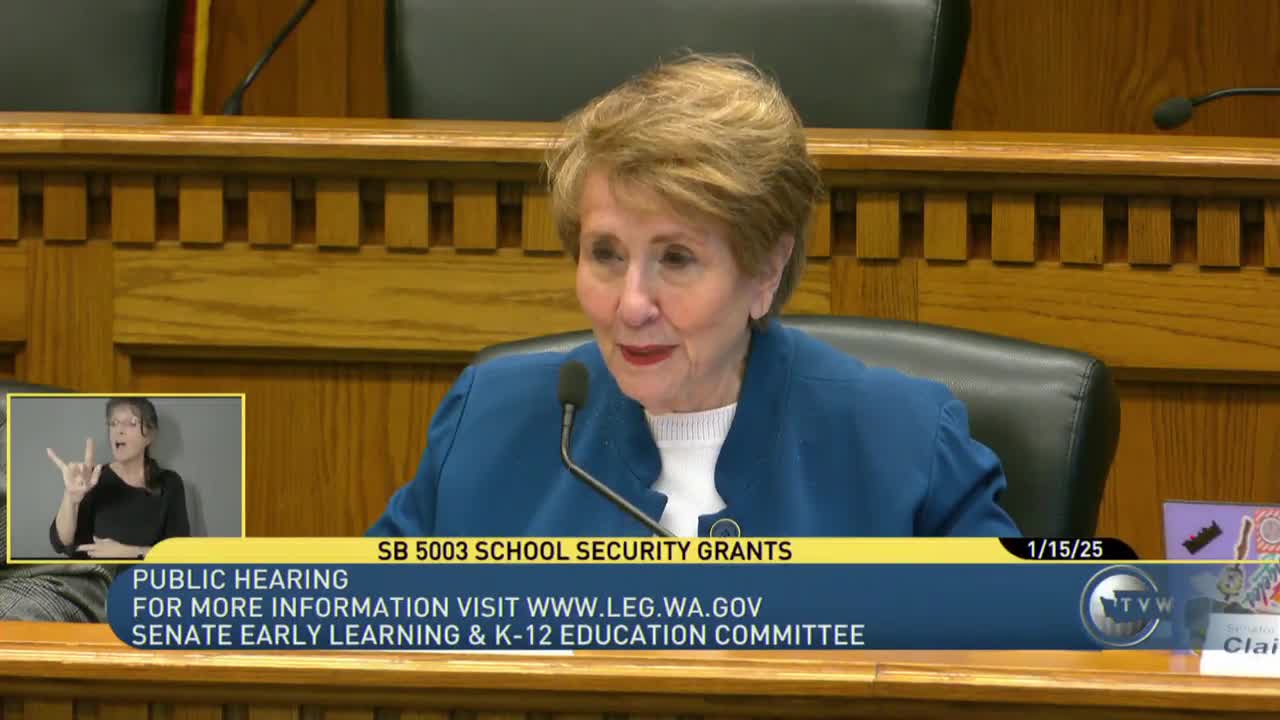
Senate Bill 5003 would create a competitive grant, administered by OSPI, to fund physical security projects at public K–12 facilities; presenters discussed eligible projects, caps, ESD coordination and an available fiscal estimate for OSPI implementation.
Senate Bill 5003, introduced by Senator Torres, was presented as a competitive grant program to increase physical security of public K–12 school facilities. The bill would direct the Office of Superintendent of Public Instruction (OSPI) to administer grants—subject to appropriation—to eligible projects such as entrance security, fencing and other infrastructure that assists emergency response.
OSPI staff summarized the bill and explained current law requires districts to maintain safe school plans and to consider perimeter and security features when building or remodeling. Under SB 5003 no award per school district may exceed $2,000,000 and no more than 3% of the program may be used for grant management. OSPI provided a fiscal estimate tied to staffing to administer the program: an estimated $197,000 for the 2025–27 biennium and $190,800 for future biennia; OSPI also noted the total award amounts would depend on appropriations and are therefore indeterminate.
Senators and witnesses discussed potential operational details, including leveraging Educational Service Districts (ESDs) for cooperative purchasing and for threat assessment training already housed at some ESDs. Tyler Munch of OSPI testified the agency is prepared to implement and that superintendents consistently ask for perimeter security assistance. Senator Torres and other members emphasized the bill is infrastructure‑focused; it does not fund school resource officers or sworn personnel (those items are in separate budget areas).
Supporters said the competitive grant would help districts with aging facilities and federally impacted districts that lack sufficient funds. OSPI indicated the program is intended to serve districts statewide and to be administered quickly if appropriated funds become available. Committee members asked about interactions with other programs (for example, whether grant work would affect eligibility for matching state construction funds); staff said the bill did not address that interagency match question and agreed to follow up.
No vote was taken during the hearing.