Get Full Government Meeting Transcripts, Videos, & Alerts Forever!
Get email alerts on the Legislative Administration topic
No spam. Unsubscribe anytime.
House Rules Committee adopts routine staff and member policies, tables legal-fee and postage items
Summary
The Minnesota House Committee on Rules and Legislative Administration approved a package of routine personnel and member expense resolutions on a voice vote and laid two resolutions on the table after questions about legal-fee documentation and digital/postage allotments.
The House Committee on Rules and Legislative Administration on an approximately 29-minute meeting approved a slate of routine personnel, compensation and expense resolutions and tabled two items after members raised questions about legal-fee payment documentation and postage/digital communication options.
The committee adopted policies on the staff service awards program (P1), donated time (P2), compensatory and time-card rules (P3), per diem start dates (P4), staff photographs and digital images (P6), chaplain and leadership compensation (R1, R2), member expense reimbursements and lodging (R3), personalized stationery (R4), member communication expense reimbursement (R6), alcohol consumption at Centennial Office Building (R7), remote work (R8), high-school page and internship stipends (R10), and several other routine items. Two resolutions were laid on the table for later consideration: P5 (policy on payment of certain legal fees and related expenses) and R5 (postage and digital constituent-communication allocation). The committee also laid R9 (policy on drug use) on the table for further review.
Why it matters: These resolutions set year-to-year administrative rules that affect House staff benefits, member expense allowances, leadership pay designations allowed under state law, and programs for pages and interns. A decision to table P5 leaves unresolved questions about the committee’s prior authorization of legal-fee payments in at least one earlier case, which several members asked the committee to review.
Key adopted items and specifics
- P1 (service award program): Committee adopted the 2025 P1 resolution; no change from prior years, per Kelly Knight, director of Human Resources for the House.
- P2 (donated time): Adopted. Knight said the only substantive change clarifies that an employee may not receive or use more than 1,044 donated hours in a calendar year; she added the policy has been used about "once and at most twice" in the last decade.
- P3 (compensatory time and time-card policy): Adopted. Clarifications include adding the word "recorded" after "hours" to reflect the House custom of using hours recorded, excluding unpaid compensatory and holiday-makeup hours from certain calculations, and permitting use of remaining fractional balances below a quarter hour.
- P4 (per diem start dates): Adopted. The resolution clarifies that per diems claimed between Jan. 6 and Jan. 13 will be treated as interim per diems rather than session per diems for the 2025 session start date extended to Jan. 14.
- P5 (policy on payment of legal fees and expenses): Laid on the table. Committee discussion focused on whether the existing policy—written to cover election contests and recount legal fees—was the clause used to authorize prior legal-fee payments. House Research cited the paragraph that allows the committee to refuse payments and noted the policy requires evaluation of each request and a detailed statement of legal fees. Representative Nash and Representative Scott said they remembered no supporting documentation being provided in a prior instance and asked that the committee review the records before renewing the policy.
- P6 (photographs and digital images): Adopted. No substantive changes from prior years; the policy makes staff photos/digital images available to membership and sets purchase fees.
- R1 (house chaplain compensation): Adopted. Chaplain compensation remains $35 per day and $2,000 for the year.
- R2 (leadership compensation): Adopted. The resolution notes Minnesota statutes allow up to five members to receive 140% of a member’s pay for leadership positions; the resolution lists specific leadership roles and notes one role (house deputy minority leader) may require future revision.
- R3 (expense reimbursement, Greater Minnesota lodging/mileage): Adopted. Includes a $175 hotel max for district travel lodging, session per diem of $86, and formalizes an option allowing a Greater Minnesota member to decline lodging in favor of business mileage.
- R4 (personalized stationery): Adopted. No changes; allocation limits remain 4,000 pieces of letterhead, 1,000 business cards, and 500 informal note/memo cards.
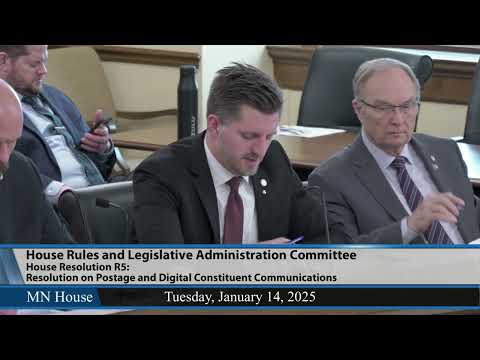
- R5 (postage and digital constituent communications): Laid on the table. The resolution as written would allocate $2,112 for postage/digital communications for 2025 and $1,056 for 2026 and defines allocation methodologies between postage and digital communications. Representative Schultz proposed an amendment to permit a member to elect 100% digital or 70% digital/30% postage; members asked House staff to review implementation and financial impacts before taking final action.
- R6 (reimbursement of member communication expenses): Adopted. Provides a $125-per-month reimbursement per member; removes obsolete long-distance reimbursement language.
- R7 (alcohol consumption): Adopted with a single change specifying the Centennial Office Building rather than the State Office Building.
- R8 (remote work policy): Adopted. Updated to reflect 2025 and adds explicit authority for the Speaker to extend or suspend the policy based on House needs.
- R9 (drug-use policy): Laid on the table. Representative Engen asked staff to consult legal counsel about implications of state marijuana law; members requested additional legal review before adoption.
- R10 (pages and interns): Adopted. High school page program maximum maintained at 100 students with stipend proposal increasing daily page reimbursement from $10 to $15; internship program maximum 40 participants with stipend raised from $75 to $125 to align with the Senate internship program. House Research advised that having a child in the page program is not treated as a financial conflict that would require recusal.
Votes at a glance
- P1: Adopted (voice vote) - P2: Adopted (voice vote) - P3: Adopted (voice vote) - P4: Adopted (voice vote) - P5: Laid on the table (motion carried) - P6: Adopted (voice vote) - R1: Adopted (voice vote) - R2: Adopted (voice vote) - R3: Adopted (voice vote) - R4: Adopted (voice vote) - R5: Laid on the table (motion carried) - R6: Adopted (voice vote) - R7: Adopted (voice vote) - R8: Adopted (voice vote) - R9: Laid on the table (motion carried) - R10: Adopted (voice vote)
Discussion highlights and context
Kelly Knight, director of Human Resources for the House, presented multiple personnel-related policies and described specific clarifying language changes to P2 and P3. On P2 Knight said the donated-time policy "may have been used once and at most twice" in the last decade. House Research explained that P5 was drafted to cover election contests and recounts but also contains language that allows the committee to evaluate and refuse payment of legal fees on a case-by-case basis.
Several committee members pressed for documentation about a prior payment of legal fees. Representative Nash said she recalled "there were no details that were provided. We did not have the documents from the court case. We did not have any specificity." Representative Scott said he believed any itemized invoice should be part of the public record and asked the committee to review the records before approving a renewal of the policy.
Adjournment
The chair closed the meeting after the committee completed its business and the committee adjourned.