
Staff summarizes 16 health-related licensing boards, fee authority and interstate compacts
Get AI-powered insights, summaries, and transcripts
Subscribe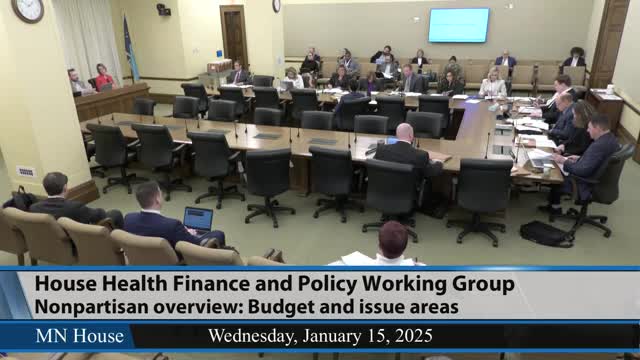
Summary
Nonpartisan staff told the committee there are 16 health-related licensing boards funded primarily from the state government special revenue fund; boards can assess licensure fees but access to the revenue requires appropriation and Minnesota participates in some interstate licensure compacts.
House Research staff told the Health Finance and Policy Work Group on Jan. 15 that Minnesota has 16 health-related licensing boards and summarized how their funding and regulatory authority work.
Why it matters: Licensing boards set scopes of practice, licensing fees and enforcement priorities for many health professions; fee decisions affect board resources and can interact with appropriations.
Joe Herving and Elizabeth Clarkvist explained that the boards are funded largely from the state government special revenue fund. Clarkvist said Minnesota law (chapter 214 of Minnesota Statutes) requires that an occupation be regulated only if regulation is necessary for the health and safety of Minnesotans. Staff emphasized that although boards can assess licensure fees, the boards’ ability to spend those fees is contingent on an appropriation provided in law; a change in statutory fee levels alone does not directly allow the board to access additional dollars unless an appropriation also authorizes it.
Staff also listed interstate licensure compacts in which Minnesota participates; compacts can ease cross-state practice for qualified professionals once the compact becomes operational.
The briefing was informational; no committee action was taken.