Get Full Government Meeting Transcripts, Videos, & Alerts Forever!
House transportation work group hears highway and transit finance overview; Chamber calls for diversified funding
Summary
Chair John Kostnick opened the Minnesota House Transportation Work Group on Jan. 15, 2025, saying the panel expects to pass a transportation bill this year and will prioritize efficient use of transportation revenues and safety across roads and transit systems.
Chair John Kostnick opened the Minnesota House Transportation Work Group on Jan. 15, 2025, saying the panel expects to pass a transportation bill this year and will prioritize efficient use of transportation revenues and safety across roads and transit systems.
The meeting featured presentations from nonpartisan House fiscal and research staff on highway and transit finance and a policy overview from the Minnesota Chamber of Commerce.
Nonpartisan overview: highways and major revenue streams
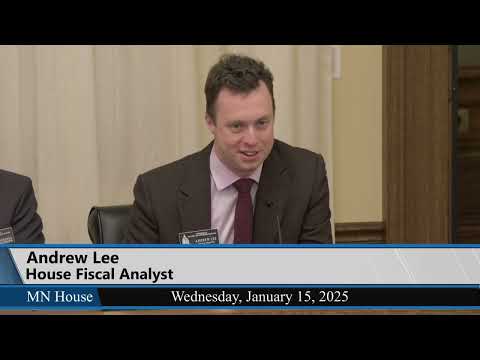
Matt Burrows, principal analyst with House Research, and Andrew Lee of House Fiscal Staff outlined the state's highway finance framework and major revenue sources. Burrows said constitutional provisions underlie much of highway funding and that the Highway User Tax Distribution Fund (HUTD) and three constitutionally established accounts'the Trunk Highway Fund, County State Aid Highway (CSAH) Fund and Municipal State Aid Street (MSAS) Fund'are central to how state highway dollars flow.
"There are three main sources of traditional highway-related revenue," Burrows said, summarizing his slides. He listed:
- The motor fuels tax (gas tax), currently $0.318 per gallon, applied to gasoline, diesel and adjusted for other fuels; - The motor vehicle registration tax, whose calculation declines as vehicles age and shifts to a flat minimum for vehicles 11 years and older; and - The motor vehicle sales tax (MVST), which is constitutionally dedicated to transportation with statutorily determined allocations.
Burrows noted other state revenue directed to transportation, including portions of the general sales tax tied to auto parts and vehicle rentals; the motor vehicle lease sales tax; and a retail delivery fee enacted in 2023: a 50-cent charge on deliveries that began July 1,…
Already have an account? Log in
Subscribe to keep reading
Unlock the rest of this article — and every article on Citizen Portal.
- Unlimited articles
- AI-powered breakdowns of topics, speakers, decisions, and budgets
- Instant alerts when your location has a new meeting
- Follow topics and more locations
- 1,000 AI Insights / month, plus AI Chat