Get Full Government Meeting Transcripts, Videos, & Alerts Forever!
Get email alerts on the Election Administration Briefing topic
No spam. Unsubscribe anytime.
State elections officials brief Ways and Means on 2024 turnout, provisional ballots and procurement plans
Summary
The Maryland State Board of Elections told the Ways and Means Committee that in-person voting remains dominant after the pandemic, provisional ballots and web-delivered ballots slowed canvass timelines, and the state is delaying purchase of a new voting system to 2028 while pursuing poll-book and registration upgrades.
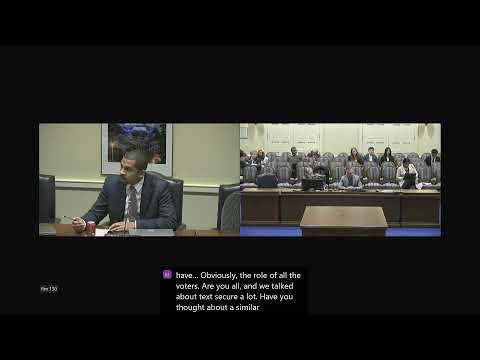
State elections officials gave the Ways and Means Committee a post‑election briefing on turnout trends, operational challenges and preparations for the 2026 gubernatorial election. State Administrator Jared Damaris and other State Board of Elections staff spoke about higher mail‑in use since the pandemic, an increase in provisional ballots, ongoing procurements and pilot programs for language access and cybersecurity.
Damaris said that while mail‑in voting remains significantly higher than before the pandemic, it has not replaced in‑person voting. "The vast majority of Marylanders continue to prefer in person voting," Damaris told the committee, noting that roughly 75% of voters cast ballots in person in the 2024 general election and that early voting returned to roughly pre‑pandemic levels in 2024.
The briefing explained why canvass and certification took longer in some counties. "Two factors really help push it beyond the 10th day, which is provisional voting and ballot duplication efforts because those are manual processes," Damaris said. He and other staff described web‑delivered ballots (ballots voters print at home after receiving them electronically) as a secure option that creates manual work for local boards when duplication or partial processing is required.
The board described several operational statistics reported to the committee: more than 3 million voters participated in the 2024 general election (above 72% turnout), the primary exceeded 1 million voters (about 28% turnout), there were 97 early voting centers, roughly 1,500 polling places, 286 drop boxes, and nearly 600,000 people on the permanent mail‑in ballot list. The board said it printed millions of ballots for the 2024 cycle (the transcript lists 5,700,000 for the primary and 9,400,000 for the general). Damaris credited a large outreach campaign that produced millions of digital impressions to reach voters.
On procurement and technology, the board said it is delaying purchase of a certified new voting system from the 2026 to the 2028 cycle because the Election Assistance Commission's updated VVSG 2.0 standards have not yet produced certified vendors. In the interim, the board will use the current certified voting system for 2026 and continue procurements for poll books and a new voter registration/election management system. Damaris also described a recent, emergency poll‑book contingency in which the state acquired remaining units from other states after canceling a poll‑book contract.
The board summarized post‑election audit work: an image‑based automated audit of ballot images by an outside vendor for 100% of the audit scope, manual post‑election audits that hand‑tally selected precincts and samples of provisional and mail ballots (local boards have until March to complete these), and a successful pilot risk‑limiting audit in Hartford County.
On policy and programs, Damaris said House Bill 585 (protecting election officials) was helpful after threats directed at election staff; the board reported 121 reports to an online disinformation portal since August 1 and five referrals to state prosecutors under a law discussed as House Bill 333. The board also reported that the state public financing fund’s balance exceeded the $9 million benchmark (the board said the fund stood at about $9.8 million), allowing public matching funds for gubernatorial candidates without additional appropriation. Baltimore City ran its first public financing cycle with eight participating candidates, four certified and one elected.
Language access and outreach were highlighted as priorities. The board described a pilot language‑assistance app used in Prince George’s County that connects voters and election judges to remote interpreters by video, and said voter registration and mail‑in applications are now available in multiple languages on the board’s website. The board said it plans to expand language assistance in 2026 subject to funding and grants.
Committee members asked about ways to shorten certification timelines and reduce provisional ballots. Damaris and staff suggested more voter education about when to use mail‑in ballots versus in‑person voting, better polling‑place communications to reduce "convenience" voters showing up in the wrong precinct, automation for duplication processes, and targeted outreach to college populations where mismatches between residence and campus voting created provisional ballots.
The briefing included several staff changes and organizational moves the board said it has made: a new audits department, a mail‑in ballot director, an in‑house state information security officer, and a planned joint communications director split with local boards. The board said it has increased coordination with local boards, instituted mentoring and training for local election directors, and is preparing for a biannual conference and future procurements.
Damaris closed by asking the committee for support on four departmental bills the board plans to introduce during the legislative session and said the agency will continue work on cybersecurity, language access, and poll‑book and voting‑system modernization.