Get Full Government Meeting Transcripts, Videos, & Alerts Forever!
Get email alerts on the Tort Reform Non Economic Damages topic
No spam. Unsubscribe anytime.
House Judiciary Committee briefed on Maryland non‑economic damages cap; current limit $950,000
Summary
The House Judiciary Committee met Jan. 14, 2025, for a briefing on Maryland’s cap on non‑economic damages in personal injury and wrongful death cases, hearing presentations from the Department of Legislative Services and the National Conference of State Legislatures.
The House Judiciary Committee met Jan. 14, 2025, for a briefing on Maryland’s cap on non‑economic damages in personal injury and wrongful death cases, hearing presentations from the Department of Legislative Services and the National Conference of State Legislatures.
The briefing summarized the statutory history, current formula and comparable state practices, and included questions from committee members about the cap’s origins, how juries are instructed, and potential effects on insurance markets.
Holly Vandegrift, policy analyst with the Department of Legislative Services and counsel for the House Judiciary Committee, told the panel, “Today we're going to be discussing non economic damages for personal injury and wrongful death.” Shamari Taylor, committee counsel for the Senate Judicial Proceedings Committee, explained basic terms: “Damages are any money claimed or ordered to be paid to a person as compensation for injuries or losses.” Heather Morton of the National Conference of State Legislatures described NCSL’s role and provided state comparisons, saying, “NCSL is the country's most trusted bipartisan organization serving legislators and staff for 50 years.”
Why it matters: non‑economic damages — commonly called pain and suffering, mental anguish, loss of consortium and similar losses — are subjective and not tied to bills or lost earnings. Maryland caps non‑economic awards in most personal injury and wrongful death suits; economic damages and punitive damages are governed separately.
Statutory background and current amounts
DLS staff summarized the statute codified in the Maryland Courts and Judicial Proceedings Article section 11-108 and the legislative steps that created the cap. Chapter 639 of 1986 enacted an initial cap ($350,000 at the time). Chapter 629 of 1989 required courts to reduce jury awards that exceed the cap and prohibited informing juries of the statutory limit. Chapter 477 of 1994 adjusted how wrongful death awards are treated, raised the base cap and set an annual $15,000 October 1 escalator.
As of Oct. 1, 2024, the base non‑economic damages cap is $950,000 for a single claimant in a personal injury or wrongful death action. For wrongful death with two or more claimants the cap is 150% of the base cap, or $1,425,000. DLS noted that when a wrongful death claim is accompanied by a survival action the combined cap for certain multi‑claimant cases is $2,375,000 (figures reflect the statutory formula and the annual escalator).
Recent legislative activity and committee questions
Committee members were told that during the 2024 legislative session sponsors introduced bills to repeal or raise the cap. As introduced, SB 583/HB 83 would have repealed the cap entirely; another bill, SB 538, was amended to raise the cap to $1,750,000 and increase the annual escalator from $15,000 to $20,000. DLS reported SB 538 passed the Senate but did not receive a vote in the House Judiciary Committee.
Members pressed DLS and NCSL staff on several recurring issues: the legislative basis for particular dollar amounts, whether juries should be informed of statutory caps, the practical effect on insurance markets if caps are raised or removed, and how caps interact with state tort‑claims limits when the State is a defendant. DLS staff said the 1986 and 1994 file materials did not clearly record a precise mathematical rationale for the original figures and that attorney general advice memoranda from the 1980s addressed constitutionality. DLS confirmed that under current law juries are not told the statutory cap and that courts must reduce awards exceeding the cap.
State comparisons
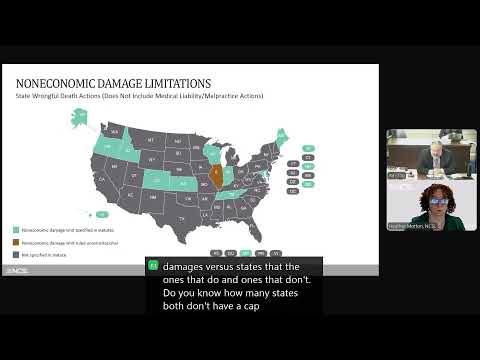
Heather Morton of NCSL provided a nationwide overview: several jurisdictions have caps or limits on non‑economic damages or punitive damages, while many states do not, and medical‑malpractice rules often differ from general wrongful‑death statutes. NCSL staff did not present insurer market withdrawal data for individual neighboring states but offered to consult insurance‑regulatory sources for that information.
Questions left for follow‑up
Committee members asked DLS to confirm technical points, including how caps apply across combined wrongful death and survival claims and how state tort‑claims caps for claims against Maryland interact with the non‑economic damages cap; DLS said it would follow up. Members also requested any available evidence on how changing caps affected insurers or premiums in neighboring states; NCSL offered to check with insurance regulators.
No formal actions or votes were taken at the briefing; the session was informational and concluded with staff offering to provide additional materials.
The committee did not adopt any policy changes during the briefing; members indicated they would continue review and follow up on technical questions raised during the Q&A.