Get Full Government Meeting Transcripts, Videos, & Alerts Forever!
Get email alerts on the Civil Harassment 258e Appeal topic
No spam. Unsubscribe anytime.
Appeals court hears challenge to 258E order over clandestine photographs; justices take case under advisement
Summary
The Massachusetts Appeals Court heard argument on Jan. 15 over whether a civil restraining order under G.L. c. 258E could be based on clandestinely taken photographs and related post-employment encounters. Appellant counsel argued the record lacks proof the defendant intended to target the alleged victim; the court took the case under advisement.
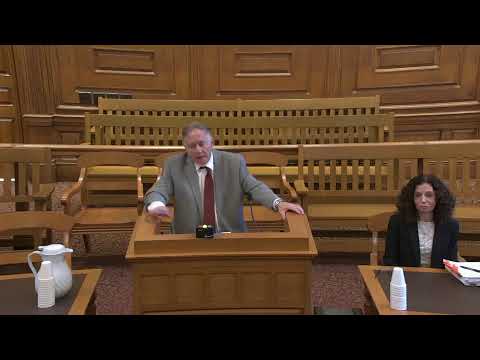
The Massachusetts Appeals Court heard oral argument Jan. 15 in Docket No. 24P151 over a partially impounded civil-anti-harassment order under G.L. c. 258E that stems from thousands of clandestine photographs and later encounters between the parties.
Attorney Steven Golan, representing the appellant, told the court that proving intent under the statute is difficult and that the record is “devoid of real specificity” showing the defendant intended each act to be directed at the alleged victim. “I think the burden again would be on the plaintiff ... to show that the defendant intended for her to find out about it,” Golan said. He argued the bulk of the photographs were taken surreptitiously and that there is no probative evidence showing the defendant intended the alleged victim to know each act was directed at her.
The panel — Justice Eric Nyman, Justice Joseph Ditkoff and Justice Chauncey Wood — pressed counsel on whether sheer volume of photographs or timing (an encounter on a street shortly after the defendant’s firing) permits an inference of targeted, willful conduct. The court also questioned whether isolated incidents (two encounters involving direct interaction or text messages) differ legally from the larger set of alleged surreptitious photographs.
Counsel and the panel framed the dispute against two statutory standards discussed in the briefs: the civil-protection statute, G.L. c. 258E, and the criminal-harassment statute (cited in argument as the statute commonly referenced for the overlapping exception). Counsel referenced appellate authority cited in briefing, including O’Brien v. Brodsky and Commonwealth v. Brennan, while judges explored whether satisfying the criminal-harassment elements would or would not control the civil 258E analysis.
No decision was announced from the bench; the court took the case under advisement after oral argument was submitted.