Get Full Government Meeting Transcripts, Videos, & Alerts Forever!
Get email alerts on the Landfill Siting Water Resources topic
No spam. Unsubscribe anytime.
Board of Water Supply warns landfill over aquifer would threaten island's drinking water; council amends, advances resolution
Summary
The Board of Water Supply told the Honolulu City Council Environment Committee on Jan. 16 that siting a municipal landfill inland, above the volcanic aquifer, would risk permanent contamination of the island's drinking-water supply.
The Board of Water Supply told the Honolulu City Council Environment Committee on Jan. 16 that siting a municipal landfill inland, above the volcanic aquifer, would risk permanent contamination of the island's drinking-water supply.
"Water is life," Ernie Lau, manager and chief engineer for the Board of Water Supply, said during a 30-slide briefing, arguing the board had formally disapproved the six inland sites proposed in 2022 and urging that new landfills be located in the coastal "caprock" zone where natural deposits offer greater protection for the freshwater lens beneath Oahu.
Lau told the committee that all of Oahu's municipal drinking water comes from underground aquifers and that rainfall and surface contamination eventually percolate through soil into those volcanic aquifers. He highlighted data showing landfill leachate can contain a broad mix of contaminants and noted that higher rainfall at some inland candidate sites could generate substantially greater volumes of leachate than the existing Waimanalo Gulch site.
"Preservation and protection of our precious, and pure groundwater resources are essential to ensure water security for our future, for generations to come," Lau said.
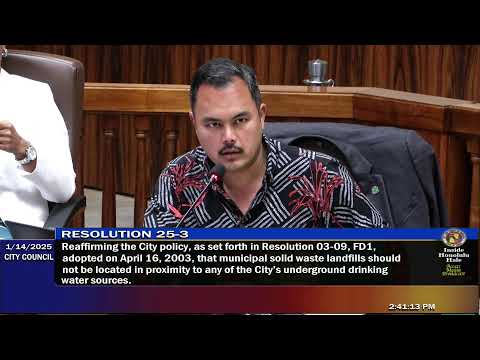
The committee then debated and amended Resolution 25-3, a reaffirmation of the council's 2003 policy that municipal solid-waste landfills should not be located "in proximity to any of the city's underground drinking water resources." Members added a new whereas clause recognizing Act 73 (2020), which restricts landfill siting in conservation districts and within a half-mile of residences, schools and hospitals, language council members said was necessary to reflect legal constraints the city faces when choosing alternative sites.
Mike Formby, the city's managing director, described the practical constraints the administration has encountered while seeking alternatives outside the aquifer. He said city officials spent more than a year negotiating with the military to identify federal lands outside the aquifer but that those options proved infeasible for operational or community-impact reasons. "We chose the first path over the aquifer to do it safely," Formby said, describing the administration's decision to pursue siting options that could be engineered to contain waste while continuing to pursue other options and state cooperation.
Roger Babcock, director of the Department of Environmental Services, told the committee the city has not settled on a final cost estimate and that earlier placeholder figures are uncertain. "We really don't have a better number than $200,000,000 at this time," Babcock said, adding that actual costs will depend on land acquisition, design, roadwork and other site-specific factors. He also described financing options: refuse capital projects would typically be funded by general obligation bonds.
Committee members pressed the administration on process and communication. Several council members and public testifiers said the news of a proposed inland site surfaced publicly at a mayoral press conference before neighborhood stakeholders and some council members were briefed. Formby said that timing was a tactical choice intended to avoid premature opposition while the administration identified options and negotiated with landowners.
Public testimony at the committee included residents and community representatives who expressed concern about placing a landfill above aquifers and called for stronger waste-reduction and recycling measures. Michael Gilbert and Raquel Achoo urged the council to avoid decisions that could repeat past environmental harms; Stephanie Nojima of the Honolulu Board of Realtors testified in support of the separate down-payment assistance bill under discussion elsewhere on the agenda.
The committee amended Resolution 25-3 to a CD1 that adds a clause noting Act 73 (2020) and then voted to report the amended resolution out of committee for adoption. The council's vote on final adoption will occur at full council.
Votes at a glance: during the same committee meeting the chair reported several other items as moved forward or delayed. Bill 192024 (housing resident preference), introduced earlier and revised as OCS 2025007, was amended to CD2 and reported out for passage on third reading. Bill 63 (2024) relating to accessory dwelling units was reported out for passage on second reading and scheduled for public hearing. Bill 64 (2024), which would expand eligibility for the city's down-payment loan program (amending ROH sec. 6-34.2), was discussed and postponed to a date to be determined. Resolution 25-2 (school food resolution), receiving public support, was also reported out for adoption by the committee.
Why this matters: Board of Water Supply testimony framed the issue as one of long-term public health and resource security. Oahu relies entirely on groundwater for drinking water, and the board told council members that contaminants in landfill leachate, including PFAS compounds cited in recent studies, can travel into volcanic aquifers over time. Council discussion showed the city faces constrained options because Act 73 limits siting in conservation zones and near residences, while federal and private lands examined as alternatives proved operationally or politically difficult.
What's next: the committee forwarded Resolution 25-3 CD1 to the full council for adoption and will continue oversight with the administration and Board of Water Supply. The administration said it will continue negotiations with private landowners and the military, pursue coordination with the state on statutory constraints, and return with more detailed cost and site information when available.