Get Full Government Meeting Transcripts, Videos, & Alerts Forever!
Los Angeles City Clerk, EmpowerLA brief Region 2 on 2025 neighborhood council candidate filing, vote-by-mail and outreach
Summary
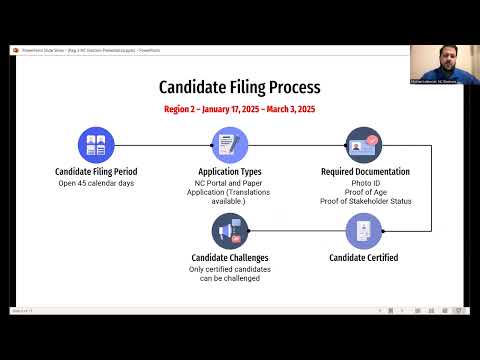
City Clerk election staff and EmpowerLA outlined 2025 neighborhood council election rules for Region 2, including candidate filing steps (Jan. 17–Mar. 3), vote-by-mail timelines (Mar. 21–May 12), documentation requirements, ballot models and a citywide outreach plan.
Los Angeles City Clerk election staff and EmpowerLA held a Region 2 briefing to explain procedures and outreach for the 2025 neighborhood council elections, including candidate filing, vote-by-mail timelines and resources for candidates and voters.
The presentation, led by Michael Electrich of the City Clerk Election Division and Marie Lu Guevara of EmpowerLA, reviewed how neighborhood council bylaws and each council’s Ballot Voting Model determine ballot types, who may run and who may vote. Electrich said the candidate filing window for Region 2 runs Jan. 17 through March 3, and the vote-by-mail registration window runs March 21 through May 12; ballot mailing is scheduled to begin April 15, and Election Day is May 20, 2025.
Why it matters: the briefing spelled out the documentation and timing that determine who appears on ballots and which ballots a stakeholder receives. That affects eligibility for multiple board seats, local outreach plans and logistical deadlines for vote-by-mail packets and ballot drop boxes.
City Clerk: bylaws, Ballot Voting Models and candidate certification
Electrich walked attendees through the parts of neighborhood council bylaws the office uses to build each election — Article 3 (boundaries), Article 4 (stakeholder definitions), Article 5 (governing board) and Article 10 (election specifics), plus Attachment A (map) and Attachment B (board structure). He summarized the four stakeholder types used across councils: live (residents), work (employees/service providers), own property (property owners) and community interest (participants in a nonprofit with a continuous physical address in…
Already have an account? Log in
Subscribe to keep reading
Unlock the rest of this article — and every article on Citizen Portal.
- Unlimited articles
- AI-powered breakdowns of topics, speakers, decisions, and budgets
- Instant alerts when your location has a new meeting
- Follow topics and more locations
- 1,000 AI Insights / month, plus AI Chat