Get Full Government Meeting Transcripts, Videos, & Alerts Forever!
Get email alerts on the Transit Safety topic
No spam. Unsubscribe anytime.
Public raises safety concerns as council takes up LAPD–Metro policing contract
Summary
Speakers questioned whether added policing under a contract with Metro will improve safety on trains and buses, and public comment highlighted incidents of assault and a desire for visible, active policing rather than fare enforcement.
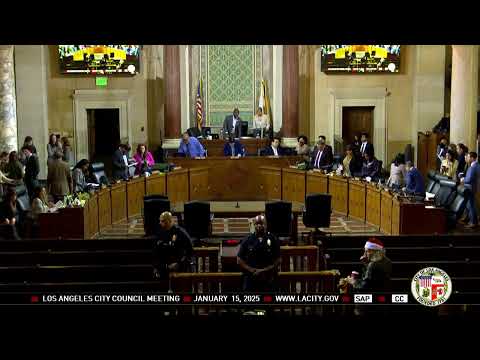
During public comment at the Jan. 5 Los Angeles City Council meeting, several speakers urged the council to prioritize passenger safety on Metro trains and buses, asking whether a contract for increased LAPD presence would put officers where assaults occur rather than focusing on fare enforcement.
One commenter asked whether police under the contract would be present on trains in ways that meaningfully protect riders, saying she often sees officers gathered at stations or checking fare cards rather than distributed along trains. “When they are on the train, it’s only momentarily to ask for tap cards,” said a public commenter who spoke about safety concerns on the Metro system. Susan Price of LA CAN also voiced support for a stronger safety presence but asked for clarity about how new resources would be deployed.
Item 20 — a contract involving LAPD and Metro — was called for a separate vote by Councilmember Marquee (transcript: Soto Martinez/So to Martinez called it special) and taken separately; the transcript records that the council opened the roll and tabulated the vote. Councilmember Hugo Soto-Martinez (recorded as So to Martinez in the transcript) registered a “no” vote that was noted on the record; the transcript excerpt does not list a full roll-call tally in the provided text.
These are public comments and reflect concerns from riders and advocates about when and where officers will be deployed, whether extra funding will meaningfully reduce assaults and harassment, and the visible behavior of officers while on duty. The transcript does not contain detailed council debate or answers to these operational questions in the excerpt provided.