Get Full Government Meeting Transcripts, Videos, & Alerts Forever!
Get email alerts on the Arts Grants Thrive topic
No spam. Unsubscribe anytime.
Metro Arts committee rescinds funding formula, adopts 75% scaled rank-order model for Thrive grants
Summary
The Metro Arts Grants and Funding Committee voted to rescind its prior Thrive funding formula and adopt a scaled, rank-order model that reduces each Thrive request to 75 percent and funds applications from the top score down until the Thrive allocation is spent.
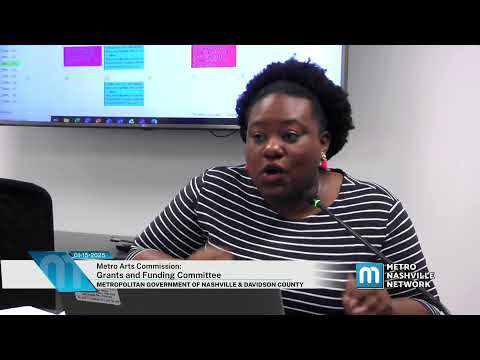
The Metro Arts Grants and Funding Committee, chaired by Commissioner Heather Lefkowitz, voted during its January meeting to rescind the previously adopted Thrive funding formula and replace it with a model that scales applicant requests to 75 percent and awards grants in rank order until the Thrive allocation is exhausted.
The change follows a presentation by Ashley Batchelder of the Metro Human Relations Commission detailing application volume and budgetary context. Batchelder told the committee that Metro Arts received roughly 200 Thrive applications and 109 general operating applications for the current cycle, and that the committee-authorized allocation to Thrive stands at about $1,300,000. She said the current pool of requests substantially exceeds available funds and summarized two possible responses: keep a $10,000 per-project cap and redistribute any surplus, or rescind the cap and adopt a scaled, rank-order approach. "Every organization that receives an eligible score will be funded," Batchelder said while describing the intent behind the funding model and the estimates used in staff analysis.
Why it matters: committee members framed the change as a response both to the recent Title VI complaint and to historic concentration of Metro Arts funding. Batchelder referenced the MHRC Title VI review and said the new policy seeks to redirect larger shares of funding toward smaller organizations and individual artists, reversing a pattern in which a small group historically received most funds.
What the committee approved - Rescission of the previously adopted funding formula (motion rescinded). The committee then considered, debated and voted to adopt a new formula (referred to in materials as "Option 2"): scale each Thrive request to 75 percent of the original ask, rank-order the scaled requests by score, and award grants from the top down until the Thrive allocation is exhausted. If any funds remain after that process, the remainder will be divided evenly among awarded Thrive recipients and added to their individual awards. Commissioner Sean Knight moved adoption of Option 2; the motion was seconded and passed after amendment.
- Tie-breaking procedure: the committee approved an amendment requiring staff to rescore or re-rank applications that are tied near the funding cutoff (the amendment directed a second review by staff rather than reuse of the original panel). That amendment passed before the main motion.
- Underrepresented-district priority: the committee voted to rescind for this grant cycle a previously stated policy that would have prioritized awards to "underrepresented council districts," citing lack of an operational definition and insufficient time to finalize rules for implementation.
Key policy clarifications and operational steps - Fiscal agents: the committee confirmed the working-group recommendation that applicants using a fiscal sponsor will submit a fiscal agency agreement (between Metro and the nonprofit fiscal agent) and a letter of agreement (between the fiscal agent and the applicant). Staff will publish clearer fiscal-agency guidance by February 1 to assist artists seeking fiscal sponsors. Committee discussion emphasized that, under Metro rules and state law, grants must be contracted to a 501(c)(3) or equivalent entity; individual artists cannot directly receive Metro grant funds.
- Timelines and rolling technical review: the committee kept February 18 as the hard resubmission deadline for updated applications but added a policy allowing applicants to "certify" completion earlier to enable rolling technical review by staff. Staff told the committee that panel scoring would follow technical review and that contracts are expected to be prepared in early March; actual disbursement must await executed contracts and required internal approvals.
- Panelists and timing: committee members noted the panelist recruitment remains incomplete; staff said panelist scoring would proceed immediately after applications reclose and technical reviews finish. The committee directed staff to operationalize a tighter timeline and accepted a revised schedule that aims to complete scoring and present an awards slate to the commission by the end of February.
- Document edits and delegation: the committee asked the chair, working with Metro staff, to finalize editorial and formatting corrections to the Thrive and operating-grant exhibits and to submit the amended supporting documents to Metro Council by the Friday deadline. The committee also asked staff to re-post the draft fiscal-agency templates and related guidance prominently on the Metro Arts grants web page.
Quotes and attributions in this report come only from speakers recorded in the meeting: Ashley Batchelder (Metro Human Relations Commission) and Committee members including Commissioner Heather Lefkowitz and Commissioner Sean Knight. Example: Batchelder said, "the Title 6 complaint came to us, because of a decision that reversed policy that allocated greater funding to small organizations and individual artists through the Thrive program," summarizing the complaint's context in the commission's review.
Next steps: staff will revise the exhibits and criteria consistent with the committee's motions, publish fiscal-agent guidance by Feb. 1, accept certifiable early resubmissions for rolling technical review before the Feb. 18 hard deadline, conduct panel scoring, and present a recommended awards slate to the Metro Arts commission for approval. Contracts are expected to be prepared in early March following commission approval and completion of contracting steps.
Background detail (from committee discussion): in prior cycles Metro Arts allocated a small number of organizations a large share of operating funds; the new Thrive allocation (40 percent of the grant budget, as authorized by the commission earlier) and the 75 percent scaling are intended to change that distribution and to better preserve project budgets when partial funding is awarded.