Get Full Government Meeting Transcripts, Videos, & Alerts Forever!
Get email alerts on the Open Meetings Records topic
No spam. Unsubscribe anytime.
Douglas County commissioners briefed on Kansas open meetings, records rules as body expands to five members
Summary
County legal counsel reviewed Kansas Open Meetings Act and Open Records Act at a Jan. 15 work session, explaining when a gathering becomes a ‘meeting,’ executive-session rules, ex parte disclosures in quasi‑judicial hearings and how electronic communications can create meeting risks.
Douglas County Board of County Commissioners held a work session on Jan. 15, 2025, to review the Kansas Open Meetings Act (COMA) and Kansas Open Records Act (CORA) after the board expanded from three to five members. County Counselor John Bullock led the presentation in the commission’s new meeting room, telling commissioners the session was meant to clarify when interactions among members must be conducted in public.
The session matters because a majority of the five-member board—three commissioners—now constitutes a quorum for purposes of COMA, creating new limits on how commissioners may communicate about official county business outside public meetings. "You're doing the public's business and the public has a right to know," Bullock said, summarizing the statutes’ public-access objective.
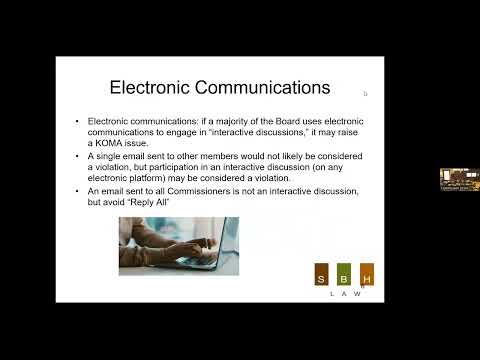
Bullock reviewed the statutory definition of a meeting as a gathering of a majority that engages in interactive discussion of the body's business, and he gave examples of conduct that can cross the line into a meeting. He cautioned that electronic communications, social-media comments, group texts and "reply all" e-mail chains can, depending on content and interactivity, create a meeting subject to COMA. "Please, at all times, avoid reply all," Bullock told the commissioners.
Commissioner Gene Dorsey asked whether three commissioners attending an event prior to being sworn in was permissible; Bullock answered that mere co‑attendance is allowed, but discussing official business in that setting could create a meeting. Bullors emphasized that optics matter and suggested notifying staff when several commissioners expect to attend the same public event so the overlap appears in the public record.
The presentation distinguished legislative matters from quasi‑judicial proceedings. Bullock explained that quasi‑judicial hearings (for example, individual land‑use cases) carry due‑process obligations: commissioners must disclose material ex parte communications so applicants can respond. By contrast, public comment on legislative matters is a common practice but not, in Bullock’s words, a statutory right in every case.
On executive sessions, Bullock recited statutory exceptions commonly used by the county, including personnel matters, attorney‑client privileged consultations, preliminary discussions about acquiring real property and limited discussions of financial data or trade secrets when permitted. He described the required motion language for an executive session—identifying the subject and statutory justification without revealing protected details—and stressed that no binding decisions may be made in executive session.
Bullock also reviewed CORA practices: public records are broadly defined and can exist on personal devices, staff servers or other media; the county must search for responsive records and may withhold material only under one of many statutory exemptions. He said the county has about 55 statutory exceptions it examines when processing requests and that, as a policy, the county charges requesters less than the full recoverable cost in keeping with Attorney General guidance.
Other operational points discussed included scheduling and staff coordination. Bullock said purely logistical scheduling (for example, arranging times for an interview) generally does not implicate COMA, but commissioners should use caution and consider directing scheduling through staff. He warned against any staff member attempting to serially solicit positions from multiple commissioners in a way that could amount to a pre‑meeting canvass.
The work session ran about an hour and concluded with Bullock offering to answer follow‑up questions; the commissioners recessed to their 5:30 p.m. business meeting, where public comment and any formal actions occur.